-
Amanda knocked three times.
Two quick taps, a pause, then one more.
I knew that knock before I opened the door.
Fifteen years ago, she had left three six-month-old babies on my porch after my son, Archie, died.
Now she stood there in a cream coat, a polished suitcase beside her, smiling as though those fifteen years had simply been waiting for her return.
“Bellina,” she said.
Not hello.
Not I’m sorry.
Just my name.
She stepped inside.
“Oh, girls! Look at you!”
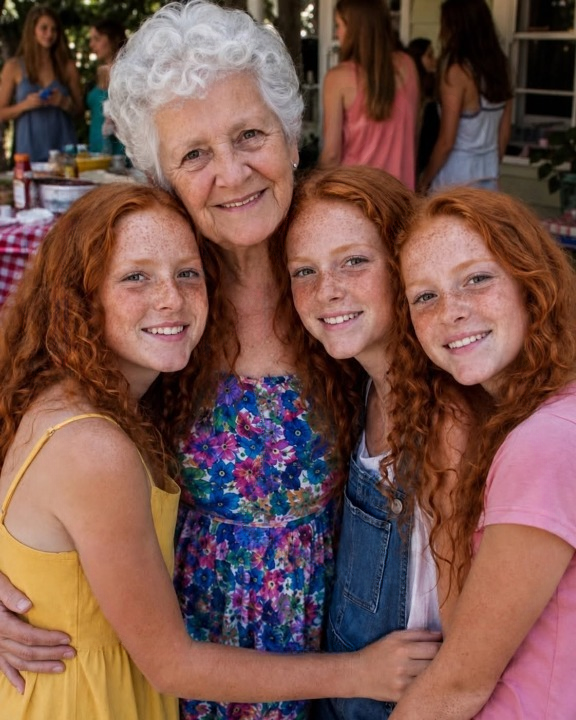
Lily, Grace, and Amelia stood together in the living room.
Amanda opened her arms.
Nobody moved.
“I know this is emotional,” she said. “But I can finally be your mother again. I have money now. I can give you opportunities you never could have had here.”
Here.
I looked around the house.
The worn couch where they had slept beside me during thunderstorms.
The hallway covered in school photographs.
The kitchen table where homework, tears, birthdays, and thousands of ordinary dinners had happened.
Amanda smiled.
“I thought you’d be happier to see me.”
Lily answered quietly.
“We are glad you came.”
Amanda brightened.
Then Lily disappeared upstairs.
“We actually have something for you.”
Amanda laughed.
“For me?”
“Yes.”
Fifteen years earlier, Amanda had stood on this same porch with three car seats.
“Take them,” she had said.
My hands shook as I picked up Lily.
“Come inside,” I begged.
“I can’t do this anymore.”
“Archie just died.”
Pain flickered across her face.
“My husband died too.”
Then she said the words I would never forget.
“I’m not spending my life trapped raising a dead man’s babies.”
She climbed into a taxi.
I waited for her to return.
A week.
A month.
Christmas.
Eventually, waiting became part of my routine.
The girls didn’t wait.
They grew.
I worked mornings at Mr. Khan’s bakery and cleaned offices at night. I learned how to braid three heads of hair. I memorized three different favorite soups and learned which granddaughter needed silence after a bad day.
I made little recipe cards for them.
“When life feels too heavy, make hot chocolate in the chipped blue mug.”
“When you’re sad and don’t know why, hang laundry outside.”
“When a problem feels too big, sit at the kitchen table. Problems sound smaller there.”
They kept those cards.
And they kept me.
When the girls were twelve, they found Amanda online.
Luxury resorts.
Yachts.
Expensive restaurants.
One caption read:
“Finally living the life I deserve.”
Grace showed me the screen.
“What if she comes back someday?”
I looked at the three of them.
“You can always welcome someone kindly,” I said. “But kindness doesn’t require forgetting the truth.”
They never mentioned her again.
Until now.
Lily returned carrying a white gift bag tied with gold ribbon.
Amanda accepted it eagerly.
“You girls are thoughtful.”
She opened the bag.
Her smile disappeared.
Inside were letters.
Dozens of them.
Drawings.
Birthday cards.
Mother’s Day crafts.
Amanda picked up the first letter.
“Dear Mom, I lost my first tooth today…”
Another.
“Dear Mom, I can ride my bike now…”
Another.
“Dear Mom, Grace got scared during the thunderstorm, so we all slept in Grandma’s bed.”
Amanda’s fingers began trembling.
“These are from you?”
Grace nodded.
“We always thought you might come back.”
Amanda swallowed.
“Why didn’t you send them?”
Amelia answered softly.
“We stopped writing.”
“Why?”
“Because one day we realized we weren’t writing to someone anymore.”
She paused.
“We were writing to an empty place.”
Amanda stared at her.
At the bottom of the bag was one final envelope.
Inside were three old recipe cards.
Amanda read the first.
“When life feels too heavy…”
She turned it over.
Grace’s childhood handwriting covered the back.
“Especially the hot chocolate.”
The second said:
“When you’re sad and don’t know why…”
On the back, Lily had written:
“Still works.”
The third was the oldest.
“When a problem feels too big, sit at the kitchen table. Problems sound smaller there.”
Amanda turned it over.
Three words.
“Love you, Grandma.”
She pressed the card against her chest.
“They kept these?”
“They became part of growing up,” Lily said.
Amanda looked around the room.
The height marks on the doorway.
The trophies.
The faded photographs.
The quilts.
The scratched kitchen table.
Fifteen years of ordinary life.
“I missed all of it,” she whispered.
Nobody contradicted her.
Nobody told her she still had time.
Some truths don’t need to be softened.
After a long silence, Amanda asked:
“May I stay for dinner?”
The girls looked at me.
I smiled.
“Of course.”
Dinner was spaghetti, garlic bread, and the last slice of apple pie.
Nobody changed anything for Amanda.
That somehow seemed important.
The girls talked over one another.
“Grandma, remember when we burned the Christmas cookies?”
“Grandma, Mr. Khan still can’t tell us apart!”
“Grandma, you owe us blueberry muffins next weekend.”
Amanda watched.
Not the food.
Not the house.
The rhythm.
Lily automatically passed Grace the parmesan.
Grace knew exactly how much basil I would add.
Amelia gathered plates without being asked.
They finished my sentences.
They laughed at stories Amanda had never heard.
She was seeing something money could never purchase.
A family built one ordinary day at a time.
After dinner, Amanda helped me clear the table.
“I thought if I came back with enough money, I could give them everything I couldn’t before.”
I dried a plate.
“Childhood doesn’t wait for anyone.”
Amanda closed her eyes.
“I know that now.”
At the door, Amelia hurried after her.
Amanda turned.
For one hopeful second, she looked like she expected an invitation to stay.
Instead, Amelia handed her one final recipe card.
It was blank.
Across the top, in my handwriting, were six words:
When life gives you another chance…
Amanda stared at it.
“What belongs underneath?”
Amelia smiled.
“You get to decide.”
Amanda slipped the card carefully into her purse.
Then she walked away.
The girls came back inside.
Lily grabbed the remote.
Grace carried the popcorn bowl into the kitchen.
Amelia returned her old recipe card to the wooden box beside her bed.
I stood alone in the hallway.
For fifteen years, I’d secretly feared Amanda’s return.
I wondered whether the girls would suddenly realize I was only the grandmother who had filled the space until their real mother came home.
Instead, I finally understood something.
Children don’t measure love by sacrifice.
They remember packed lunches.
Someone waiting after nightmares.
Hair braided before school.
A warm mug of hot chocolate.
A kitchen table where problems somehow seemed smaller by morning.
That’s how families are built.
Not in one grand gesture.
But in thousands of ordinary Tuesdays.
And Amanda had missed all fifteen years of them.