After forty years of marriage, I thought I knew exactly how my husband Frank and I would eventually say goodbye.
We had talked about it more than once, usually during those quiet conversations couples have when they’ve spent most of their lives together.
Frank always said he wanted nothing elaborate.
“No expensive funeral,” he’d tell me. “Take me back to the lake.”
The lake was where we had first met.
There was an old willow tree near the water where Frank had asked me to marry him four decades earlier. We had returned there on anniversaries, after difficult years, and whenever we needed to remember how everything had started.
Our agreement was simple.
Whoever passed away first would have their ashes scattered beneath that willow.
I never imagined I’d have to keep that promise without having the chance to say goodbye.
Frank had a daughter named Claire from his first marriage.
She was forty-five and had lived abroad for almost twelve years.
Their relationship had been complicated.
For several years, they barely spoke.
Frank’s first marriage had ended badly, and Claire had carried resentment toward her father into adulthood.
But during the previous year, something changed.
She started calling.
At first, the conversations lasted only ten minutes.
Then half an hour.
Eventually, Frank would sit in his favorite chair talking to her for nearly two hours.
I was happy for him.
“They’re trying,” I told friends. “That’s what matters.”
So when Claire invited Frank to spend three weeks with her, I encouraged him to go.
He hesitated.
“What about you?”
“I’ve survived forty years of you leaving wet towels on the bathroom floor. I can manage three weeks alone.”
He laughed.
Then he booked the flight.
The morning he left, he kissed me at the airport.
“Don’t enjoy the peace too much.”
“No promises.”
He waved as he entered security.
That was the last time I saw my husband alive.
Six days later, my phone rang just before seven in the morning.
Claire.
I answered cheerfully.
“Is your father already causing trouble?”
There was silence.
Then I heard crying.
My stomach dropped.
“Claire?”
“It’s Dad.”
I sat down.
“What happened?”
She struggled to speak.
Frank had apparently complained of feeling dizzy after breakfast.
A few minutes later, he collapsed.
Claire called emergency services, but by the time help arrived, Frank could not be revived.
The doctors believed he’d experienced a sudden cardiac event.
I couldn’t understand what she was saying.
Frank had gone for a checkup only months earlier.
He had high blood pressure, but nothing that made us think something like this was about to happen.
“I need to come there,” I said.
Claire immediately responded, “There’s nothing you can do.”
“He’s my husband.”
“I know.”
“I need to see him.”
“The hospital paperwork is already underway.”
I felt completely lost.
Claire explained that dealing with international transportation would be complicated and expensive. Frank had apparently once told her that if anything happened while traveling, he wanted to be cremated rather than transported home.
That sounded like Frank.
Practical even in hypothetical death.
I didn’t like it, but I was in shock.
So I agreed.
Claire handled everything.
Two weeks later, a package arrived at my house.
Inside was a beautiful ceramic urn.
Soft blue.
Frank’s favorite color.
I sat on the living room floor holding it against my chest.
For the first time since receiving Claire’s call, the truth became real.
My husband was gone.
For a month, the urn remained on the mantel.
Every morning, I walked past it.
Every evening, I told myself tomorrow would be the day I took Frank to the lake.
I couldn’t do it.
Scattering the ashes felt too final.
Then one morning, I woke before sunrise and knew it was time.
I carried the urn to my car and drove to the lake.
The old willow was still there.
I sat beneath it and talked to Frank.
I told him I was angry that he’d left without saying goodbye.
I told him I’d accidentally bought his favorite cereal the week before.
I told him the house was unbearably quiet.
Then I cried.
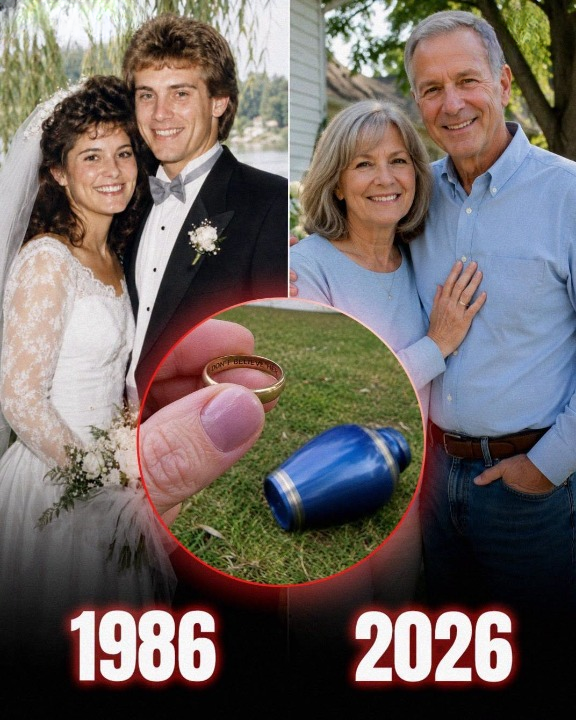
Eventually, I removed the urn’s lid.
Inside was a sealed bag containing the ashes.
My hands trembled as I lifted it.
Then I heard something.
A tiny metallic sound against the ceramic bottom.
Something dropped onto the grass.
I bent down.
A gold ring.
My heart almost stopped.
Frank’s wedding ring.
I recognized every scratch.
He’d worn it for forty years.
Once, after surgery, a nurse tried to remove it, and Frank joked that she’d need written permission from his wife.
I picked it up.
Then I remembered something Claire had told me.
“Dad was cremated wearing his wedding ring.”
At the time, I’d been strangely comforted by that.
Now the ring was sitting in my hand.
How?
I turned it over.
That was when I noticed the engraving.
There were words inside the band.
Three of them.
DON’T BELIEVE HER.
I stared until the letters blurred.
That engraving had never been there before.
I knew because Frank’s ring had once become too tight and we’d had it resized. I had examined the inside myself.
There had been no message.
My first thought was Claire.
Then immediately, I hated myself for thinking it.
Frank’s daughter had just lost her father too.
Maybe she’d had the ring engraved as some strange message.
Maybe there was an explanation.
But why would it say that?
And why had she told me Frank was cremated wearing it?
I didn’t call her.
Instead, I went home and began thinking.
I reread our text messages from the days before Frank died.
He had sent me photos during his trip.
A market.
A seaside restaurant.
Claire’s garden.
Then I noticed something strange.
His last message had arrived late the night before his death.
Having an interesting time. Lots to explain when I get home. Love you.
I had replied with a heart.
I’d thought nothing of it.
Now I couldn’t stop reading the sentence.
Lots to explain.
Two days later, I booked a flight.
I told Claire nothing.
I knew showing up without warning sounded extreme, but I needed answers before anyone had time to prepare them for me.
I arrived in her city on a Wednesday afternoon.
I rented a car and drove to the address Frank had written on his travel documents.
Claire lived in a quiet residential neighborhood.
I parked half a block away.
For several minutes, I simply sat there wondering what exactly I expected to find.
Then Claire’s front door opened.
A man stepped outside.
I froze.
For one impossible second, I thought I was looking at Frank.
Same height.
Same silver hair.
Same way of adjusting his glasses.
Then he turned.
It wasn’t my husband.
But the resemblance was extraordinary.
Claire followed him outside.
They hugged.
Then she handed him a folder.
I took out my phone and snapped a photograph.
The man drove away.
I waited another ten minutes before walking to Claire’s door.
When she opened it, all the color disappeared from her face.
“Margaret?”
“Hello, Claire.”
“What are you doing here?”
“I came because your father left me a message.”
Her eyes immediately moved toward my hands.
That reaction told me she knew exactly what I meant.
I stepped inside.
“Who was the man who just left?”
Claire closed the door.
“It’s complicated.”
“I’ve had enough of that word.”
She sat down.
Then she started crying.
“Dad made me promise.”
I almost laughed.
“Apparently Frank spent his final week making everyone promise things.”
I placed the wedding ring on her table.
Claire covered her mouth.
“You found it.”
“Yes.”
She looked terrified.
“Why did you tell me he was cremated wearing it?”
“Because that’s what Dad told me to say.”
I stared.
“Why?”
Claire wiped her eyes.
“Because he didn’t trust me to tell you the truth.”
My stomach tightened.
“About what?”
She pointed toward the photograph I’d taken of the man.
“His name is Robert.”
“Who is he?”
Claire looked directly at me.
“My father’s brother.”
I shook my head.
“Frank didn’t have a brother.”
“Yes, he did.”
“No.”
“Dad had an identical twin.”
The room went completely silent.
Frank had never once mentioned a twin.
Claire explained that Frank and Robert had become estranged in their twenties.
Robert developed serious gambling problems and repeatedly borrowed money from relatives.
Eventually, after a major family conflict, Frank cut contact.
Their parents died.
The brothers stopped speaking.
“Why didn’t Frank tell me?”
“He was ashamed.”
“Of having a brother?”
“Of what happened between them.”
According to Claire, Robert disappeared for nearly thirty years.
Then, two months before Frank’s trip, he contacted Claire.
He was seriously ill.
He wanted to reconcile with his brother.
Claire convinced Frank to visit.
“That was the real reason Dad came,” she said.
“He told me he was coming to see you.”
“He was.”
“But also Robert.”
She nodded.
I sat down.
“So Frank met him?”
“Three times.”
“And?”
“They argued.”
Robert claimed Frank owed him money from an old family inheritance.
Frank denied it.
Then Robert produced documents suggesting their father’s estate had been divided incorrectly decades earlier.
“Dad was furious,” Claire said.
“Why?”
“Because some of the documents looked real.”
Suddenly, Frank’s message made sense.
Lots to explain when I get home.
“What does this have to do with his death?”
Claire shook her head quickly.
“Nothing, as far as I know.”
“As far as you know?”
“Dad really did collapse.”
“You saw it?”
“Yes.”
Her answer was immediate.
“He wasn’t harmed, Margaret. I swear.”
Then she told me something even stranger.
The morning before he died, Frank privately asked Claire to take off his wedding ring.
He’d already had the message engraved.
DON’T BELIEVE HER.
“But why ‘her’?” I demanded.
Claire started crying harder.
“Because he thought I was helping Robert.”
“Were you?”
“Yes.”
That surprised me.
Claire had been passing messages between them.
She’d also helped Robert locate old family financial records.
Frank discovered what she’d been doing and felt betrayed.
“He thought Robert was manipulating me,” Claire said.
“Was he?”
“I didn’t know then.”
“And now?”
She gestured toward the folder Robert had taken.
“Now I think Dad was right.”
After Frank’s death, Robert apparently became obsessed with the old inheritance.
He insisted Claire owed him access to documents Frank had kept.
He even claimed that because Frank died abroad, certain property issues could be challenged.
Claire had begun giving him papers because she felt guilty.
“That’s why he was here today?”
She nodded.
“What was in the folder?”
“Copies of Dad’s old financial records.”
I stood.
“Call him.”
Claire looked frightened.
“Margaret—”
“Call him and tell him you made a mistake. Tell him you want the folder back.”
Robert refused.
So I called Frank’s attorney back home.
That conversation finally completed the picture.
Frank had contacted him two days before his death.
He’d explained the situation involving Robert.
He was worried that his brother was using Claire to obtain information about family accounts.
The attorney confirmed there had been an old inheritance dispute, but the matter had been legally resolved decades earlier.
Robert had no legitimate claim.
Most importantly, Frank had left detailed instructions.
The ring was supposed to reach me if anything happened before he returned.
Claire had panicked.
She followed some instructions but ignored others because she didn’t want me learning about Robert immediately after Frank’s death.
“I thought I was protecting you,” she whispered.
“You lied to me.”
“I know.”
That was difficult to forgive.
But there was no mystery surrounding Frank’s death after all.
Medical records, hospital reports, and eventually an independent review confirmed that his death was consistent with natural causes.
The shocking truth wasn’t that Claire had harmed her father.
It was that Frank had carried a family secret for our entire forty-year marriage.
An identical twin.
A broken relationship.
A dispute he’d been too ashamed to tell me about.
Robert eventually returned the documents after lawyers became involved.
He didn’t receive the money he believed he was owed.
But I did speak to him once.
Seeing his face was one of the strangest experiences of my life.
He looked so much like Frank that I had to keep reminding myself they were different people.
“Your husband hated me,” Robert said.
“No,” I replied. “I think he stopped trusting you.”
Robert looked away.
There is a difference.
Claire and I eventually returned home together.
Our relationship needed time.
I couldn’t simply forget that she’d lied about the ring.
But I also understood she had lost her father while being caught in a family conflict she never should have been forced to manage.
A month later, I returned to the willow.
This time, Claire came with me.
I carried Frank’s ashes.
She carried the blue urn.
Before scattering them, I slipped his wedding ring onto a chain around my neck.
I decided not to bury it.
I wanted to keep it.
Not because of the warning engraved inside.
Because it had been on Frank’s hand for almost our entire marriage.
I stood beneath the willow and said quietly:
“You should have told me about Robert.”
Claire smiled sadly.
“He probably knows.”
Then we scattered Frank’s ashes together.
Watching them disappear beneath the branches, I realized something uncomfortable about long marriages.
You can spend forty years beside someone and still not know every chapter that came before you.
That doesn’t necessarily mean the love was false.
Sometimes people hide parts of themselves because they’re afraid those old wounds will change the way they’re seen.
I wish Frank had trusted me with the truth.
But in the end, the message hidden inside his wedding ring did exactly what he intended.
It made me ask questions.
It made Claire stop helping someone she didn’t fully understand.
And it revealed a piece of my husband’s life he had spent decades trying to leave behind.
I went to the lake believing I was finally saying goodbye to the man I’d known for forty years.
Instead, I learned that even after four decades, Frank still had one final story left to tell.