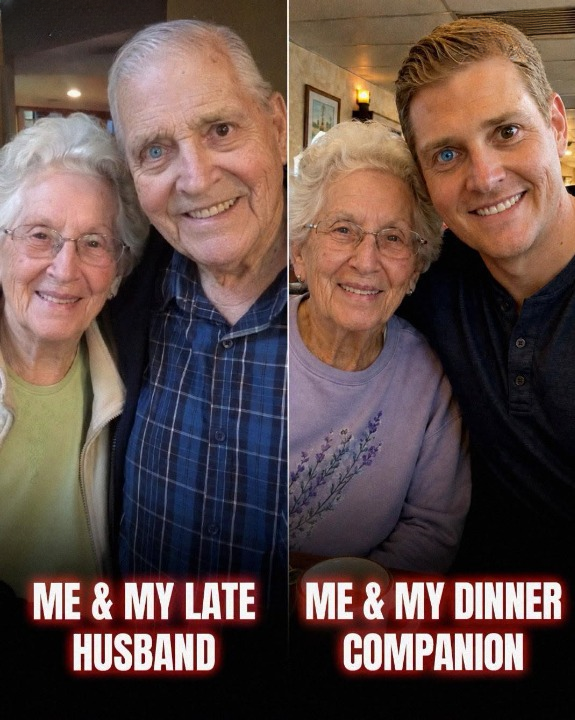
A month after my husband died, I discovered that loneliness has a sound.
It sounds like a refrigerator humming in a kitchen where no one is talking.
It sounds like the television playing to an empty room because silence has become too uncomfortable.
It sounds like reaching across the bed in the middle of the night and remembering there is no longer anyone sleeping beside you.
John and I had been married for fifty-two years.
More than half a century.
We had raised children, welcomed grandchildren, survived arguments, illnesses, financial worries, retirement, and all the ordinary problems that come with building a life beside another person.
Then, one morning, John was gone.
His death was sudden.
One evening, we were discussing what to make for dinner the following day.
By sunrise, I was sitting in a hospital waiting room being told that my husband wasn’t coming home.
Our children came for the funeral, of course.
So did the grandchildren.
For several days, my little house was full again.
There were flowers everywhere.
Casseroles in the refrigerator.
People sleeping on couches and folding chairs.
Someone was always asking whether I needed anything.
Then the funeral ended.
Everyone returned to their own lives.
My daughter lived nearly six hours away.
My son lived in another state.
They called every day, but a telephone conversation isn’t the same as hearing another person moving around the kitchen.
For the first week, I barely cooked.
There seemed to be no point in making an entire meal for one person.
Then one evening, I walked past a small café about three blocks from my house.
John and I had eaten there occasionally.
Nothing fancy.
Soup.
Sandwiches.
Coffee.
The kind of place where the waitress remembers if you like extra lemon in your tea.
I almost kept walking.
Instead, I went inside.
The hostess seated me at a table near the window.
I ordered tomato soup and bread.
I had eaten perhaps three spoonfuls when someone stopped beside my table.
“Excuse me, ma’am.”
I looked up.
A young man stood there.
He couldn’t have been more than thirty.
Dark hair.
Brown eyes.
A narrow face.
For one strange second, my heart seemed to forget how to beat.
He looked remarkably like John had when we were young.
Not identical.
But close enough that memories rushed through me.
John standing outside my parents’ house at twenty-two.
John in our wedding photographs.
John holding our first child.
The young man gestured toward the empty chair.
“Would you mind if I sat here? The café is crowded.”
I looked around.
It wasn’t particularly crowded.
Still, I said, “I’d like that.”
He smiled.
“Thank you.”
His name was Carl.
At first, our conversation was ordinary.
Weather.
Food.
How long I had lived in town.
Then he asked whether I was married.
I looked at my wedding ring.
“I was.”
His expression softened.
“I’m sorry.”
“My husband died recently.”
“How recently?”
“A few weeks ago.”
Carl became strangely quiet.
Then he said, “What was he like?”
Nobody had asked me that since the funeral.
People asked how John died.
They asked how I was coping.
They asked whether I planned to move closer to my children.
But Carl asked what John had been like.
So I told him.
I told him John had a terrible singing voice but sang constantly anyway.
I told him he claimed not to like cats, yet every cat we owned eventually slept on his side of the bed.
I told him that after fifty-two years, he still bought me flowers from the grocery store whenever he thought I’d had a difficult week.
Carl listened.
Really listened.
By the time I finished, my soup was cold.
The next evening, I returned to the café.
Carl was there.
“Mind if I join you?”
I smiled.
“I was wondering if you would.”
That became our routine.
Every evening at approximately six thirty, Carl appeared.
Sometimes he was already seated when I arrived.
Sometimes I saved him a chair.
We ate soup, sandwiches, pasta, whatever the café served.
And we talked.
Mostly, I talked.
I told him about my children.
My grandchildren.
My marriage.
John.
Especially John.
Carl seemed fascinated by every story.
Yet he said almost nothing about himself.
Whenever I asked where he’d grown up, he became vague.
“A lot of places.”
“What brought you here?”
“Work.”
“What do you do?”
“A little of everything.”
“Are you married?”
“No.”
“Parents?”
He hesitated.
“Not really.”
Eventually, he told me he’d been raised without a stable family.
“I’m basically an orphan,” he said.
The answer made me stop asking questions for a while.
I assumed the subject was painful.
But there were moments when Carl’s behavior puzzled me.
Once, I told him about the first house John and I rented after our wedding.
Carl suddenly looked away.
Another evening, I mentioned a small scar John had above his left eyebrow from a childhood accident.
Carl’s face went completely still.
“Are you okay?” I asked.
“Fine.”
Then he excused himself to the restroom.
He returned several minutes later with red eyes.
I pretended not to notice.
Perhaps grief had made me too trusting.
Perhaps I simply needed the company.
Either way, I didn’t question him.
For almost a month, Carl became the brightest part of my evenings.
I started looking forward to six thirty.
I began cooking breakfast for myself again.
I opened curtains that had stayed closed since the funeral.
My daughter even noticed the change over the phone.
“You sound better, Mom.”
“I’m trying.”
“Have you made friends?”
“One.”
She laughed.
“Already?”
“He’s young enough to be your little brother.”
“Mom!”
I laughed for the first time in weeks.
Then came the thirtieth evening.
Carl arrived late.
The moment I saw him, I knew something was wrong.
He looked pale.
There were dark circles beneath his eyes.
And he was carrying a black canvas bag I had never seen before.
“You look terrible,” I told him.
“Thank you.”
“You know what I mean.”
He sat down.
The waitress brought his usual coffee.
He didn’t touch it.
For nearly ten minutes, Carl barely spoke.
He kept glancing toward the bag resting against his chair.
Finally, I asked, “What’s in there?”
He immediately pulled the bag closer.
“Nothing.”
“Carl.”
His hands were shaking.
I reached across the table.
“What happened?”
He suddenly looked at me.
“You don’t actually think I’ve been coming here every night for no reason, do you?”
His tone was sharper than anything I’d heard from him before.
I pulled my hand back.
“I thought we were friends.”
“We are.”
“Then why are you talking to me like that?”
He closed his eyes.
“I’m sorry.”
Several seconds passed.
Then he whispered, “I waited for John to die.”
Every bit of warmth left my body.
“What?”
Carl looked terrified.
“I didn’t mean it like that.”
“Then explain exactly how you meant it.”
He stared at the table.
“I’ve known who you are since before we met.”
I pushed my chair backward.
“Carl, what is this?”
“Please don’t leave.”
“You’ve been following me?”
“No.”
“Then how did you know me?”
He swallowed.
“Because John told me about you.”
I froze.
“My husband knew you?”
“Yes.”
“How?”
Carl looked toward the canvas bag.
Then he said, “He was my father.”
I actually laughed.
Not because anything was funny.
Because the sentence seemed impossible.
“No.”
Carl’s eyes filled with tears.
“He was.”
“You are thirty years old.”
“I know.”
“John and I were married for fifty-two years.”
“I know that too.”
My hands began trembling.
“You are telling me my husband had a child with another woman while we were married?”
Carl’s face crumpled.
“No.”
“Then what are you telling me?”
He opened the bag.
Inside were photographs.
Letters.
Old documents.
He placed one photograph on the table.
John was in it.
Much younger than when he died, perhaps twenty-five.
Beside him stood another young man who looked almost exactly like him.
I stared.
“Who is that?”
“John’s brother.”
My confusion deepened.
John had told me he was an only child.
At least, that was what I had believed for fifty-two years.
Carl took a breath.
“His name was Robert.”
I said nothing.
“Robert was my biological father.”
I looked from the picture to Carl.
The resemblance suddenly made sense.
Not John’s son.
His nephew.
“Why did John tell me he didn’t have a brother?”
Carl looked miserable.
“Because Robert disappeared.”
The story came slowly.
John and Robert had grown up in a difficult home.
Their father had been harsh and controlling.
Their mother died young.
John escaped first.
He left for college, built his own life, and eventually met me.
Robert stayed behind.
Years later, after a serious disagreement with their father, Robert disappeared.
John tried finding him.
He never did.
“He thought Robert was dead,” Carl said.
“But he wasn’t.”
“No.”
Robert had moved several states away and changed his last name.
He eventually had a son.
Carl.
When Carl was six, Robert died.
Carl entered foster care.
I stared at him.
“You really were raised without parents.”
He nodded.
“I wasn’t lying about that.”
“Then how did you find John?”
“DNA testing.”
My heart pounded.
Three years earlier, Carl had taken a genealogy test hoping to learn something about his father’s family.
One match eventually connected him to a distant relative.
From there, he discovered John.
“He didn’t believe me at first,” Carl said.
“So you met?”
“Yes.”
“When?”
“Two years ago.”
Two years.
My husband had known Carl for two years.
And never told me.
I felt betrayal rise inside me.
“He hid this from me.”
Carl nodded.
“But not because he was ashamed of you.”
“I didn’t say that.”
“He was ashamed of himself.”
I stared.
“For what?”
Carl took another envelope from the bag.
“He knew he had failed Robert.”
“How?”
Apparently, shortly before Robert disappeared, he had written John asking for help.
Robert wanted to leave their father’s house.
He needed money.
He needed somewhere to stay.
John was newly married then.
We were struggling financially.
He never responded.
My chest tightened.
“I never knew.”
“He knew that.”
Carl continued.
“John told me he spent his whole life wondering what would’ve happened if he’d answered that letter.”
I remembered John’s occasional sadness whenever conversations turned to siblings.
I’d assumed it came from wishing he’d had one.
Instead, he’d been remembering the brother he’d lost.
“Why didn’t he tell me about you once he found you?”
Carl’s eyes filled.
“Because he was afraid.”
“Of what?”
“That you’d look at him differently.”
I shook my head.
“After fifty-two years?”
“He carried the secret for so long that telling you became harder every year.”
That sounded painfully human.
Still wrong.
But human.
Carl pushed another letter toward me.
“He wrote this before he died.”
My name was on the front.
Margaret.
John’s handwriting.
My breath caught.
I opened it.
My love,
There is something I should have told you more than fifty years ago.
I had a younger brother.
His name was Robert.
I stopped reading and closed my eyes.
The letter continued with everything Carl had already explained.
Then came the part that made me cry.
John wrote:
I spent decades telling myself I kept Robert secret because the memory hurt too much.
The truth is uglier.
I was ashamed.
He asked me for help, and I was too frightened and too poor and too selfish to answer.
By the time I tried to find him, he was gone.
Then, two years ago, Carl found me.
I looked across the table.
Carl was crying silently now.
I kept reading.
He is Robert’s son.
My nephew.
He has my brother’s eyes and his terrible habit of tapping his fingers when he’s nervous.
I wanted to bring him home to you the first day I met him.
I didn’t.
I told myself I needed time.
Then time became another secret.
That part hurt.
Then I reached the paragraph that explained our month of dinners.
When I became ill, I asked Carl for one favor.
I asked him not to tell you until after I was gone.
Not because I wanted to deceive you further.
Because I knew losing me would leave you alone, and I hoped Carl might first meet you as himself rather than as the keeper of one of my regrets.
I covered my mouth.
Carl whispered, “He knew you’d come to this café.”
“How?”
“He said it was where you went whenever you didn’t want to cook.”
Despite everything, I almost smiled.
John knew me.
Of course he did.
Carl continued.
“He told me to sit with you if you seemed lonely.”
“And not tell me who you were?”
“Not immediately.”
I looked down at the letter.
John had written:
If he tells you on the first evening, you will spend every conversation thinking about my lie.
If he waits, perhaps you will get to know him first.
It was selfish of me.
Possibly manipulative.
You may be furious.
You probably should be.
I actually laughed through my tears.
That sounded like John too.
At the bottom, he wrote:
Please do not punish Carl for my cowardice.
He spent his childhood without family.
You have spent your life making family wherever you go.
If there is room at your table for him, I hope you will leave the chair open.
I lowered the letter.
For a long time, neither of us spoke.
Then I asked, “Why tonight?”
Carl looked toward the bag.
“Because tomorrow I’m leaving.”
My heart sank unexpectedly.
“Leaving where?”
“I got a job in another city.”
“How far?”
“About four hours.”
I hated how disappointed I felt.
He noticed.
“I didn’t want to disappear without telling you.”
“That would have been cruel.”
“I know.”
“And you weren’t planning to tell me before you left?”
“I’ve been trying every night for a week.”
That explained his nervousness.
I looked at the photographs again.
One showed Robert holding Carl as a baby.
Another showed John and Carl sitting on a park bench.
John looked older and thinner, but he was smiling.
I’d never seen the picture.
“Did John care about you?”
Carl’s eyes immediately filled.
“Yes.”
That answer mattered more than I expected.
“Did you care about him?”
Carl looked away.
“I did.”
Then his voice broke.
“I only had him for two years, but yes.”
I reached across the table.
This time, he didn’t pull away.
“You should’ve told me sooner.”
“I know.”
“John should have told me fifty years ago.”
“I know.”
“I’m very angry with both of you.”
“I know.”
I squeezed his hand.
“But I don’t want you to leave thinking you’re alone.”
Carl looked at me.
I surprised myself with the next question.
“Are you busy Sunday?”
He blinked.
“What?”
“My children call every Sunday afternoon.”
“Okay.”
“I think they’d like to meet their cousin.”
Carl stared at me.
Then he started crying.
Again.
I laughed.
“You cry more than John did.”
“So I’ve been told.”
The following Sunday, my dining room table was full.
My daughter and son joined by video call because they lived too far away to come immediately.
I introduced Carl.
There were questions.
Many questions.
There was anger too.
My children were hurt that their father had hidden such an important part of his past.
But beneath it, there was something else.
Curiosity.
Recognition.
Family.
A month later, Carl moved for his new job.
But he didn’t disappear.
He called.
He visited.
At Christmas, he came to my house and brought far too much food.
My grandchildren became fascinated with the idea that Grandpa had secretly had a nephew.
One of them said, “So Carl is like a bonus uncle?”
I smiled.
“Something like that.”
Grief didn’t disappear because Carl entered my life.
Nothing could replace John.
Nor should it.
But the empty house became less empty.
The chair across from me at the café stopped feeling like a reminder of who was gone.
Sometimes Carl still sits there when he visits.
We order soup.
We talk until it gets cold.
And occasionally, we talk about John.
Not the perfect husband I had imagined after his death.
The real man.
The man who loved me deeply.
The man who carried regret.
The man who made mistakes.
The man who waited too long to tell the truth.
I wish John had trusted me enough to tell me about Robert while he was alive.
I wish he had introduced me to Carl himself.
But life doesn’t always give us neat endings.
Sometimes we inherit unfinished conversations.
Sometimes we discover that the people we knew best had rooms inside themselves they never opened.
And sometimes a stranger sits down across from you in a café, and a month later you learn he was never really a stranger at all.
Carl once asked me whether I regretted letting him sit at my table that first evening.
I told him no.
Then I added:
“But if you ever keep a fifty-year family secret from me again, you’re paying for dinner.”
He laughed so loudly the waitress turned around.
And for the first time since John died, the sound of laughter followed me all the way home.