I believed my wedding day would become one of the happiest memories of my life. Instead, it revealed a side of my groom that I could no longer ignore.
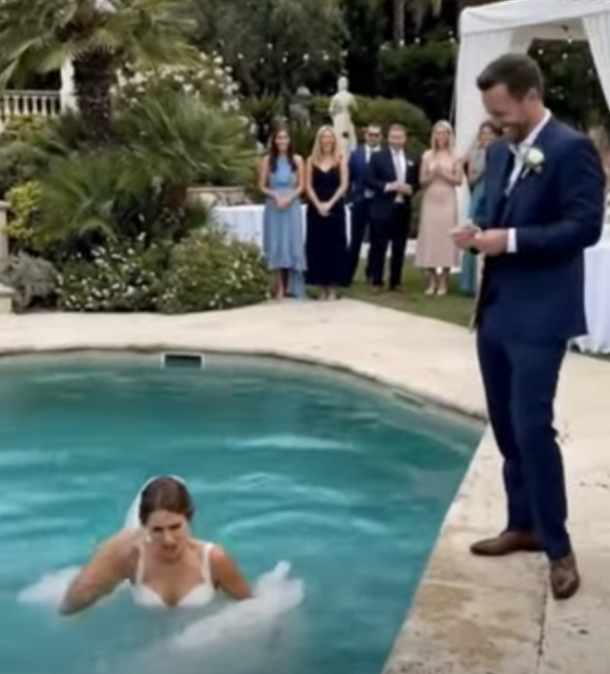
In front of nearly 200 guests, Theo called me to the edge of the pool and promised that he had prepared a surprise. Before I realized what he intended to do, he pushed me into the water while I was still wearing my wedding dress.
He laughed as I struggled to reach the surface.
What Theo did not expect was that I would not dismiss his behavior as a harmless wedding joke. When I finally responded, his smile disappeared—and our celebration took a turn no one had anticipated.
When I first met Theo, he appeared to be everything I wanted in a partner. He was confident, sociable, and remarkably good at making people feel important. He remembered birthdays, arrived with thoughtful gifts, and always seemed to know what to say.
My parents liked him immediately. Even my father, who was normally cautious about the people I dated, admitted that Theo had made a good impression.
“He seems serious about you,” Dad told me after their first meeting. “Just make sure he respects you when no one else is watching.”
At the time, I thought my father was being overly protective.
Theo and I dated for almost three years before he proposed. He arranged a romantic dinner at the restaurant where we had shared our first official date. After dessert, he knelt beside the table and presented me with a beautiful ring.
I said yes without hesitation.
For the following year, nearly all our free time went into planning the wedding. We selected an elegant estate featuring a landscaped garden, a white-stone terrace, and a large outdoor swimming pool.
It was more expensive than we originally intended, but Theo insisted that we should make the occasion unforgettable.
“You only get one wedding day,” he frequently said. “We should give everyone something to talk about.”
Looking back, I wish I had paid closer attention to those words.
Theo loved attention. He enjoyed making jokes at other people’s expense and sometimes continued even after the person involved became uncomfortable. Whenever I objected, he told me that I was taking things too seriously.
During our engagement party, for example, he showed our guests several embarrassing photographs of me from college. Everyone laughed, and I tried to smile along with them. Later, I explained that I felt humiliated.
“You looked beautiful in every picture,” he said. “It was only a joke.”
That was how he handled every disagreement. If his actions hurt someone, the problem was supposedly their inability to appreciate his humor.
Still, I loved him and believed his good qualities outweighed his thoughtless moments. I told myself that marriage would help us grow into better partners.
On our wedding day, the estate looked magnificent. White flowers decorated the garden, strings of lights hung above the terrace, and rows of chairs faced an arch overlooking the surrounding countryside.
I wore a dress that had taken months to select and alter. It had delicate lace sleeves, a fitted bodice, and a long skirt with several layers of fabric. My mother helped me fasten the veil that had belonged to my grandmother.
Before walking down the aisle, Dad took my hand.
“You look just like your mother did on our wedding day,” he whispered.
The ceremony itself was beautiful. Theo appeared emotional when he saw me, and for a while, every doubt I had ever experienced disappeared. We exchanged vows, posed for photographs, and walked into the reception while our guests applauded.
Dinner was served, champagne glasses were raised, and music filled the garden. I felt relieved that all the planning had finally come together.
Then Theo took the microphone.
“I need my beautiful bride to join me for a moment,” he announced.
He was standing close to the swimming pool.
I assumed that he had planned a romantic gesture. Perhaps he wanted to give a speech or present me with a special gift. He had repeatedly hinted that he was preparing a reception surprise.
Smiling, I walked across the terrace toward him.
Theo wrapped one arm around my shoulders and addressed the guests.
“My wife has been asking about her surprise all week,” he said. “I think it’s finally time to give it to her.”
Some guests raised their phones to record us.
I looked at Theo, waiting for him to continue.
“Well, here it is!” he shouted.
Without warning, he placed both hands against me and pushed.
The next few seconds happened so quickly that I barely understood them. I lost my balance, felt the edge of the pool beneath one heel, and fell backward into the water.
My heavy dress pulled around my legs. The cold water shocked the air from my lungs, and for a frightening moment, I could not tell which direction led to the surface.
When I finally emerged, gasping for breath, my veil was floating several feet away. Makeup ran into my eyes, and the weight of my soaked dress made it difficult to move.
The garden had gone almost completely silent.
Theo stood at the edge of the pool, laughing.
Not a nervous laugh or a brief reaction of surprise. He was bent forward, holding his stomach as if he had just performed the most entertaining joke imaginable.
He did not offer me his hand.
He did not ask whether I was all right.
Two members of the venue staff rushed over and helped me reach the steps. Across the terrace, I saw my father moving toward us as quickly as he could with his cane.
His expression told me that he was furious.
“Dad, please stop,” I called.
He paused.
I knew my father wanted to confront Theo, but I did not want the situation to become a physical argument. More importantly, I needed to make my own decision.
One of my bridesmaids wrapped a tablecloth around my shoulders and led me inside. My mother and two friends followed us into the bridal suite.
No one spoke for several moments.
Then my mother gently asked, “What do you want to do?”
I looked at myself in the mirror. My dress was stained from the pool, my hair was ruined, and mascara had created dark lines beneath my eyes.
Surprisingly, those details no longer mattered.
What mattered was the image of Theo laughing while I struggled in the water. He had not acted impulsively during a private moment. He had planned the entire incident, positioned himself near the pool, summoned me with a microphone, and encouraged guests to watch.
He wanted to embarrass me.
Worse, he expected me to accept it because we were surrounded by people and had just held a wedding ceremony.
“I’m leaving,” I said.
My mother nodded immediately.
I changed into the simple white dress I had packed for the end of the reception. I washed my face, tied my wet hair back, and returned to the garden.
By then, Theo had apparently decided that the incident was over. The music had resumed, and he was standing near the bar with several friends.
When he saw me approaching, he smiled.
“There she is!” he called. “You have to admit, everyone will remember that forever.”
“You’re right,” I answered. “I certainly will.”
I asked the band to stop playing and requested the microphone.
The guests slowly turned toward me. Some appeared uncomfortable, while others looked genuinely concerned.
“Theo wanted to give everyone a memorable wedding surprise,” I began. “He succeeded. What happened beside the pool taught me something important about the person I was prepared to build my life with.”
Theo’s smile weakened.
I continued calmly.
“A joke is something both people can laugh about. Deliberately frightening or humiliating someone is not a joke—especially when that person has already asked you to stop using embarrassment as entertainment.”
A few guests nodded.
Theo stepped toward me.
“Come on,” he said quietly. “Don’t turn this into a dramatic scene.”
I looked directly at him.
“You created the scene. I’m simply deciding what it means.”
I removed my wedding ring and placed it on the table beside the microphone.
Gasps moved through the crowd.
“I will not begin a marriage by pretending that public humiliation is an acceptable expression of love,” I said. “This reception is over for me.”
Theo stared at the ring.
Only then did he realize that I was serious.
“How dare you?” he shouted. “Do you have any idea how much this wedding cost?”
His reaction confirmed my decision.
He did not apologize for pushing me. He did not ask whether I had been hurt or frightened. His first concern was the expense and the embarrassment he now felt.
“My parents paid for most of this wedding,” I reminded him. “But even if you had paid for every detail, money would not give you permission to treat me that way.”
Theo accused me of overreacting. He insisted that the pool was not deep and claimed that he knew I would be safe. He said couples played pranks on one another at weddings all the time.
I asked him one simple question.
“If you were certain I would find it funny, why didn’t you tell me about it beforehand?”
He had no answer.
My father came to stand beside me, but he allowed me to speak for myself.
The venue manager arranged for a car to take me and my parents home. My mother collected my belongings, while my bridesmaids stayed close in case Theo attempted another confrontation.
Several guests left with us. Others remained behind, uncertain what to do. I did not blame them. They had arrived expecting to celebrate a marriage, not witness its collapse.
The following morning, Theo sent dozens of messages. At first, he was angry. He said I had humiliated him in front of his relatives and destroyed a celebration that had taken a year to organize.
Later, his tone changed. He apologized, but each apology came with an excuse.
He had been nervous.
His friends had encouraged him.
He thought I would laugh.
He had consumed too much champagne.
He never intended to hurt me.
I read the messages but did not answer immediately. I needed time to separate his words from the pattern I had ignored throughout our relationship.
The pool incident was not the only reason I walked away. It was the moment that made all the previous incidents impossible to dismiss. Every embarrassing photograph, insensitive joke, and rejected concern suddenly looked different.
Theo had repeatedly shown me that my discomfort mattered less to him than the attention he received from making others laugh.
A week later, we met in a public place to discuss practical matters. He expected me to forgive him and move forward.
Instead, I ended our relationship.
Theo appeared stunned.
“You would throw away three years over one joke?” he asked.
“No,” I replied. “I’m ending this because you still call it a joke.”
Leaving was not easy. I had loved him, planned a future with him, and imagined raising a family together. For several months, I questioned whether I had acted too quickly.
But whenever doubt appeared, I remembered being in the water and seeing him laugh instead of reaching out to help me.
My father never said that he had warned me. He simply reminded me of what he told me when he first met Theo: respect matters most when no audience is present.
In Theo’s case, even the presence of an audience did not inspire respect. It encouraged him to behave more cruelly.
The wedding photographs remained stored away for a long time. Eventually, I kept a few showing my parents, friends, and grandmother’s veil. I discarded the ones that reminded me of a future that had never truly existed.
I also donated the wedding dress after it was professionally cleaned. A local theater group transformed parts of it into costumes. Knowing that the fabric would be used to create joy for other people helped me let it go.
Today, I no longer view that day only as a disaster. It was painful and humiliating, but it also gave me clarity before I invested more years in a relationship without mutual respect.
Theo believed that pushing me into the pool would become a funny story we told at parties.
Instead, it became the moment I learned that love without respect is not a foundation for marriage.
Walking away in front of 200 guests was difficult. Staying with someone who enjoyed humiliating me would have been far more difficult.
My wedding did not end the way I expected, but my response gave me something more valuable than a flawless celebration: the courage to protect my dignity and choose a healthier future.