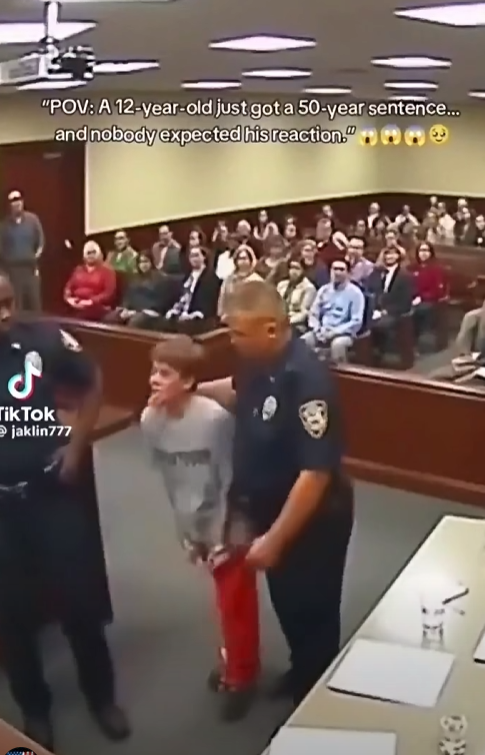
A 12-Year-Old Faces a 50-Year Prison Sentence: A Courtroom Moment That Raises Difficult Questions About Juvenile Justice
A courtroom fell silent as a judge announced a sentence that would potentially keep a 12-year-old boy behind bars for decades.
The decision immediately raised difficult questions about childhood, accountability, justice, and the possibility of rehabilitation.
For a child who had barely entered adolescence, the prospect of spending most of his life in prison was an overwhelming reality to confront.
The emotional reaction that followed became the focus of attention. It was a reminder that behind every criminal case involving a young defendant is a human being whose future, development, and opportunities for change deserve careful consideration.
But the situation also raises another important question: How should society respond when a child is accused of committing a serious crime?
Should the justice system focus primarily on punishment, or should it leave room for rehabilitation and the possibility of a different future?
These questions have no simple answers.
The Moment the Sentence Was Announced
Courtrooms are generally places of procedure and careful language.
Judges listen to arguments, attorneys present evidence, and decisions are delivered according to established legal standards.
Yet some moments are difficult to experience without an emotional response.
Imagine a young defendant sitting beside his legal representatives, waiting for a decision that could determine the direction of his entire life.
He may have entered the courtroom understanding that serious consequences were possible. However, hearing a sentence measured in decades is different from simply knowing that punishment may follow.
For an adult, a 50-year sentence is already difficult to comprehend.
For a 12-year-old, the meaning of such a decision can be especially overwhelming.
The number represents far more than a period of confinement. It raises questions about education, family relationships, personal development, and the possibility of ever returning to ordinary life.
An emotional response in such circumstances would be understandable.
A child might struggle to process the information, ask repeated questions, or seek reassurance from family members.
The courtroom setting can make that experience even more difficult.
Why Cases Involving Children Are Different
The justice system has long recognized that children are not simply smaller versions of adults.
Young people are still developing emotionally, socially, and intellectually.
Their ability to evaluate risks, control impulses, understand consequences, and make complex decisions changes considerably throughout adolescence.
This does not mean that children cannot understand right and wrong.
It means that their development, circumstances, and capacity for change must be considered when decisions about their future are made.
A 12-year-old is at a particularly early stage of development.
At that age, many children are still learning how to manage difficult emotions, resolve disagreements, recognize the consequences of their choices, and understand the wider effects of their actions.
Family circumstances, education, exposure to violence, peer relationships, and access to appropriate support can all influence a child’s development.
None of these factors automatically excuses harmful behavior.
However, they can help professionals understand how a young person reached a particular point and what interventions might prevent future harm.
That distinction is essential when discussing juvenile justice.
Accountability matters, but understanding the reasons behind harmful behavior can also help society prevent it from happening again.
The Difficult Balance Between Justice and Rehabilitation
When a serious crime involves a child, two important responsibilities come into focus.
The first is justice for victims.
People who have experienced serious harm deserve recognition, protection, support, and a legal process that takes their suffering seriously.
Their families also deserve compassion and consideration.
The second responsibility is the future of the young defendant.
Even when a child has committed a serious offense, the justice system must consider whether meaningful rehabilitation is possible.
These responsibilities should not be treated as opposing ideas.
A justice system can recognize the suffering of victims while also acknowledging that children have different developmental needs from adults.
Rehabilitation does not mean ignoring the consequences of harmful actions.
It can involve structured education, psychological support, behavioral interventions, accountability programs, and carefully supervised opportunities for personal development.
The objective is to reduce the likelihood of future harm while helping young people develop the skills necessary to make better decisions.
For some children, early intervention can make an important difference.
For others, the circumstances may be more complicated and require long-term professional support.
The challenge is determining an appropriate response that protects society without unnecessarily eliminating the possibility of positive change.
What Science Tells Us About Adolescent Development
Research into adolescent development has helped explain why juvenile justice systems often treat children differently from adults.
During childhood and adolescence, the brain continues developing.
The prefrontal cortex, which contributes to planning, decision-making, impulse regulation, and evaluating potential consequences, continues maturing into young adulthood.
This development does not mean that young people lack responsibility for their actions.
Rather, it demonstrates why age and developmental maturity are relevant considerations when evaluating behavior.
A young person may understand that an action is wrong while still having difficulty assessing its long-term consequences or controlling an impulsive response in a stressful situation.
The influence of peers can also be particularly significant during adolescence.
Emotional pressure, fear, social expectations, and unstable environments may affect the decisions young people make.
Understanding these factors allows professionals to develop more appropriate approaches to rehabilitation.
It also helps explain why treating every juvenile defendant exactly like an adult may fail to account for important developmental differences.
The Importance of Listening to Victims
Discussions about juvenile sentencing sometimes become so focused on the defendant that the people harmed by the offense receive less attention.
That should never happen.
Victims and their families deserve to be heard.
Their experiences should not be minimized because the person responsible is young.
Serious wrongdoing can create lasting emotional, physical, and financial consequences.
Families may experience grief, anxiety, uncertainty, and difficulties rebuilding their lives.
They may also struggle with the belief that the justice system is not taking their suffering seriously.
A fair process must recognize these realities.
Victim support services, appropriate compensation where available, access to information, and respectful communication are important parts of a responsible justice system.
It is possible to believe that children deserve opportunities for rehabilitation while also recognizing that victims deserve meaningful justice.
Compassion for one person does not require indifference toward another.
Why Rehabilitation Can Benefit Society
One of the most important questions in juvenile justice is whether punishment alone can prevent future harm.
A lengthy sentence may remove an individual from society for an extended period, but it does not automatically address the factors that contributed to harmful behavior.
Rehabilitation attempts to address those underlying issues.
Depending on the circumstances, a comprehensive juvenile rehabilitation program may include:
-
- Education: Helping young people continue their schooling and develop practical skills.
-
- Mental health support: Providing appropriate professional assistance when emotional or psychological difficulties are present.
-
- Behavioral programs: Teaching healthy ways to manage anger, frustration, and conflict.
-
- Family involvement: Supporting healthier relationships and improving the environment to which a young person may eventually return.
-
- Accountability programs: Helping young people understand the consequences of their decisions and the harm experienced by others.
-
- Long-term supervision: Providing structured guidance and monitoring when appropriate.
These approaches are not guarantees of success.
However, they offer opportunities to address behavior rather than simply impose consequences.
For a child who still has many years of development ahead, access to appropriate intervention can be particularly important.
Should a 12-Year-Old Receive a 50-Year Sentence?
This is perhaps the most difficult question raised by the hypothetical situation.
A 50-year sentence imposed on a child deserves careful examination.
The seriousness of the underlying offense matters. The circumstances of the case matter. The impact on victims matters. The defendant’s developmental maturity and individual circumstances also matter.
Different countries have different laws governing the age of criminal responsibility, juvenile sentencing, and the circumstances under which young defendants may receive particularly lengthy sentences.
Some legal systems prohibit certain sentences for children.
Others permit lengthy sentences under exceptional circumstances, although constitutional and international human rights standards may impose important restrictions.
The United Nations Convention on the Rights of the Child establishes protections for children involved in the justice system.
Its principles emphasize that detention should be used only as a last resort and for the shortest appropriate period, while promoting the child’s dignity, development, and reintegration into society.
The legal position depends on the jurisdiction and the specific circumstances.
Therefore, an alleged 50-year sentence involving a 12-year-old should never be discussed without examining the actual court decision and applicable law.
Sensational headlines alone cannot establish whether a sentence was legally imposed, whether it was subject to review, or whether the reported details are accurate.
The Role of Families in Preventing Youth Crime
The responsibility for preventing youth crime does not belong exclusively to courts and law enforcement agencies.
Families, schools, community organizations, and social services all have important roles.
Children need environments where they feel safe enough to discuss problems.
They need adults who recognize warning signs and respond before difficulties become more serious.
Sometimes behavioral changes may indicate that a young person is struggling.
These changes might include:
-
- Sudden withdrawal from friends and family.
-
- Increasing difficulty managing anger.
-
- Serious problems at school.
-
- Persistent involvement in aggressive conflicts.
-
- Exposure to harmful peer influences.
-
- Difficulty coping with stressful experiences.
Such behaviors do not automatically indicate criminal intentions.
However, they may suggest that a child needs additional support.
Parents and guardians can help by maintaining open communication, establishing reasonable boundaries, and seeking professional assistance when necessary.
Schools can provide counseling, mentoring, conflict-resolution education, and early intervention programs.
Communities can create safe opportunities for young people to develop confidence, responsibility, and positive relationships.
Prevention is often more effective when support begins before a child becomes involved in the justice system.
Why Public Reactions Can Become So Divided
Cases involving young defendants often attract strong public reactions.
Some people believe severe punishment is necessary whenever an offense causes serious harm.
Others argue that children should receive additional protection because their development and ability to change are different from those of adults.
Both perspectives often come from deeply held concerns.
People who emphasize punishment may be thinking about victims, public safety, and the importance of accountability.
Those who emphasize rehabilitation may be thinking about childhood development, fairness, and the possibility that a young person can become a responsible adult.
Online discussions can make these disagreements even more intense.
A short video or emotional headline may circulate without sufficient information about the case.
People may form opinions before learning the facts, the applicable laws, or the circumstances surrounding the offense.
This is why responsible reporting matters.
Journalists and publishers should distinguish verified information from speculation, avoid presenting unconfirmed stories as established facts, and consider the long-term impact of identifying or humiliating children involved in legal proceedings.
The public deserves accurate information rather than emotional manipulation.
The Importance of Giving Young People a Future
One of the most important principles of juvenile justice is recognizing that childhood is a period of development.
A 12-year-old is not the same person they may become at 18, 25, or 35.
Their understanding, emotional maturity, and ability to make decisions will continue changing.
This does not erase past harm.
It does, however, raise an important question about whether a justice system should permanently define a child by the worst decision of their young life.
For some young people, rehabilitation can provide a path toward education, personal responsibility, and a safer future.
For others, progress may be slower and require more intensive intervention.
There are no guarantees.
But a justice system that leaves room for development recognizes something important: children are capable of learning, growing, and changing.
Protecting society and preserving the possibility of rehabilitation should remain central considerations.
A More Thoughtful Conversation About Juvenile Justice
The story of a young defendant facing an extraordinarily long sentence reminds us that justice is rarely a simple subject.
It involves victims, families, communities, legal principles, public safety, and the future of the person accused of wrongdoing.
It requires us to think carefully about accountability without overlooking compassion.
It also reminds us that emotional courtroom moments should not replace a careful examination of evidence and law.
Before forming an opinion about a particular case, we should ask whether the information is verified, understand the circumstances, and consider the legal standards involved.
Most importantly, we should remember that every child deserves to be treated with dignity, even when serious allegations or harmful actions are involved.
That principle does not diminish the importance of justice.
It strengthens the responsibility to pursue justice fairly.
Final Thoughts
A sentence measured in decades is difficult to imagine for anyone, especially someone who is only 12 years old.
Such a case naturally raises questions about punishment, accountability, rehabilitation, and the future of juvenile justice.
Victims deserve justice.
Communities deserve protection.
And children who enter the justice system deserve a fair process that recognizes their age, circumstances, and capacity for development.
The challenge is finding an approach that takes all these responsibilities seriously.
Perhaps the most important lesson is that justice should not be measured only by the severity of a punishment.
It should also be measured by whether the system protects people, recognizes harm, prevents future wrongdoing, and provides meaningful opportunities for positive change.
A child’s future should never be treated as an unimportant detail in the pursuit of justice.