I never expected a child’s silence to teach me so much about love.
When I first met Jonah, he was nine years old, carrying a small backpack and looking around my home as though he were carefully memorizing every detail. He didn’t say hello. He didn’t ask where he would sleep. He didn’t even look directly at me for more than a few seconds.
He simply stood in the doorway and waited.
The caseworker, Maribel, had warned me.
“He doesn’t speak,” she had said before bringing him to my house. “Not with adults. Not with other children. He hasn’t spoken for a very long time.”
I remember nodding.
“Does he communicate in other ways?”
“He writes sometimes. He gestures. Mostly, he observes.”
Maribel paused before adding, “You should know that several families have decided they weren’t prepared for his needs.”
I looked at her.
“I’m not asking him to become someone else,” I said. “I just want him to feel safe.”
She gave me a long look.
“I hope you mean that.”
I did.
At that point in my life, my house had been quiet for years.
I had once imagined having a busy home filled with children, laughter, toys, school projects, and someone asking me what was for dinner every ten minutes.
Life had turned out differently.
After several heartbreaking losses, my marriage eventually fell apart. My former husband and I had once shared plans for the future, but grief affected us differently. Eventually, we could no longer find our way back to the people we had been before.
When he left, the house became painfully quiet.
I tried to fill the emptiness with work and volunteering. I helped at a community center, organized clothing drives, and spent weekends delivering donated supplies to families who needed them.
But one afternoon, I found myself holding a child’s forgotten jacket at the center.
It was tiny.
Someone had left it behind after an event.
I stared at it for longer than I should have.
For the first time, I realized that I wasn’t simply missing the child I had once imagined.
I still had love to give.
I just hadn’t found the right place to put it.
That thought eventually led me to foster care.
The process was not quick.
There were interviews, training sessions, background checks, home inspections, paperwork, and conversations about the realities of welcoming a child who had already experienced significant changes.
I listened carefully to everything.
I wasn’t looking for a perfect child.
I wasn’t trying to rescue anyone.
I simply wanted to provide a stable home.
Then Maribel called.
“There’s a boy I think you should meet,” she said.
His name was Jonah.
He was nine.
And he had been silent for years.
When he arrived, I crouched down so we were at the same eye level.
“Hi, Jonah. I’m Mira.”
He stared at me.
“You can call me whatever feels comfortable.”
Nothing.
“That room down the hall can be yours. We can change anything you don’t like.”
Still nothing.
I pointed toward the kitchen.
“I made hot chocolate. If you’d like some, it’s there.”
He nodded once.
That tiny movement felt like our first conversation.
I poured him a cup and placed it on the table.
He drank slowly.
That was our beginning.
I quickly learned that Jonah communicated without words.
He pointed.
He nodded.
He shook his head.
He wrote short sentences on scraps of paper.
Sometimes he simply looked at something for a long time, and I learned to wait rather than demand an explanation.
Most importantly, I stopped measuring his progress by whether he spoke.
Instead, I noticed everything else.
The first week, he stayed mostly in his room.
The second week, he began sitting on the couch while I cooked.
A month later, he started leaving his bedroom door open.
One evening, I was making dinner while telling him about a ridiculous mistake I’d made when I was younger.
I had attempted to cut my own hair.
The result had been so uneven that my mother had laughed for several minutes before taking me to a salon.
Jonah was sitting at the kitchen table.
I turned around and noticed his shoulders moving.
For a second, I thought he was upset.
Then I realized he was trying not to laugh.
I smiled.
“You’re allowed to laugh, you know.”
He covered his mouth.
I laughed too.
It was the first time the kitchen had felt truly warm in years.
From then on, we developed our own rhythm.
Every morning, I packed his lunch.
Sometimes I added a small note.
“You’ve got this.”
“Have a good day.”
“I’m glad you’re here.”
I never expected him to respond.
One afternoon, I found one of my notes folded neatly on the kitchen counter.
Underneath it was another piece of paper.
Jonah had written:
“I like your notes.”
I stared at those four words for nearly a minute.
Then I sat down at the kitchen table and cried.
Not because I was sad.
Because I finally understood that Jonah had been hearing me all along.
He simply needed time.
As the months passed, little changes appeared everywhere.
He began helping me carry groceries.
He started choosing movies for our Friday nights.
He left books on the coffee table because he knew I liked reading before bed.
He even began correcting my pronunciation when I tried words from a language he was studying at school.
“Apparently, I have a terrible accent,” I told him.
He raised one eyebrow.
I laughed.
“Fine. You don’t have to say it.”
He smiled.
That smile became one of my favorite things in the world.
People sometimes asked questions I didn’t appreciate.
“Does he still not talk?”
“Have you tried making him speak?”
“Don’t you think he needs to get over it?”
I always answered the same way.
“He doesn’t owe anyone a performance.”
Jonah wasn’t a project.
He wasn’t a problem I needed to solve.
He was a child who deserved patience, security, and respect.
As the years passed, our relationship changed.
He became more confident.
He participated in school activities.
He made friends.
He began communicating more openly through writing and gestures, and eventually he became comfortable using his voice in situations where he felt safe.
But even when he started speaking more, I never forgot the little boy who had entered my home carrying that backpack.
The boy who had taught me that communication isn’t always measured in words.
When Jonah turned fourteen, I finally brought up adoption.
We were sitting at the kitchen table.
He was doing homework, and I was sorting through mail.
I put everything aside.
“Jonah?”
He looked up.
“I want to ask you something, but you don’t have to answer right away.”
He waited.
“If you want, I’d like to adopt you.”
His pencil stopped moving.
I continued.
“You don’t have to decide today. You don’t have to say anything. You can write your answer. You can think about it. You can ask me questions.”
His eyes became shiny.
“I just want you to know that whether you become my legal son or not, you’re already my family.”
He looked down at his notebook.
Then he wrote:
“I thought I already was.”
I couldn’t speak for a moment.
I reached across the table and held his hand.
“You are.”
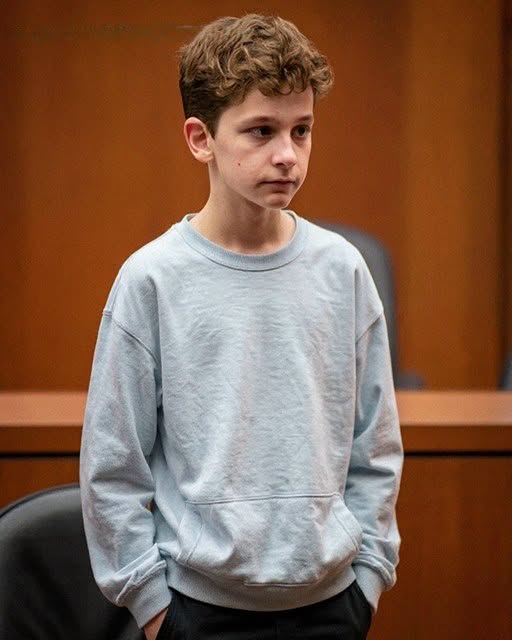
Several months later, we went to court.
The morning of the hearing, Jonah was unusually quiet.
He kept folding and unfolding a napkin at breakfast.
“You’re nervous,” I said.
He nodded.
“It’s okay.”
He looked at me.
“You’re not being sent anywhere,” I told him. “Today is just about making official what we’ve already known for years.”
He gave me a small smile.
When we entered the courtroom, Judge Holloway greeted us warmly.
She reviewed the paperwork, spoke with the attorneys, and asked Jonah a few simple questions.
Then she leaned forward slightly.
“Jonah, I understand that speaking in court may not be comfortable for you.”
Jonah nodded.
“You can answer however you wish. You can write something down, nod, shake your head, or simply take your time.”
Another nod.
The judge smiled.
Then she asked the question that changed the entire room.
“Jonah, do you want Mira to become your legal mother?”
The courtroom became completely silent.
I looked at Jonah.
He looked at me.
For several seconds, he didn’t move.
Then he reached into his pocket and pulled out a folded piece of paper.
My heart began pounding.
He unfolded it.
There were only a few words.
The judge asked, “Would you like to read that yourself, or would you like me to?”
Jonah looked at me.
Then, for the first time in that courtroom, he spoke clearly.
“I can read it.”
My breath caught.
His voice was quiet, but steady.
“I don’t need a new mother,” he said.
He paused.
“She’s already my mom.”
I covered my mouth.
Jonah continued.
“I just want everyone else to know it too.”
Judge Holloway looked down for a moment.
When she looked back up, her eyes were shining.
“I think,” she said gently, “that everyone understands.”
The hearing continued, but I barely remember the rest.
What I remember is Jonah reaching for my hand.
What I remember is the way his fingers tightened around mine.
And what I remember most is realizing that the child who once entered my home without saying a single word had just spoken the most important sentence I had ever heard.
Years earlier, I had worried that I wouldn’t know how to help him.
I had wondered whether I would be enough.
But Jonah taught me something I should have understood from the beginning.
Love isn’t always loud.
Sometimes love is a glass of water left beside your bed when you’re sick.
Sometimes it’s a folded note on the kitchen counter.
Sometimes it’s a child sitting quietly in the same room because being near you feels safe.
And sometimes, after years of silence, love is only a few simple words spoken at exactly the right moment.
That day in court, I didn’t feel like I had rescued Jonah.
I felt like we had found each other.
And when the judge finally signed the papers, Jonah leaned toward me and whispered:
“Can we get ice cream?”
I laughed through my tears.
“Absolutely.”
He smiled.
Then he took my hand, and together we walked out of the courtroom—not as foster parent and child, but as mother and son.