Have you ever looked closely at your fingernails and noticed lines, ridges, grooves, or unusual changes in their appearance?
If so, you may have wondered whether those marks are simply a normal part of growing older or whether they could be connected to something happening inside your body.
The good news is that nail changes are often harmless. Fingernails naturally change over time, and small ridges or lines can appear for many ordinary reasons. However, certain changes can sometimes be associated with an injury, nutritional concerns, medications, skin conditions, or other health issues.
That doesn’t mean you should immediately assume the worst.
Your nails can provide useful clues, but they aren’t a reliable way to diagnose a medical condition on their own. A single line or ridge usually doesn’t tell the whole story. Doctors consider other symptoms, your medical history, medications, recent illnesses, and the overall appearance of the nails before determining whether further evaluation is necessary.
What Kind of Lines Are You Seeing?
One of the most important things to notice is the direction of the line.
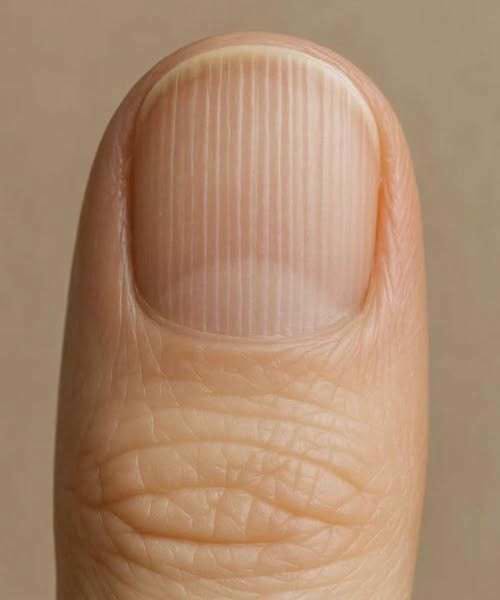
Some people develop vertical ridges, which run from the base of the nail toward the tip. These are extremely common and can become more noticeable with age. In many cases, they are simply part of normal nail development.
Other lines run horizontally across the nail. These can look quite different and may sometimes appear after the nail’s growth has temporarily been interrupted.
For example, if your body goes through a significant period of stress, illness, injury, or another major event, nail growth can temporarily slow down. As the nail continues growing afterward, a visible groove may remain.
This is one reason your nails can sometimes seem to contain a small record of the past.
But again, seeing a horizontal line doesn’t automatically mean that something is seriously wrong.
There are many possible explanations.
Why Do Nail Ridges Appear?
Nails are constantly growing, although the process is slow enough that changes aren’t always immediately noticeable.
Everyday factors can influence their appearance. Repeated exposure to water, cleaning products, nail polish removers, manicures, or minor injuries can affect the nail surface.
Dry skin and naturally changing nail texture can also make ridges more visible.
Some people simply have more prominent nail ridges than others.
If the ridges have always been present and haven’t changed significantly, they may not be a reason for concern.
However, if a noticeable change suddenly appears, especially across several nails, it can be worthwhile to discuss it with a healthcare professional.
Your Nails Don’t Tell the Whole Story
Social media posts often suggest that a particular nail mark means one specific disease.
Real life is much more complicated.
The same visible nail change can have several possible explanations, ranging from something completely harmless to a condition that deserves medical attention.
That’s why it isn’t a good idea to diagnose yourself based on a photograph or a short online post.
For example, changes in nail color, thickness, texture, or shape can occur for many different reasons. Some are related to normal aging, while others may involve the skin around the nails, an injury, infection, nutritional issues, or an underlying medical condition.
The surrounding skin matters too.
A healthcare professional will usually look at the entire nail rather than focusing on one line.
When Should You Pay More Attention?
A nail change deserves more attention when it is new, persistent, worsening, or accompanied by other symptoms.
You may want to speak with a healthcare professional if you notice things such as a significant change in nail color, unexplained changes affecting multiple nails, persistent pain or swelling, repeated nail separation from the nail bed, unusual thickening, or a dark mark that doesn’t appear to be explained by an obvious injury.
This doesn’t mean that these changes necessarily indicate a serious problem.
It simply means they are worth having evaluated rather than trying to determine the cause yourself.
It’s particularly important to seek professional advice when a change continues to progress or doesn’t improve as the nail grows.
What About Dark Lines?
Dark streaks or bands on a nail can have several possible causes.
Sometimes they are related to harmless pigmentation, previous trauma, or other common factors. In other situations, a persistent or changing dark streak may require examination by a dermatologist or another qualified healthcare professional.
Because some causes can look similar at first glance, it is better not to assume that every dark line is harmless—or that every dark line represents something dangerous.
If you notice a new or changing dark streak, especially if you don’t remember injuring the nail, professional evaluation is the safest approach.
Could Nutrition Affect Your Nails?
Nutrition can influence the health and appearance of hair, skin, and nails.
Your body needs a variety of nutrients to support normal tissue growth. If someone has a significant nutritional deficiency, changes may sometimes occur in the nails.
However, nail changes alone aren’t enough to determine that you have a deficiency.
Taking large amounts of supplements without professional advice isn’t necessarily helpful either. Some nutrients can be harmful in excessive amounts, and supplements may interact with medications or other health conditions.
If you are concerned about your nutrition, a doctor or registered dietitian can help determine whether dietary changes or testing are appropriate.
Can Stress Affect Nail Growth?
Major physical or emotional stress can affect the body in many ways, and nail growth can sometimes reflect periods when the body experienced significant strain.
Because fingernails grow slowly, a visible change may appear weeks or months after the event that influenced nail growth.
That can make the timing confusing.
Someone might notice a groove today and assume it was caused by something that happened recently, when the underlying interruption in nail growth may have occurred much earlier.
This is another reason why looking at the entire health picture is more useful than trying to interpret one mark in isolation.
Simple Ways to Care for Your Nails
Regardless of why your nails have developed lines or ridges, basic nail care can help keep them healthy.
Keep your nails clean and reasonably short. Avoid repeatedly biting or picking at them. If your hands are frequently exposed to water or cleaning products, consider using protective gloves.
Moisturizing the hands and the skin around the nails can also help prevent excessive dryness.
If you regularly use artificial nails, gels, or other nail treatments, give your nails appropriate breaks if they become brittle or irritated.
And remember that aggressively buffing away ridges isn’t always the best solution. The goal is to protect the nail rather than repeatedly thinning its surface.
Don’t Let an Online Post Frighten You
One of the biggest problems with health information online is that a simple symptom can be presented as though it has only one explanation.
A headline might say that a particular nail line is a warning sign of a specific disease.
That can understandably make people anxious.
But medicine rarely works that way.
A visible change can have multiple causes, and context matters enormously.
If you notice something unusual on your nails, take a photograph so you can compare it over time. Pay attention to whether the change affects one nail or several, whether it is growing out with the nail, and whether you have any other symptoms.
Then, if the change concerns you, bring it up with a healthcare professional.
The Bottom Line
Lines or ridges on your nails don’t automatically mean that you have a serious health problem.
Vertical ridges are common and often become more noticeable with age. Horizontal grooves can sometimes reflect a temporary interruption in nail growth, but they can have different causes as well.
The most important thing is to avoid jumping to conclusions based on a single visual change.
Instead, look at the bigger picture.
If a nail change is new, persistent, changing, painful, or accompanied by other unusual symptoms, consider having it checked by a qualified healthcare professional.
Your nails can sometimes provide clues about what’s happening in your body, but they aren’t a substitute for a proper medical evaluation.
So the next time you notice a line on your nail, don’t panic.
Take a closer look, keep track of any changes, and remember that an unusual appearance doesn’t automatically mean something is wrong.