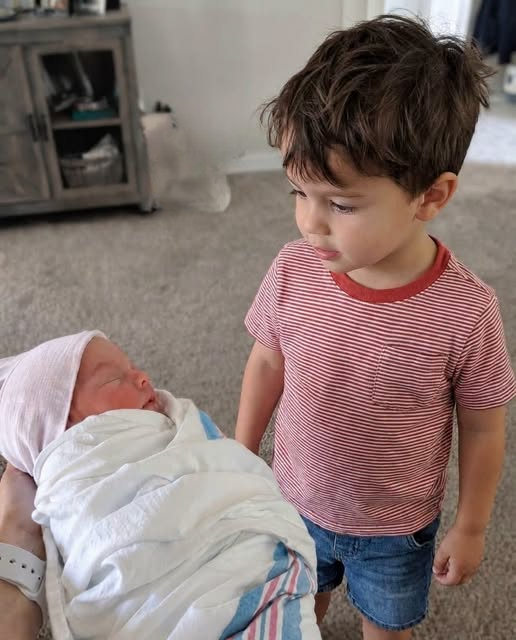
The night we brought our newborn daughter home, I expected my five-year-old son, Max, to be the happiest person in the house.
He had been waiting for his new role for months.
During my pregnancy, he helped us choose blankets, picked out a stuffed rabbit for the nursery, and proudly told everyone at kindergarten that he was going to become “the best big brother ever.”
He talked about the baby constantly.
Sometimes he would put his hand on my stomach and ask whether she could hear him.
Other times, he would tell her about the things they would do together once she was born.
At the hospital, he was fascinated by her.
He sat beside my bed and carefully held her tiny hand.
He noticed the small crescent-shaped birthmark behind her right ear.
Then he leaned toward her and whispered:
“I’m your big brother. I’ll protect you.”
It was one of those little moments I knew I would remember forever.
So when we finally brought our daughter home, I expected Max to run into the nursery.
Instead, he stopped in the doorway.
He didn’t smile.
He didn’t move.
He simply stared at the baby sleeping in the crib.
Then he slowly stepped backward.
“Mommy?”
I turned around.
“What’s wrong?”
He pointed toward the crib.
“You brought home the wrong baby.”
For a moment, I thought he was joking.
I smiled.
“No, sweetheart. That’s your sister.”
He shook his head.
“No.”
His expression was completely serious.
“That’s not her.”
I Thought He Was Jealous
My husband and I exchanged a quick glance.
We assumed we understood what was happening.
Max had spent five years being the center of our attention.
Now there was a newborn in the house.
The baby needed feeding, changing, soothing, and constant attention.
Perhaps Max was having difficulty adjusting.
We didn’t want to make him feel guilty for being confused.
So I knelt beside him.
“Are you feeling a little upset because the baby is getting lots of attention?”
He shook his head.
“No.”
“Are you angry?”
“No.”
“Then why do you think she’s not your sister?”
He didn’t answer.
Instead, he walked away.
I assumed the conversation was over.
I was wrong.
The First Few Days
During the following days, Max behaved differently around the baby.
He wasn’t mean to her.
He didn’t try to hurt her.
He simply kept his distance.
Whenever we asked whether he wanted to sit beside her, he usually said no.
When relatives asked him about his new sister, he changed the subject.
One afternoon, his grandmother asked him what the baby looked like.
Max answered:
“She looks like a baby.”
His grandmother laughed.
I didn’t.
Something about his behavior continued to bother me.
Children can have vivid imaginations.
They can become confused by changes.
They can say things they don’t fully understand.
But Max had never been particularly fearful or withdrawn.
Something was bothering him.
I just didn’t know what.
The Night Everything Changed
Three nights later, I woke up around two in the morning.
The house was quiet.
I checked on the baby first.
She was sleeping peacefully.
Then I noticed a small figure sitting on the floor outside the nursery.
It was Max.
He had his knees pulled toward his chest.
His face was wet with tears.
I immediately sat beside him.
“Max?”
He looked up.
I hugged him.
“What’s wrong?”
He pointed toward the nursery.
“That’s not my sister.”
This time, I didn’t tell him he was wrong.
Instead, I asked:
“Why do you think that?”
He squeezed my hand.
Then he whispered:
“Because I saw something at the hospital.”
My heart began beating faster.
“What did you see?”
He looked down the hallway.
“Daddy took me to get juice.”
I nodded.
“Okay.”
“When we came back, I saw two babies.”
I paused.
“Two babies?”
He nodded.
“They were both wearing white hats.”
A Child’s Memory
At first, I wasn’t sure what he meant.
Hospitals have many newborns.
Babies can look remarkably similar.
They can wear identical blankets and hats.
There may be several families with babies in the same maternity unit.
I asked Max to tell me exactly what he remembered.
He explained that he had been walking back from the cafeteria with his father.
They had stopped near the nursery area.
Through a window, he had seen several babies.
Then he saw a nurse move one baby from one bassinet to another.
He remembered seeing a small identification band.
He also remembered something else.
“The baby had a little mark.”
I immediately looked at him.
“What kind of mark?”
He pointed behind his ear.
“Like our baby.”
My stomach tightened.
That was the same birthmark I had noticed on our daughter.
Was Max Actually Confused?
I didn’t want to jump to conclusions.
There could be a perfectly ordinary explanation.
Hospitals have strict procedures for identifying newborns.
Babies are routinely moved between rooms for examinations, feeding, monitoring, and other routine care.
A five-year-old watching from a distance could easily misunderstand what he saw.
Still, I wanted to understand his memory.
I asked him one more question.
“What made you think the baby at the hospital wasn’t your sister?”
He thought for a moment.
“Her blanket.”
“What about it?”
“It was blue.”
I smiled gently.
“Your sister had a blue blanket at the hospital.”
He shook his head.
“No. Your baby had the pink blanket.”
That stopped me.
I remembered something I hadn’t thought about since leaving the hospital.
Our daughter had indeed been wrapped in a pink blanket when we first saw her.
But hospital blankets can be changed.
The color didn’t prove anything.
Still, I couldn’t ignore how strongly Max remembered the moment.
Calling the Hospital
The next morning, I contacted the hospital.
I explained that my son had become confused about something he believed he had witnessed.
I didn’t accuse anyone.
I didn’t suggest that anything had gone wrong.
I simply asked whether someone could explain the newborn identification procedures to me.
The staff member I spoke with was calm and professional.
She explained that newborn identification involves multiple checks.
Parents and babies are matched using identification bands and hospital records.
Staff members also follow procedures whenever babies are moved for examinations or other care.
The explanation immediately made me feel better.
There was no reason to assume anything unusual had happened.
Still, I wanted to understand exactly what Max might have seen.
An Ordinary Explanation
Later that day, a hospital representative explained that newborns can sometimes be temporarily moved to different areas.
A baby may be taken for routine observation.
Another may be brought back to the maternity room.
From a young child’s perspective, seeing several babies being moved around could easily look confusing.
The staff also confirmed that different babies can wear similar hats and blankets.
Suddenly, Max’s memory made much more sense.
He had probably seen another newborn being moved.
Then he saw our daughter later.
His five-year-old brain had connected the two moments.
But there was still one detail I couldn’t explain.
The Birthmark
Max had remembered the birthmark.
That surprised me.
He had only seen it once.
At the hospital, he had noticed it behind his sister’s ear.
When he later saw another baby from a distance, he may have believed that baby’s appearance was different.
Children often focus on small details that adults overlook.
Maybe he had seen another baby without the same mark.
Maybe that was what created the confusion.
I asked Max to explain.
“Did the other baby have the mark?”
He shook his head.
“No.”
“Could you see clearly?”
He hesitated.
“Not really.”
That answer told me everything I needed to know.
He had been standing several feet away.
He had seen the babies through a window.
He couldn’t possibly have identified every detail accurately.
Talking to Max
That evening, I sat with Max in the nursery.
I explained that hospitals sometimes have many babies.
I told him that nurses and doctors have special systems for making sure every baby stays with the correct family.
Then I asked him whether he still believed we had brought home the wrong baby.
He looked at his sister.
For a long time, he didn’t say anything.
Finally, he walked toward the crib.
He looked at her carefully.
Then he smiled.
“I think she’s my sister.”
I laughed softly.
“You think?”
He nodded.
“Yes.”
Then he touched the stuffed rabbit he had chosen for her.
“I think she likes it.”
The Big Brother He Wanted to Be
That was the first time Max willingly approached the crib.
He didn’t touch the baby immediately.
He simply stood there.
Then he asked:
“Can I show her the rabbit?”
I told him yes.
He carefully placed the stuffed rabbit beside the crib.
“This is for you.”
The baby moved her hands.
Max smiled.
“See? She likes it.”
It was a small moment.
But it felt like a turning point.
The fear and uncertainty that had been bothering him seemed to disappear.
Why Children Notice Different Things
The experience reminded me how differently children interpret the world.
Adults usually understand context.
A child sees individual moments.
Max saw his father take him away.
He saw several newborns.
He saw nurses moving babies.
He remembered a different blanket.
He remembered the birthmark.
Then he returned to our room and saw his sister.
His brain tried to connect everything.
To him, the simplest explanation was that something had changed.
He wasn’t trying to create a dramatic story.
He was trying to understand something he didn’t understand.
I Also Realized We Had Made a Mistake
My husband and I had assumed Max was simply jealous.
That wasn’t entirely fair.
We had decided what he was feeling before actually asking him.
Once we listened carefully, we discovered that his behavior came from confusion rather than resentment.
That was an important lesson for us.
When children say something unusual, it’s easy to dismiss them.
Sometimes they need reassurance.
Sometimes they need an explanation.
And sometimes they simply need an adult to listen.
Giving Him a Role
After that night, we began involving Max more in caring for his sister.
He helped choose her clothes.
He brought us diapers.
He picked out bedtime stories.
He liked sitting beside me while I fed her.
We made sure he knew that he was still important.
Having a newborn didn’t mean there was less room for him.
Our family had simply grown.
That seemed to make him much more comfortable.
His Favorite Question
A few weeks later, Max developed a new habit.
Whenever someone visited, he would proudly announce:
“I’m the big brother.”
Then he would tell them about the stuffed rabbit.
He would explain that his sister had a birthmark.
He would tell them that she slept a lot.
And occasionally, he would add:
“At first, I thought they brought home the wrong baby.”
Every adult who heard the story would look surprised.
Then Max would laugh.
“But I was wrong.”
What Happened at the Hospital
Eventually, we received a fuller explanation of what Max had probably seen.
A nurse had been moving newborns through the maternity area as part of normal hospital procedures.
Several babies had been wearing similar hats.
One had been wrapped in a blue blanket.
Our daughter had been moved around during her own routine care.
From Max’s viewpoint, the sequence looked mysterious.
But there had been no mix-up.
No missing child.
No secret.
No dramatic explanation.
Just a five-year-old trying to make sense of an unfamiliar environment.
The Importance of Reassurance
The situation also taught me something about parenting.
When children are confused, reassurance can be more useful than correction.
Instead of saying:
“That’s silly.”
We can say:
“Tell me what you saw.”
Instead of immediately dismissing them, we can ask questions.
Instead of assuming we know what they mean, we can listen.
That approach helped Max explain what had frightened him.
Once he understood what he had seen, the fear disappeared.
A New Family Routine
As the weeks passed, our home settled into a new routine.
The baby began sleeping for longer periods.
Max returned to his normal kindergarten schedule.
My husband and I became more confident parents of two children.
There were still difficult nights.
There were still moments when everyone was tired.
But the strange tension that had filled the nursery during those first days was gone.
One evening, I walked past the nursery and saw Max sitting beside his sister.
He was quietly reading her a picture book.
She was too young to understand the story.
Max didn’t care.
He was determined to read every page.
The Promise
When he finished, he leaned toward her.
“I told you I’d protect you.”
I smiled from the doorway.
He had made that promise at the hospital.
Now he was keeping it in the way a five-year-old could.
By being there.
By talking to her.
By bringing her toys.
By making her part of his world.
What I Learned
The experience changed the way I listened to my son.
I learned that a child’s unusual statement doesn’t necessarily mean something is wrong.
It can mean they are confused.
It can mean they noticed something adults didn’t.
It can mean they need reassurance.
Most importantly, it reminded me that children deserve to be heard even when their explanation doesn’t immediately make sense.
Max wasn’t trying to frighten us.
He wasn’t trying to reject his sister.
He was simply trying to understand something he had seen.
And once we helped him understand it, everything changed.
A Memory We Still Laugh About
Today, the story has become one of those family memories we occasionally tell.
Max is older now.
He understands exactly what happened.
Whenever someone mentions the day his sister came home, he remembers standing in the nursery doorway and insisting that we had brought home the wrong baby.
Then he laughs.
His sister, of course, has no memory of any of it.
But she still has the little stuffed rabbit Max picked out before she was born.
It’s slightly worn now.
The ears are no longer perfectly white.
But Max refuses to let us throw it away.
“It’s hers,” he says.
And perhaps that is the sweetest part of the entire story.
The little boy who was once afraid that his sister had somehow been replaced became the person most determined to make sure she always knew she belonged.
Final Thoughts
The first days after bringing home a new baby can be emotional for everyone.
Parents are adjusting to new routines.
Older children are learning how their family has changed.
And young children may not always have the words to explain what they’re feeling.
Max’s unusual statement initially frightened me.
But listening to him carefully revealed something much more ordinary.
He had seen a confusing scene at the hospital and interpreted it through the eyes of a five-year-old.
There was no mystery behind his sister’s identity.
There was simply a child who needed an explanation.
That experience reminded me of something every parent can benefit from remembering:
When a child says something that sounds strange, listen before you dismiss it.
Sometimes the answer isn’t hidden in a dramatic secret.
Sometimes it’s simply hidden inside the way a child sees the world.
And sometimes, after you listen carefully, you discover that what seemed frightening at first was actually just a misunderstanding waiting to be explained.