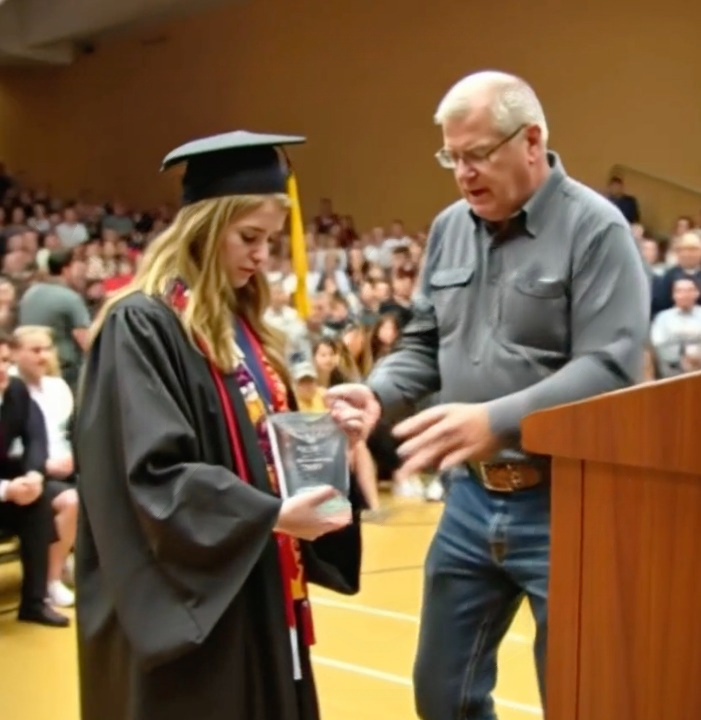
My Dad Ruined My Graduation Moment—But His Silence Told Me There Was More to the Story
When I heard my name announced over the microphone, everything I had worked for seemed to become real at once.
“Sophie Hart, valedictorian.”
For a moment, I couldn’t move.
I had imagined hearing those words for years, but imagining something and actually experiencing it are two completely different things.
The gymnasium was filled with students, families, teachers, and school staff. Sunlight came through the high windows, falling across rows of folding chairs. My classmates were dressed in graduation gowns, some smiling nervously, others already looking toward the celebrations waiting for them outside.
I walked toward the stage.
My hands were shaking slightly.
The tassel on my graduation cap brushed against my cheek as I climbed the steps. A medal hung around my neck, and somewhere behind me I could hear my classmates cheering.
For most people, graduation is a celebration of the past and the beginning of something new.
For me, it represented something more.
It represented early mornings.
Late-night essays.
Long bus rides.
Hours spent working at a local diner after school.
Studying when I was exhausted.
Saving money when my friends were buying things I couldn’t afford.
There had been plenty of evenings when I wondered whether all the effort would eventually matter.
Standing on that stage, I finally knew it had.
I had graduated at the top of my class.
I had earned my place there.
And for a few seconds, I felt completely happy.
Then my father walked through the doors.
The Moment Everything Changed
I noticed him before most people did.
He stood near the back entrance of the gym.
His work boots were dusty, and he was still wearing the clothes he had probably worn that morning. He looked uncomfortable in the crowded room, as though he wasn’t sure whether he belonged at a school ceremony.
Our eyes met.
I smiled.
He didn’t.
Then he looked at the trophy I was holding.
I remember thinking that maybe he was simply overwhelmed.
Maybe he was proud but didn’t know how to show it.
My father had never been particularly expressive.
He wasn’t the kind of person who gave long speeches about feelings.
He believed that providing for the family was how you demonstrated love.
Words had never come easily to him.
I should have remembered that.
Instead, I watched as he walked toward the stage.
He reached me.
For one second, neither of us spoke.
Then he took the trophy from my hands.
The next moment happened so quickly that I barely understood it.
He dropped it onto the floor.
The sound echoed through the gym.
Several people gasped.
I stared at the broken pieces.
My father looked at me and said something that I would remember for a long time.
“Success isn’t worth much if it costs you everything.”
Then he turned around and walked away.
The room became silent.
Not the comfortable silence of an audience waiting for the next name.
It was the uncomfortable silence of hundreds of people who had just witnessed something they didn’t know how to interpret.
I stood there.
My face felt hot.
I could hear someone whisper my name.
One of my teachers stepped toward me, but I shook my head.
I wasn’t going to leave.
Not then.
Not after everything it had taken to get there.
I picked up the microphone.
And I gave my speech.
Finishing What I Started
My graduation speech wasn’t what I had originally planned.
I had prepared several jokes.
I had written down stories about our teachers.
I had planned to talk about friendship, uncertainty, and the future.
But standing there after what had just happened, those carefully prepared words suddenly felt different.
I took a breath.
“Graduation isn’t about having everything figured out,” I said.
The room became quiet.
“It’s about recognizing how far we’ve come.”
I looked toward my classmates.
I thanked our teachers.
I thanked the people who had supported us.
I made one of the jokes I had prepared, and the audience laughed.
It wasn’t a huge laugh.
It wasn’t the kind of reaction I might have received under different circumstances.
But it was enough.
Then I continued.
I talked about how many students had overcome challenges nobody else could see.
I talked about how success isn’t always measured by awards.
And I talked about how the people sitting around us had helped shape the people we were becoming.
When I finished, the applause lasted longer than I expected.
I stepped away from the microphone.
My hands were still trembling.
But I had done it.
Whatever happened next, nobody could take that moment away from me.
I Didn’t Go to the Celebration
After the ceremony, several classmates invited me to join them.
Normally, I would have gone.
I had spent years looking forward to this day.
But I wasn’t ready to celebrate.
I thanked everyone and told them I needed some time.
Instead of going to the restaurant where my friends were meeting, I walked home.
The evening sky was beautiful.
The sunset had turned the clouds soft shades of orange and pink.
It seemed almost unfair that the world could look so peaceful when I felt anything but peaceful.
I kept thinking about my father.
Why had he come?
Why had he behaved that way?
And why had he said something that sounded almost like criticism but also somehow like concern?
I didn’t have answers.
When I reached home, the house was quiet.
My father was sitting at the kitchen table.
His work boots were still on.
His hands were folded in front of him.
He was staring at the table.
He didn’t look up immediately.
I stood near the doorway.
“You came,” I said.
He nodded.
“Your mother would have wanted me to.”
That sentence changed the atmosphere immediately.
We hadn’t talked about my mother much in recent months.
Her absence was one of those subjects that seemed to exist in every room without anyone saying her name.
I sat across from him.
Neither of us spoke.
The Question About the Dress
Eventually, my father looked at me.
“How much did the graduation dress cost?”
I almost laughed.
Not because it was funny.
Because after everything that had happened, that was the question he chose to ask.
“It was borrowed,” I said.
He nodded.
“Figures.”
I looked at him.
“What does that mean?”
“Nothing.”
But it didn’t sound like nothing.
I waited.
He looked toward the window.
Then back at the table.
I finally asked the question I had been carrying home with me.
“Why did you do that?”
He didn’t answer.
“In front of everyone?” I continued. “Why would you do something like that?”
He rubbed his hands together.
His expression changed.
For the first time since I had come home, he looked less like an angry father and more like a tired man who didn’t know how to explain himself.
“I shouldn’t have done it,” he said.
I wasn’t expecting that.
“You know that?”
“Yes.”
“Then why?”
He was silent again.
My Father’s Silence Had a History
My father had always been a quiet person.
When I was little, I thought he simply didn’t like talking.
As I grew older, I began to understand that silence was how he handled difficult emotions.
When my mother became sick, he didn’t talk much.
When she died, he didn’t talk much.
When bills became difficult, he worked longer hours.
When I came home upset from school, he would make food instead of asking questions.
When I received good grades, he would nod and say, “Keep going.”
I used to think he didn’t care.
Eventually, I realized that he cared deeply but didn’t always know how to express it.
That didn’t excuse what had happened at graduation.
But it gave me some context.
I looked at him.
“You could have just told me you were proud.”
He lowered his eyes.
“I know.”
“You could have said congratulations.”
“I know.”
“You could have let me have one day.”
He nodded.
“I know.”
Those two words were becoming harder to hear.
Not because they were cruel.
Because they sounded like regret.
What He Finally Told Me
My father leaned back in the chair.
“When your mother got sick,” he said, “she told me something.”
I waited.
“She said you were going to go farther than either of us.”
I looked down.
“She told me that you shouldn’t spend your whole life worrying about what things cost.”
I smiled faintly.
“That sounds like Mom.”
He nodded.
“She wanted you to go to college. She wanted you to travel. She wanted you to have choices.”
He paused.
“And I promised her I’d make sure you had them.”
I didn’t know what to say.
My father had spent years working extra shifts.
He had repaired things himself instead of paying someone else.
He had driven an old truck long after most people would have replaced it.
I had always assumed he was simply being stubborn.
Now I began to wonder whether there had been another reason.
The Part of the Story I Didn’t Know
My father went to a drawer in the kitchen.
He took out an envelope.
It was old.
The edges were worn.
He placed it on the table.
Inside were several documents.
One was a letter from the university I had been hoping to attend.
Another was a financial statement.
I looked at him.
“What is this?”
“Your tuition.”
I stared at the papers.
“I don’t understand.”
“I’ve been saving.”
“For how long?”
He didn’t answer immediately.
“Years.”
I felt tears forming in my eyes.
“But I thought you couldn’t afford it.”
“I couldn’t afford to pay everything.”
He paused.
“So I started early.”
I looked at the numbers.
It wasn’t enough to cover everything.
But it was enough to make a meaningful difference.
My father had been quietly saving money while I worked at the diner and applied for scholarships.
He hadn’t told me.
He hadn’t wanted me to stop working hard.
Or perhaps he simply didn’t know how to talk about it.
The Trophy Wasn’t Really About the Trophy
I finally understood something.
My father hadn’t broken the trophy because he thought I was worthless.
He had reacted badly because the trophy represented something complicated in his mind.
To him, success wasn’t an object.
It wasn’t an award.
It wasn’t a title.
It wasn’t being called valedictorian.
He had spent years watching my mother put family ahead of herself.
He was afraid I might do the same.
He was afraid that I would become so focused on achieving things that I would forget to live.
But his way of expressing that concern had been completely wrong.
He had embarrassed me.
He had taken away part of a day I could never repeat.
And he had hurt me in front of the people who mattered to me.
His intention did not erase the impact.
That was something we both needed to understand.
We Had a Difficult Conversation
“I understand what you’re trying to say,” I told him.
He looked at me.
“But you hurt me.”
He nodded.
“I know.”
“You can’t make decisions for me because you’re afraid I’ll make the wrong ones.”
Another nod.
“And you can’t embarrass me because you don’t know how to tell me you’re worried.”
He looked down.
“I know.”
I took a breath.
“I need you to talk to me.”
He was quiet.
Then he said something I hadn’t expected.
“I don’t know how.”
It was perhaps the most honest thing he had ever told me.
My father had spent his life believing that being strong meant solving problems.
He could repair a broken appliance.
He could work another shift.
He could pay a bill.
He could build a fence.
But he couldn’t always explain what was happening inside his head.
That was something we would have to learn together.
The Next Morning
The next morning, I found the broken pieces of the trophy on the kitchen counter.
My father had gathered them from the gym