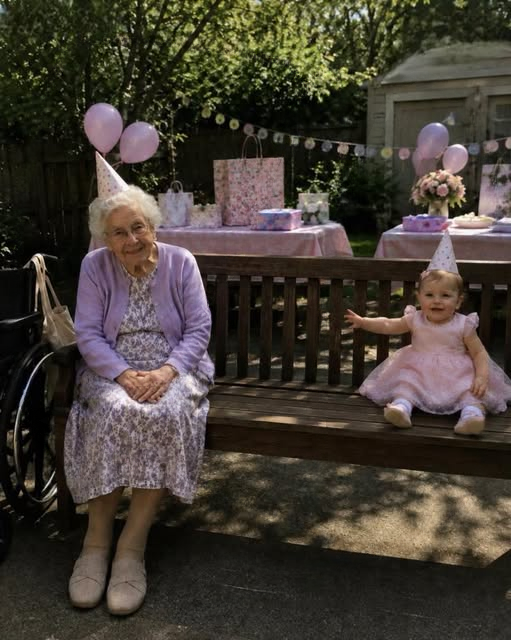
Everyone told me my 101-year-old grandmother wouldn’t make it to my daughter’s first birthday.
She couldn’t walk anymore, and even a short car ride left her exhausted. Her doctor had warned us that she needed to rest more.
But Grandma refused to miss Lily’s birthday.
When she finally arrived, she was sitting in her wheelchair with a small canvas bag hanging from the handle.
I assumed it contained a birthday gift.
I had no idea it contained a piece of our family’s history.
“Not yet,” Grandma whispered when I reached for the bag.
I smiled. “Grandma, everyone is here.”
She shook her head.
“Your mother isn’t.”
I turned toward the house.
Mom was still helping with the cake.
My uncle went inside to get her.
For some reason, my heart started beating faster.
Grandma sat beneath the apple tree while Lily played nearby. My husband, Mark, stood beside her with one hand behind Lily’s back because Grandma no longer had the strength to hold her securely.
Grandma didn’t seem to mind.
She stared at Lily with an expression I had never seen before.
“She has your ears,” she said.
I laughed.
“That isn’t exactly a compliment.”
“They’re good ears.”
“They stick out.”
“So did yours.”
“Exactly.”
Grandma smiled and touched Lily’s cheek.
“Worth waiting for.”
Those three words nearly made me cry.
Mom finally came outside carrying the cake knife.
“What are we waiting for?”
Grandma pointed toward the bag.
“Sit down.”
Mom frowned.
“Why?”
“Because I’m 101 and you’re still stubborn.”
My uncle laughed.
Mom sat beside us.
I opened the bag carefully.
Inside was a dark wooden box with a brass clasp.
I recognized it immediately.
“Grandma’s sewing box.”
I’d seen it countless times growing up.
It had always sat beside Grandma’s chair, filled with buttons, thread, needles, scraps of fabric, and mysterious little treasures I was never allowed to touch.
Grandma nodded.
“For Lily.”
I opened the box.
The first thing I saw was a tiny white dress embroidered with yellow flowers.
My breath caught.
I knew that dress.
It was the one I had worn in a photograph Grandma kept beside her chair for decades.
“Grandma…”
“You wore it when you were four.”
“You kept it?”
“Of course.”
Mom reached inside.
Then she froze.
“My dress.”
She pulled out a pale blue child’s dress with tiny covered buttons.
I stared at her.
“You wore that when you were two,” Grandma said.
Mom pressed the dress against her chest and began to cry.
Then Grandma said, “Keep going.”
Beneath the two old dresses was another.
This one was cream-colored linen with tiny green leaves stitched along the hem.
But it wasn’t finished.
One sleeve was missing.
Several pins still held the collar together.
I looked at Grandma.
“You made this?”
“Started it.”
“When?”
She looked away.
“Years ago.”
Mom stared at her.
“How many years?”
Grandma ignored the question.
“Look in the pocket.”
I searched the dress and found a tiny envelope.
My name was written on it in Grandma’s shaky handwriting.
I opened it.
The first line said:
“For the baby I hope I live long enough to meet.”
I couldn’t read any further.
Tears filled my eyes.
Grandma looked at me.
“Read it.”
So I did.
“My darling girl,
You once told me you were afraid you might never become a mother.
I didn’t know how to fix that.
So I did what I knew how to do.
I started a dress.”
I remembered that conversation.
I had been 34.
Another fertility treatment had failed, and I had gone to Grandma’s kitchen convinced that motherhood might never happen for me.
I had cried across the table.
“Maybe this just isn’t going to happen.”
Grandma had held my hand.
“Maybe. But today isn’t every day.”
Apparently, she went home that night and started sewing.
I continued reading.
“I did not make this dress because I knew you would have a baby.
I made it because hope needs somewhere to sit while it waits.
If no baby ever wore it, that would not make your life smaller.
You were never waiting to become enough.
But if a baby did come, I wanted her to have something made before she was even known.”
I had to stop.
Mark squeezed my hand.
Grandma waited patiently.
I read the next paragraph.
“I finished most of it when I was 94.
Then my hands became too weak.
So I left one sleeve unfinished.
If I am lucky enough to meet your daughter, perhaps you can finish what I started.”
I looked at the unfinished sleeve.
“Grandma, I’m terrible at sewing.”
She smiled.
“I know.”
Everyone laughed.
Then I read the final lines.
“Do not save these dresses so carefully that nobody gets to live in them.
Clothes are meant to wrinkle.
Children are meant to stain things.
Love is not improved by keeping it untouched.
And if I’m there when you open this, give me the baby.”
I lowered the letter.
Grandma held out her arms.
I carefully placed Lily in her lap.
She couldn’t hold her without Mark’s help, but the moment Lily settled against her, Grandma’s face lit up.
“Hello, little girl,” she whispered.
Lily grabbed Grandma’s necklace.
Grandma laughed.
“She has trouble in her eyes.”
“She gets that from me.”
“No,” Grandma said. “She gets it from all of us.”
I knelt beside her.
“You really came all this way just for this?”
“Obviously.”
“You could have stayed home.”
She gave me an offended look.
“I wasn’t going to miss her first birthday.”
I laughed through my tears.
At 101, Grandma still sounded like she was in charge of everyone.
Before she left, she pointed at the unfinished dress.
“Finish the sleeve.”
“I’ll try.”
“No.”
She squeezed my hand.
“Finish it.”
That was Grandma.
She never asked me to try when she believed I could finish.
She stayed for another hour, ate half a slice of cake despite claiming she wasn’t hungry, and let Lily fall asleep against her.
Then my uncle wheeled her toward the car.
Before the door closed, Grandma looked back at me.
“Worth waiting for.”
Those became some of the last words she ever said to me.
Six weeks later, I brought the dress to her house.
By then, my sewing attempts were embarrassing.
She examined the sleeve.
“This seam is terrible.”
“I know.”
“Take it out.”
“It took me two hours.”
“Then you’ll be faster the second time.”
I rolled my eyes.
She smiled.
I kept working.
I redid the sleeve twice.
The collar three times.
One night, I nearly threw the dress into the box and gave up.
Then I heard Grandma’s voice in my head.
Finish it.
So I did.
When Lily was 13 months old, we returned to Grandma’s house.
I put Lily in the cream dress.
The sleeve wasn’t perfect.
The stitching wasn’t nearly as neat as Grandma’s.
But it was finished.
We placed Lily on the same front step where my childhood photograph had been taken.
Mom stood beside Grandma.
Mark held the camera.
Lily immediately tried to crawl away.
“Of course,” I said.
Everyone laughed.
Then Lily looked up.
Click.
We had the picture.
Me at four in Grandma’s yellow-flowered dress.
Mom at two in pale blue.
Lily at one in cream and green.
Three generations.
Three dresses.
One woman who had stitched them together.
Grandma died four months later.
She was 101 years old.
She died peacefully, surrounded by family.
For a long time, I wished I had arrived earlier that morning.
I wanted one more conversation.
One more criticism.
One more ridiculous instruction.
But eventually, I understood something.
Grandma had already given me everything she needed to give me.
The sewing box.
The letter.
The dress.
The birthday.
The lesson.
She taught me that love isn’t something you preserve behind glass.
You use it.
You wear it.
You stain it.
You repair it.
And sometimes, you finish a sleeve for someone who began it decades before you were ready.
The sewing box now sits in my home.
The yellow dress has a tiny tear.
The cream dress has a strawberry stain.
Lily has already pulled several buttons loose.
I don’t throw anything away.
I repair what I can.
And when Lily is old enough, I’ll show her the photograph of her great-great-grandmother sitting beneath the apple tree at 101, holding her on her first birthday.
I’ll tell her that before she was born, Grandma started making her a dress without knowing whether she’d ever meet her.
And I’ll tell her the most important thing Grandma ever taught me:
Hope doesn’t promise that everything will work out.
Sometimes hope simply gives you a reason to keep stitching until the next piece holds.