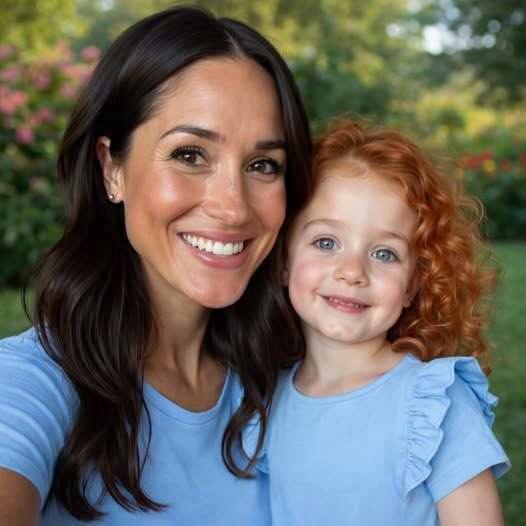
Stories about members of the British royal family often attract enormous attention, particularly when they involve children. Photographs, family milestones, and personal announcements can quickly become subjects of discussion across newspapers, social media platforms, and entertainment websites.
A recent style of online headline claims that Meghan Markle publicly revealed a new photograph of her daughter, Princess Lilibet, and then made a surprising statement about the child’s appearance and biological parentage. However, claims about a child’s parentage are highly sensitive and should not be presented as established fact without reliable evidence.
A more responsible approach is to focus on the family’s public life, the interest surrounding Lilibet, and the broader question of how royal children are represented in the media.
Why Photographs of Royal Children Attract So Much Attention
Members of the British royal family have lived under intense public scrutiny for generations.
Whenever a new family photograph appears, audiences around the world may immediately begin discussing it. The interest becomes even stronger when the photograph involves a child who has largely grown up away from the public spotlight.
Lilibet Diana Mountbatten-Windsor is the daughter of Prince Harry and Meghan Markle. Because her parents have made decisions about how much of their family life to share publicly, photographs of her can generate significant interest.
That attention is understandable, but it also raises important questions about privacy.
Children do not choose to become public figures simply because their parents are famous.
The Importance of Separating Facts From Online Speculation
Celebrity stories can spread extremely quickly online.
A headline may begin with a real photograph or genuine announcement and then add speculation designed to attract clicks.
The result can be a story that sounds dramatic but contains claims that have not been independently established.
This is especially important when the subject involves family relationships or biological parentage.
Claims about who a child’s biological parent is should never be treated casually.
Without reliable evidence, such statements remain speculation.
A responsible article should clearly distinguish between confirmed information, commentary, and rumors.
Lilibet’s Public Profile
Lilibet was born in June 2021 in California.
She is the second child of Prince Harry and Meghan Markle, following the birth of their son, Prince Archie.
Because the family has generally maintained a relatively private approach to their children’s lives, public photographs of the children can receive considerable attention.
That doesn’t necessarily mean every photograph or online claim deserves the same level of credibility.
A picture can be authentic while the story attached to it is misleading.
This is a common problem with viral celebrity content.
Why Appearance-Based Speculation Can Be Misleading
People naturally notice physical characteristics when looking at family photographs.
Hair color, facial features, height, and other traits can appear similar between relatives.
However, physical appearance alone cannot establish biological parentage.
Genetic inheritance is complicated, and children can inherit characteristics from parents, grandparents, and more distant relatives.
Hair color can also change as children grow.
For these reasons, attempting to determine someone’s parentage simply by looking at a photograph is unreliable.
A photograph may be interesting, but it is not proof of a biological relationship.
The Family’s Relationship With the Media
Meghan Markle and Prince Harry have had a complicated relationship with the media.
Both have spoken publicly about the pressures associated with intense media attention, particularly during their years as working members of the royal family.
Their decision to step back from senior royal duties and establish a different life has continued to generate discussion.
Because of that history, nearly every significant family-related announcement can become the subject of extensive media coverage.
The situation is particularly sensitive when children are involved.
Privacy and Children in the Public Eye
Royal children occupy an unusual position.
They are connected to one of the world’s most recognizable families, yet they are still children who deserve an appropriate level of privacy.
This creates a difficult balance.
The public may be curious about their lives, while parents may want to protect ordinary childhood experiences from constant attention.
For parents of any background, deciding when and how to share photographs of their children is a personal decision.
That consideration is even more significant when millions of people are watching.
Why Viral Headlines Use Dramatic Language
Online publishers often compete for attention.
A headline that says a celebrity “stuns the world” or reveals a supposedly shocking secret is more likely to encourage curiosity than a straightforward headline.
This doesn’t automatically mean the underlying story is false.
However, sensational wording should encourage readers to investigate further rather than immediately accepting every claim.
Phrases involving secret identities, hidden parentage, shocking revelations, or dramatic family mysteries are particularly common in viral entertainment content.
Readers should be cautious when such claims are not supported by reputable sources.
A Better Way to Discuss Celebrity Families
There are plenty of interesting topics surrounding Meghan Markle, Prince Harry, and their children without relying on unverified claims.
Readers may be interested in:
- How the family has approached privacy
- The children’s place within the wider royal family
- Public appearances and official announcements
- The history of royal family photography
- How modern celebrities manage media attention
- The difference between verified news and online speculation
- The changing relationship between public figures and social media
These subjects provide meaningful context without making unsupported statements about a child’s personal background.
The Role of Social Media
Social media has transformed how celebrity news spreads.
In the past, photographs typically passed through newspapers, magazines, television networks, and professional photographers.
Today, a single post can reach a global audience almost instantly.
That speed has benefits.
Fans can receive announcements directly from public figures.
Families can share important milestones in their own words.
Audiences can interact with celebrities without relying entirely on traditional media.
But social media also makes rumors easier to spread.
A claim can be reposted thousands of times before anyone checks whether it is accurate.
Why Readers Should Check the Source
When encountering a dramatic celebrity story, one of the simplest questions to ask is:
Where did this information come from?
Is there an original announcement?
Was the statement actually made by the person being quoted?
Has a reputable news organization independently reported the claim?
Is there reliable documentation supporting the story?
Or does the article simply repeat something that appeared somewhere else online?
These questions can help readers distinguish genuine news from speculation.
Respecting Personal Boundaries
Celebrity status doesn’t eliminate someone’s right to personal boundaries.
This is particularly important for children.
A public figure may choose to discuss aspects of their own life, but that does not mean every private detail about their family should become public discussion.
Respectful reporting can acknowledge public interest while avoiding unnecessary speculation.
That balance is increasingly important in the age of viral content.
A Photograph Doesn’t Tell an Entire Story
A single family photograph captures one moment.
It cannot explain a family’s complete history, relationships, or personal circumstances.
It is easy for viewers to look at an image and create their own interpretation.
But interpretation is not the same as fact.
This distinction is especially important when discussing sensitive subjects such as family relationships.
Rather than assuming that a physical resemblance proves something, it is better to recognize that appearances can be influenced by many aspects of genetics.
The Larger Story Is About Public Interest
The fascination surrounding Lilibet reflects something broader than one photograph.
It demonstrates the continuing global interest in the British royal family and the way modern audiences consume celebrity news.
People are interested in royal traditions, family milestones, fashion, public appearances, and personal stories.
At the same time, modern audiences increasingly expect transparency and responsible reporting.
That means entertainment publishers have an opportunity to create engaging stories without relying on unsupported claims.
Final Thoughts
Stories about Meghan Markle, Prince Harry, and their children will likely continue to attract worldwide attention.
A photograph of Lilibet may generate excitement among royal followers, particularly because her parents have generally limited how much of their children’s lives they share publicly.
However, claims about biological parentage should not be presented as fact without credible evidence.
A child’s appearance cannot establish biological parentage, and dramatic online claims should always be checked against reliable sources before being accepted or repeated.
There is plenty of genuine interest in the family’s story without turning speculation into fact. Their approach to privacy, their relationship with the media, and the way modern royal families navigate public attention are all compelling subjects in their own right.
Ultimately, the most responsible way to cover stories involving children is to keep the focus on verified information while respecting their privacy.