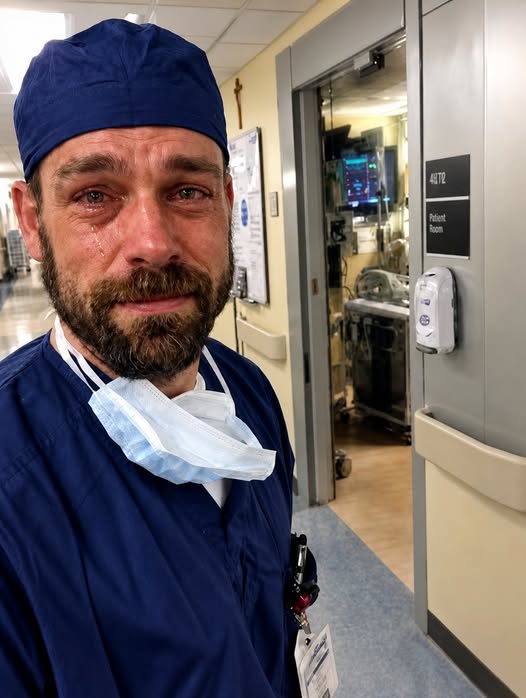
I Went to Surprise My Husband at the Hospital—Then His Colleague Asked If He Had Told Me the Truth
I went to the hospital that Tuesday afternoon carrying my husband’s favorite lunch, a slice of homemade apple pie, and a small handwritten note.
I thought I was going to make his day a little easier.
Instead, I walked into a conversation that changed the way I understood the past year of our marriage.
My husband, Ben, had always been a dedicated surgeon.
For eleven years, I had known that his work would sometimes come first.
There would be emergencies.
There would be long operations.
There would be difficult cases that required him to stay late.
I understood all of that.
What I didn’t understand was why the distance between us had grown so quietly that I hadn’t realized how serious it had become.
Then I walked into the hospital and saw his colleague, Arnold.
He looked at me for several seconds without saying anything.
His eyes filled with tears.
Then he asked a question that made my stomach drop.
“Ben hasn’t told you anything, has he?”
I stared at him.
“Tell me what?”
Arnold looked toward the hallway.
Then he took a breath.
“Maybe we should sit down.”
The Year Everything Changed
Ben and I had been married for eleven years.
We had met when I was twenty-nine and he was already working toward becoming a surgeon. Even then, his schedule was demanding.
Our first few years together were filled with long shifts, study sessions, examinations, and the constant uncertainty that came with medical training.
I knew what I was signing up for.
At least, I thought I did.
But there is a difference between understanding something intellectually and experiencing it inside a marriage.
There were birthdays when Ben arrived late.
There were dinners that became cold before he could eat them.
There were weekends when we had planned to spend time together but a call from the hospital changed everything.
Still, I never resented him for helping people.
I was proud of him.
When someone asked what my husband did, I always smiled before answering.
“He’s a surgeon.”
And I meant it when I said that I was proud.
But during the previous year, something had changed.
It wasn’t just that Ben was working more.
He seemed different.
Quieter.
More distracted.
Sometimes he would sit at the kitchen table after dinner without touching his coffee.
I’d ask him what was wrong.
He would shake his head.
“Just tired.”
I believed him.
At least at first.
The Missed Moments
The first major warning sign should probably have been Thanksgiving.
Our daughter, Lily, had been looking forward to the holiday for weeks.
She was eight years old and still loved everything about family traditions.
She helped me decorate the table.
She made a paper turkey and placed it beside Ben’s chair.
She kept asking what time Daddy would be home.
“He’ll be here as soon as he can,” I told her.
But he wasn’t.
An emergency had come up at the hospital.
I understood.
Lily tried to understand too.
She ate dinner quietly and eventually fell asleep on the couch.
Ben came home after midnight.
He stood in the doorway of her room for several minutes watching her sleep.
The next morning, he apologized.
I told him it was okay.
And I believed that it was.
Then our anniversary came.
Ben missed that too.
There was another emergency.
Then another.
Then our daughter’s eighth birthday.
That one hurt more than I expected.
He had promised Lily he would be there.
He had even bought her a present.
But when the day came, he wasn’t able to leave the hospital.
Lily kept looking at the front window.
At one point she asked me, “Does Daddy forget things because he’s a doctor?”
I forced a smile.
“No, sweetheart. Daddy just has a very demanding job.”
She nodded.
But children notice more than adults sometimes realize.
The Nights He Didn’t Come Home
Eventually, there were nights when Ben didn’t come home at all.
He would send me a short message.
“We’re short-staffed.”
Or:
“Don’t wait up.”
Or:
“Sorry. It’s been a long night.”
I started preparing his dinner before I sat down to eat my own.
I’d put a plate in the refrigerator.
Sometimes I’d leave a note.
Sometimes I wouldn’t.
I became accustomed to sleeping on one side of the bed.
I became accustomed to hearing the front door open at two or three in the morning.
I became accustomed to waking up just enough to hear Ben take a shower before climbing quietly into bed.
And because I knew how difficult his profession could be, I didn’t complain.
I told myself this was simply a difficult season.
A busy year.
Something that would eventually pass.
Then one night, I woke up and saw Ben sitting on the edge of our bed.
The room was dark.
His shoulders were shaking.
“Ben?”
He quickly wiped his face.
He turned toward me.
“Go back to sleep.”
I sat up.
“Are you crying?”
“No.”
“Ben.”
He looked at me for a moment.
Then he gave me a tired smile.
“Just a rough night.”
I wanted to ask more.
Instead, I reached for his hand.
He held it tightly.
Then he whispered:
“I love you.”
I told him I loved him too.
I thought that was the end of the conversation.
I was wrong.
The Lunch
A few weeks later, I decided to surprise him.
There was no special reason.
I simply missed my husband.
I made his favorite sandwich.
I packed some fruit.
I added a small container of pasta salad.
And because I knew he rarely had time to eat dessert, I baked an apple pie the night before.
Before leaving, I wrote a note and slipped it beneath the fork.
“You spend so much time taking care of everyone else. Let me take care of you for once.”
I smiled as I closed the lunch bag.
I imagined Ben opening it during a break and laughing.
Maybe he’d call me.
Maybe he’d tell me I was crazy for driving across town just to bring him lunch.
Maybe we’d have ten minutes together.
Ten minutes would have been enough.
I drove to the hospital feeling lighter than I had in weeks.
But the moment I entered the building, I sensed something was wrong.
The Strange Silence
The hospital was unusually quiet around the nurses’ station.
Not actually silent.
Hospitals are never silent.
There were phones ringing.
Footsteps in the hallway.
Machines beeping.
People talking.
But when the nurse at the desk saw me, her expression changed.
She had known me for years.
Normally she would smile.
This time, she didn’t.
“Hi,” I said.
She looked at the lunch bag in my hand.
“Is Ben here?”
She hesitated.
“Yes.”
“Where is he?”
Another nurse glanced at her.
I noticed.
“Is everything okay?”
Neither woman answered immediately.
My heart started beating faster.
“What happened?”
“It’s nothing,” the first nurse said.
But her voice didn’t sound convincing.
I stepped closer.
“Please. Where is my husband?”
Before she could answer, I saw Arnold coming down the hallway.
Arnold had worked with Ben for years.
We knew each other well enough that I had always considered him a friend.
When he saw me, he stopped.
His expression changed completely.
“Arnold!”
I smiled.
“I came to surprise Ben.”
He didn’t smile back.
He walked toward me slowly.
“Are you okay?” I asked.
He looked at the lunch bag.
Then at me.
Then toward the hallway behind him.
His eyes became glassy.
“Has Ben talked to you?”
“About what?”
Arnold swallowed.
He seemed to be searching for the right words.
Then he asked:
“He hasn’t told you anything, has he?”
The Question
I felt a cold sensation move through me.
“What hasn’t he told me?”
Arnold looked down.
I waited.
He finally said, “I think you should sit down.”
“I don’t want to sit down.”
My voice sounded sharper than I intended.
“Where is my husband?”
Arnold took a breath.
“He’s upstairs.”
“Is he hurt?”
“No.”
“Then what is this?”
Arnold closed his eyes for a moment.
When he opened them again, there were tears in them.
“Ben has been trying to protect you.”
I stared at him.
“From what?”
Arnold didn’t answer immediately.
Then he said something I wasn’t prepared to hear.
“Ben hasn’t been staying at the hospital because we’re short-staffed.”
The hallway seemed to tilt beneath my feet.
“What?”
Arnold continued carefully.
“There have been difficult cases, yes. But that isn’t why he’s been spending so much time here.”
I looked at the lunch bag in my hand.
Suddenly, the note underneath the fork felt ridiculous.
“What is happening?”
Arnold motioned toward a quiet waiting area.
“We should talk somewhere private.”
The Truth About Ben’s Long Hours
We sat across from each other.
Arnold explained that several months earlier, Ben had begun experiencing severe professional exhaustion.
Not because he no longer cared about medicine.
Quite the opposite.
He cared too much.
He had become increasingly affected by difficult cases, especially situations involving children and families.
One particular case had stayed with him.
He had performed everything expected of him.
The procedure had gone according to plan.
But the patient had developed complications afterward.
The medical team had done everything possible.
Still, the outcome was not what anyone wanted.
Ben had blamed himself.
Arnold told me that Ben had begun staying at the hospital after his shifts ended because he didn’t want to go home carrying the emotional weight of the day.
“He thought if he stayed busy, he wouldn’t have to think about it,” Arnold said.
I stared at him.
“So all those nights…”
“Some were legitimate emergencies,” Arnold explained. “But others were Ben avoiding going home because he didn’t know how to explain what he was feeling.”
I felt a mixture of relief and sadness.
I had spent months believing my husband was simply working.
He had been struggling.
And I hadn’t known.
Why He Kept It From Me
“Why didn’t he tell me?”
Arnold sighed.
“Because he’s Ben.”
I almost laughed.
It was such a simple answer.
But it was true.
Ben had always been the person who believed he needed to solve problems himself.
When our washing machine broke, he fixed it.
When our daughter had a fever, he stayed awake all night.
When I was worried about money, he reassured me.
When his mother needed help, he drove three hours to take care of her.
He was always the person other people leaned on.
Perhaps he didn’t know how to be the person who needed help.
Arnold continued.
“He was afraid that if he told you how overwhelmed he was, you’d think he couldn’t handle his job anymore.”
I shook my head.
“I would never think that.”
“I know.”
“Then why didn’t he trust me?”
Arnold looked at me kindly.
“I don’t think this was about trust.”
That sentence stayed with me.
Sometimes people hide their struggles not because they don’t trust the people who love them.
Sometimes they hide them because they are ashamed of needing help.
The Part That Hurt Most
I asked Arnold whether Ben was still working.
“He is,” he said. “But he’s been receiving support.”
“Professional support?”
“Yes.”
That made me feel better.
Then Arnold added:
“He’s also been working with the hospital on adjusting his schedule.”
I looked at him.
“How long has this been happening?”
“Several weeks.”
“Several weeks?”
He nodded.
I thought about all the evenings I’d spent waiting.
All the dinners I’d prepared.
All the mornings when I woke up alone.
I thought about our daughter’s birthday.
And I realized something.
I wasn’t angry because Ben had needed help.
I was hurt because he had believed he had to face it alone.
Finding Ben
Arnold finally took me upstairs.
I walked through the familiar hospital corridors.
Everything looked exactly as it always had.
But it didn’t feel the same.
We reached a quiet consultation room.
Ben was sitting inside.
When he saw me, his face changed.
For several seconds, neither of us spoke.
Then he stood.
“Why are you here?”
I held up the lunch bag.
“I came to surprise you.”
His eyes moved toward Arnold.
Arnold gave him a small nod.
Ben closed his eyes.
“You told her.”
“I thought she deserved to know,” Arnold said.
Then he left us alone.
The Conversation We Should Have Had Months Earlier
Ben sat down.
I sat across from him.
“You’ve been struggling.”
He nodded.
“Why didn’t you tell me?”
He looked at his hands.
“I didn’t know how.”
“You could have started with ‘I’m not okay.'”
His eyes filled with tears.
“I know.”
I reached across the table.
He took my hand.
“I thought I could handle it,” he said.
“I know.”
“I thought it would pass.”
“I know.”
“I didn’t want you to worry.”
I looked at him.
“Ben, I was already worried.”
He nodded.
“I know that now.”
For the first time in months, he looked at me without trying to hide how tired he was.
He told me about the cases that had stayed with him.
The decisions he replayed in his mind.
The conversations with families that followed difficult outcomes.
The pressure he felt to remain calm even when he was emotionally exhausted.
And the guilt.
So much guilt.
“I kept thinking that if I felt tired, maybe it meant I wasn’t strong enough to do this job.”
I squeezed his hand.
“Being tired doesn’t mean you’re weak.”
He looked at me.
“It doesn’t?”
“No.”
I smiled sadly.
“It means you’re human.”
What I Had Missed
As we talked, I realized that there had been signs everywhere.
I had simply interpreted them differently.
The nights he sat silently at the table.
The way he stopped talking about work.
The sudden difficulty sleeping.
The moments when he seemed far away even while sitting beside me.
The tears that night.
I had assumed he was simply exhausted.
In reality, he had been struggling emotionally.
And because he was a doctor, I had unconsciously expected him to know how to manage everything.
That wasn’t fair.
Being medically trained doesn’t make someone immune to stress.
It doesn’t eliminate grief.
It doesn’t prevent exhaustion.
And it certainly doesn’t mean someone automatically knows when they need support.
The Lunch He Never Expected
I opened the lunch bag.
Ben laughed softly when he saw the apple pie.
“You actually made this?”
“Yes.”
He shook his head.
“You drove all the way here?”
“Yes.”
“I don’t deserve you.”
I shook my head.
“Don’t say that.”
He looked at the note.
He read it silently.
Then he folded it carefully and put it in his pocket.
“I needed this,” he said.
“The pie?”
He smiled.
“The note.”
For the first time in a long time, we laughed together.
It wasn’t a dramatic moment.
There was no perfect speech.
No sudden solution.
Just two people sitting in a hospital room, finally having an honest conversation.
And somehow, that felt more important.
The Changes That Followed
The conversation didn’t magically solve everything.
That was one of the lessons I learned afterward.
Emotional exhaustion doesn’t disappear because someone finally talks about it.
Ben continued receiving professional support.
He worked with the hospital to create a more sustainable schedule.
He began taking his days off seriously.
He started leaving work when he was supposed to leave.
Sometimes that meant other people had to take over.
At first, Ben felt guilty.
Then he slowly learned that taking care of himself wasn’t the opposite of caring for patients.
It was part of being able to continue doing his job responsibly.
At home, we changed too.
We stopped pretending everything was fine when it wasn’t.
If Ben had a difficult day, he could tell me.
If I felt lonely or overwhelmed, I could tell him.
If our daughter missed him, she could say so without worrying about hurting his feelings.
We started eating dinner together whenever possible.
Not every night.