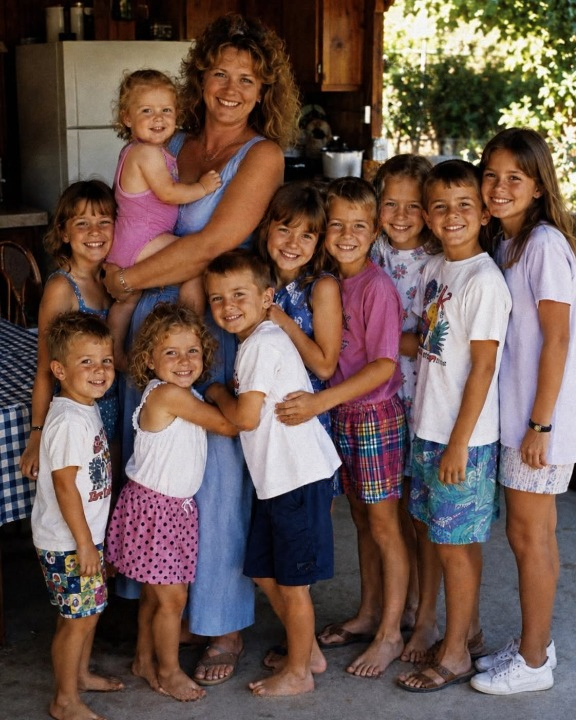
I thought I understood why my future fell apart one week before my wedding.
It took three decades to discover how much of the story I had never known.
I was 32 when I met Robert. He was five years older, kind, patient, and already carrying a life that should have frightened me.
He had ten children.
His wife had died two years earlier, leaving him to raise them alone.
I met him in a grocery store when a little girl reached from his cart and grabbed my hand.
“That’s Sophie,” Robert said apologetically. “She does that whenever someone smiles at her.”
“Then I suppose I’ll keep smiling,” I replied.
He laughed.
That was the beginning.
Within months, I had become part of their household. Amanda, the oldest, was fifteen. Derrick was quiet and good with his hands. Sue talked constantly. Jacob and David were inseparable twins. The younger children seemed to move as one noisy, energetic group.
And Sophie started calling me Mama.
I fell in love with Robert.
But more importantly, I fell in love with his children.
Six months later, Robert proposed over meatloaf and mashed potatoes.
“Will you marry us?” he asked.
I laughed through my tears.
“Yes.”
My mother thought I had lost my mind.
“Ten children, Margaret,” she warned. “You haven’t even had your own life yet.”
“They are my life.”
She shook her head.
But I was happy.
Until the week before the wedding.
Robert had been losing weight for months. He complained about headaches and exhaustion but always blamed his work.
One morning, I woke to an empty bed.
His truck was gone.
On the kitchen table sat a folded note.
My hands shook as I opened it.
“I’m sorry. I can’t do this anymore.”
That was all.
No explanation.
No goodbye.
No mention of the children.
I called his brother, his friends, his employer, and anyone else who might know where he had gone.
Nobody did.
Then Sophie wandered into the kitchen wearing pajamas and carrying her stuffed rabbit.
“Mama, can I have juice?”
I looked at her and realized my life had split in two.
My mother told me to let the authorities handle the children.
“They aren’t your responsibility.”
I looked upstairs at ten frightened children.
“They call me Mama.”
“Margaret, don’t throw your life away.”
But I couldn’t abandon them.
I went to the county office and signed the guardianship papers.
The first year nearly destroyed me.
I worked during the day at a fabric warehouse and sewed uniforms at night. The older children helped wherever they could.
Amanda learned to cook.
Derrick handled repairs.
Sue managed laundry.
The twins turned every chore into a competition.
The younger children filled the house with noise.
Some nights, after everyone was asleep, I sat alone at the kitchen table and wondered why Robert had left.
Maybe he had met someone else.
Maybe he had debts.
Maybe ten children had finally become too much.
Maybe I hadn’t been enough.
But I never walked away.
The years passed.
Amanda became a pediatric nurse.
Derrick opened an auto shop.
Sue became a teacher.
Jacob and David became engineers.
Sophie became a social worker because, she once told me, she wanted to help children the way I had helped her.
Eventually, there were grandchildren running through the same house.
Thirty years passed.
I never remarried.
I didn’t regret it.
Then, one Saturday afternoon, someone knocked on my door.
I opened it to find a man in a gray suit holding a leather folder.
“Margaret?”
“Yes?”
“My name is Mr. Johnson. I was Robert’s attorney.”
My heart stopped.
He held out a thick envelope.
Your name was written across it in handwriting I recognized immediately.
“Robert instructed me to deliver this to you today. Exactly thirty years after he left.”
I couldn’t speak.
He handed me the envelope and walked away.
Behind me, my ten grown children had gone silent.
“Mama?” Amanda whispered.
I carried the envelope to the table.
My hands trembled as I opened it.
Robert’s letter began with an apology.
He explained that he had been seriously ill before our wedding.
The headaches, weight loss, and exhaustion had not been stress.
They were cancer.
One week before our wedding, doctors told him he had only months, perhaps a year, to live.
There was an experimental treatment.
But there were no guarantees.
“I couldn’t bear to marry you,” he wrote, “only to make you a widow and leave you with ten grieving children and enormous medical bills.”
I stopped reading.
Sophie squeezed my hand.
Then I continued.
“The treatment worked.”
My breath caught.
Robert had survived.
But by the time doctors were confident the treatment had succeeded, nearly two years had passed.
He returned to our neighborhood.
He drove past the house three times.
Then he saw the children.
Amanda was carrying groceries.
Derrick was teaching the twins how to repair a bicycle.
Sophie was running across the yard toward me, calling me Mama.
Robert stayed in his truck.
“I understood what I had done,” he wrote. “You had given them stability. You had stayed.”
He feared returning would destroy everything.
There could be legal battles, confusion, resentment, and emotional chaos.
So he left again.
For thirty years, he stayed away.
But he never stopped watching from a distance.
He hired a retired investigator to make sure the children were safe.
He knew about their graduations.
Their careers.
Their marriages.
Their accomplishments.
He knew everything.
Then came the final revelation.
Robert had created a trust.
He had spent decades putting money into it for the family he had left behind.
“It isn’t a fortune,” he wrote. “And it isn’t an apology.”
Then came the sentence that broke me.
“You gave them the life I couldn’t.”
He asked me to forgive him if my heart ever allowed it.
The room was silent.
Sue wiped her eyes.
“He watched us grow up?”
I nodded.
Derrick stared at the letter.
“He loved us all this time?”
“Yes.”
For thirty years, I had carried one belief inside me:
I hadn’t been enough for Robert to stay.
Now I understood that wasn’t the truth.
He had left because he believed he was protecting us.
Maybe he had been wrong.
Maybe leaving had caused wounds he could never repair.
But his decision had not been because we were unworthy of love.
I looked around the table.
Ten children.
Ten lives.
Ten people I had somehow raised.
“I forgive him,” I whispered.
I was sixty-two years old.
I didn’t want to spend the rest of my life carrying anger.
Sophie leaned against my shoulder.
Derrick raised his teacup.
“To Robert.”
I lifted mine.
“To Robert.”
Then Amanda smiled through her tears.
“And to Mama.”
The others joined her.
“To Mama!”
I laughed and cried at the same time.
For thirty years, I had thought the empty chair Robert left behind represented everything I had lost.
But that afternoon, surrounded by the ten children he had entrusted to me, I finally understood something.
That empty chair wasn’t the end of our story.
It was simply where our story had begun.
And the family sitting around the table was the answer to everything that came after.