This morning started like any other.
I woke up, made a cup of coffee, and headed into the kitchen planning to prepare a simple breakfast. Nothing fancy—just a couple of fried eggs, some toast, and a quiet moment before starting the day.
Everything seemed completely normal.
At least until I cracked the first egg.
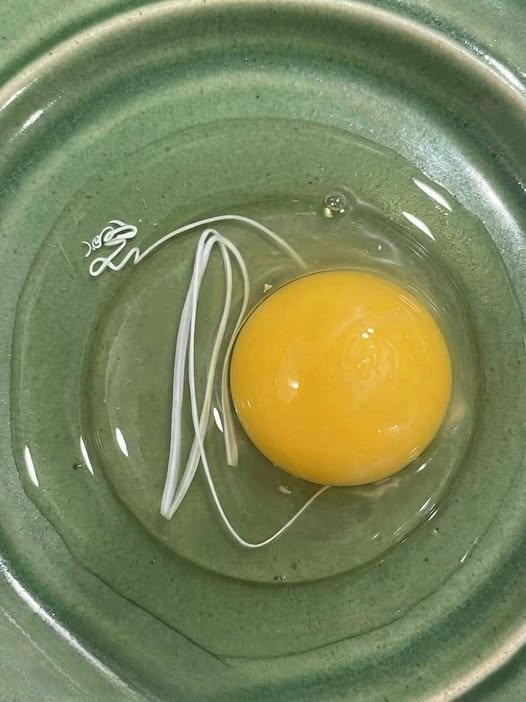
As the contents slid onto the plate, something unusual caught my attention immediately.
Attached to the yolk was a strange white ribbon-like strand.
It wasn’t something I remembered seeing before, and it definitely wasn’t what I expected to find in my breakfast.
I paused.
Then I stared at it.
For much longer than I care to admit.
My appetite disappeared almost instantly.
The more I looked at it, the more questions I had.
Was it normal?
Was the egg spoiled?
Was it safe to eat?
Had something gone wrong during production?
For nearly half an hour, I sat at my kitchen table examining this mysterious white strand and wondering whether I should throw everything away.
If you’ve ever experienced something similar, you’re certainly not alone.
Many people are surprised the first time they notice this unusual feature inside an egg.
The good news is that what appears alarming at first glance is usually completely natural.
The Mystery Inside an Egg
Eggs are one of the most common foods found in kitchens around the world.
Because we use them so often, many of us assume we know exactly what they should look like.
However, eggs are surprisingly complex structures.
Most people focus on the yolk and the egg white, but there are several other components inside every egg that often go unnoticed.
One of those components is a structure called the chalaza.
The chalaza appears as a white, rope-like or ribbon-like strand attached to the yolk.
Its purpose is incredibly important.
It helps keep the yolk centered inside the egg.
Think of it as a natural support system designed to hold the yolk in place and protect it during development.
Without it, the yolk would move around much more freely inside the shell.
Why It Looks So Strange
The reason many people become concerned when they spot a chalaza is simple.
Most of the time, we don’t notice it.
Sometimes it’s small and blends into the egg white.
Other times it’s more visible and stands out dramatically.
When it appears larger than usual, it can easily be mistaken for something abnormal.
The texture often resembles a thin ribbon, cord, or string.
To someone seeing it for the first time, it may look unusual enough to raise concerns.
However, its appearance is completely natural.
In fact, noticing a prominent chalaza can sometimes indicate that an egg is relatively fresh.
Fresh Eggs Often Show It More Clearly
One interesting fact that many people don’t know is that fresher eggs frequently have more visible chalazae.
As eggs age, internal structures gradually break down and become less noticeable.
In newer eggs, the chalaza tends to remain stronger and more defined.
That’s why farm-fresh eggs often display this feature more clearly than older store-bought eggs.
People who raise chickens or purchase eggs directly from local farms commonly notice these white strands more often.
For experienced egg users, seeing a chalaza is usually considered a sign of freshness rather than a cause for concern.
Understanding Egg Anatomy
To better understand why this structure exists, it helps to know a little about how eggs are formed.
An egg contains several layers and protective components.
These include:
- The shell
- The shell membranes
- The egg white (albumen)
- The yolk
- The chalaza
- The air cell
Each part serves a purpose.
The shell protects the contents.
The egg white cushions and provides nutrients.
The yolk contains important nutrients as well.
And the chalaza acts like a stabilizing anchor.
Nature designed eggs remarkably well.
Every component contributes to protecting and supporting the developing contents.
Is It Safe to Eat?
One of the first questions people ask after noticing a white ribbon inside an egg is whether it’s safe to eat.
In normal circumstances, the answer is yes.
The chalaza is a natural part of the egg.
It is edible and poses no health concerns.
Many people cook and consume eggs containing visible chalazae without even realizing it.
During cooking, the structure often becomes less noticeable or disappears entirely.
Professional chefs encounter chalazae regularly and rarely give them a second thought.
Some bakers remove them for aesthetic reasons in certain delicate recipes, but this is generally a matter of preference rather than safety.
When Should You Be Concerned?
While a visible chalaza is typically harmless, there are situations where an egg should be discarded.
Pay attention to signs such as:
- An unpleasant odor
- Discoloration
- Unusual textures
- Cracked shells with contamination
- Mold growth
These signs may indicate spoilage.
A simple white strand attached to the yolk, however, is generally not among those warning signs.
When evaluating an egg, overall freshness indicators matter far more than the presence of a chalaza.
Why Many People Don’t Know About It
It’s interesting how many common foods contain features most people never notice.
Eggs are a perfect example.
Millions of people eat eggs every day.
Yet many have never heard the term “chalaza.”
The reason is simple.
Most of us rarely stop to examine our breakfast closely.
We crack eggs into pans, mix them into recipes, or scramble them without paying much attention to the details.
Then one day, something catches our eye, and suddenly we’re questioning everything we thought we knew.
Moments like that remind us how fascinating everyday foods can be.
Common Myths About Strange Egg Findings
Over the years, numerous myths have circulated about unusual features found inside eggs.
Some people mistakenly believe white strands indicate contamination.
Others worry about parasites or defects.
In reality, many unusual-looking features inside eggs are completely natural.
Examples include:
- Chalazae
- Blood spots
- Meat spots
- Variations in yolk color
- Differences in shell color
Most of these variations occur naturally and do not necessarily indicate a problem.
Learning more about food production helps eliminate unnecessary concerns and misunderstandings.
The Value of Curiosity
One positive thing came from my strange breakfast experience.
Curiosity.
Instead of immediately throwing the egg away, I decided to learn more about what I was seeing.
That curiosity led me to discover something fascinating about a food I had eaten my entire life.
It’s a reminder that everyday experiences often provide opportunities to learn something new.
Sometimes the things that seem unusual at first turn out to be perfectly normal.
And sometimes the answers are much more interesting than we expect.
A Breakfast Lesson I Didn’t Expect
When I woke up that morning, I thought I was simply making breakfast.
I certainly didn’t expect to spend thirty minutes researching egg anatomy.
Yet that’s exactly what happened.
What initially looked strange and concerning turned out to be a natural part of how eggs are designed.
The mysterious white ribbon wasn’t evidence that something was wrong.
It was evidence that nature had done its job remarkably well.
Final Thoughts
Finding an unexpected white ribbon-like strand inside an egg can be surprising, especially if you’ve never seen one before.
However, in most cases, it’s simply the chalaza—a natural structure that helps keep the yolk centered and protected.
Rather than indicating a problem, it often serves as a reminder of how complex and fascinating even the most ordinary foods can be.
The next time you crack an egg and notice a white strand attached to the yolk, you probably won’t feel quite as alarmed.
Instead, you’ll know you’re looking at a perfectly normal part of the egg’s structure.
And unlike me that morning, you may actually get to enjoy your breakfast while it’s still warm.