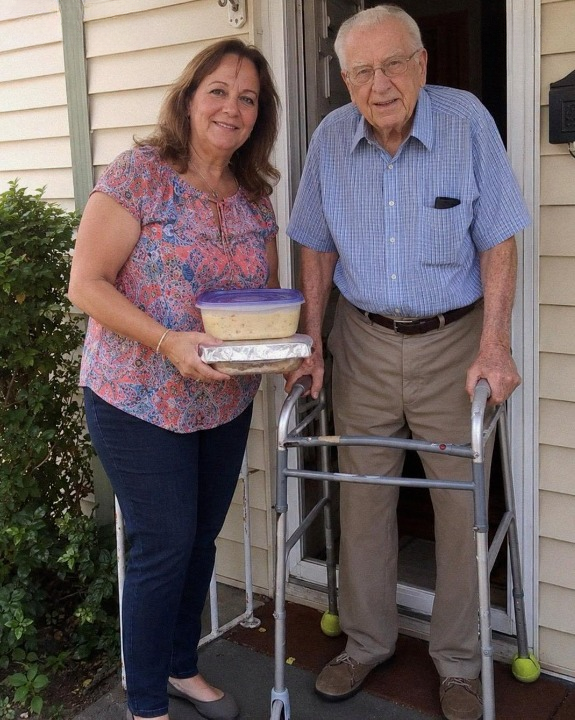
Nine years ago, my life looked nothing like I had imagined it would.
I was 48, recently divorced, raising two children, and trying to convince myself that starting over wasn’t the same thing as failing.
After the divorce, the kids and I moved into a modest house in a quiet neighborhood. It wasn’t fancy, but it was affordable, peaceful, and far enough away from my old life that I felt like I could finally begin again.
That’s where I met Lawrence.
He lived in the small house next door.
Lawrence was already in his late seventies when we moved in. He was thin, soft-spoken, and fiercely independent. His lawn was always neatly trimmed, his curtains were opened every morning, and he had a habit of sitting on his front porch with a cup of coffee regardless of the weather.
The first time I introduced myself, I offered to help if he ever needed anything.
He smiled politely.
“I’ve been taking care of myself for a long time,” he said. “But thank you.”
I quickly realized that Lawrence was the kind of man who would rather struggle quietly than admit he needed help.
For the first few months, we were simply neighbors.
We waved when we saw each other. Sometimes we talked over the fence. He asked about my children, and I asked about his garden.
Then winter arrived.
One particularly cold week, snow covered nearly every driveway on our street. One morning, while walking to my mailbox, I noticed something unusual.
Lawrence’s mailbox was overflowing.
That wasn’t like him.
He usually collected his mail every afternoon.
The next day, nothing had changed.
By the third day, I became worried.
I walked next door and knocked.
There was no answer.
I knocked again.
Finally, I heard slow footsteps.
Lawrence opened the door wearing an old robe. His face was pale, and he looked exhausted.
“Lawrence, are you okay?”
He tried to smile.
“Just caught something. I’ll be fine.”
I asked whether he’d seen a doctor.
He shook his head.
Then I asked whether he needed anything.
For a moment, he resisted. Eventually, he admitted that he had run out of one of his regular medications and hadn’t felt well enough to go to the pharmacy.
“Give me the information,” I said. “I’ll pick it up.”
He immediately reached for his wallet.
I refused.
“I have to go out anyway.”
That wasn’t entirely true, but I knew it was the only way he’d accept my help.
Later that afternoon, I returned with his medicine.
Before leaving, I noticed how empty his kitchen looked.
The next evening, I made chicken soup for my children and me. Without thinking much about it, I filled an extra container.
I walked next door and left it with Lawrence.
The following morning, the empty container was sitting neatly outside my door with a handwritten note.
“Best soup I’ve had in years. Thank you.”
That small exchange became the beginning of something neither of us expected.
Whenever I cooked pasta, stew, roasted chicken, or soup, I made an extra portion for Lawrence.
Sometimes I left the food on his porch.
Other times, he’d invite me inside for coffee.
If I was going grocery shopping, I’d call him.
“Need anything?”
Usually, he would say no.
Then five minutes later, he’d call back.
“Well, maybe some milk.”
Eventually, I learned to stop asking.
I’d simply bring him the basics I knew he used.
Bread. Eggs. Fruit. Coffee.
Whenever he needed medicine, I’d pick that up too.
Lawrence always tried to reimburse me.
Sometimes he’d hide money underneath the empty food containers.
I’d find it and return it.
Once he slipped twenty dollars into my mailbox.
I marched next door and handed it back.
“Stop trying to pay me.”
He laughed.
“You’re stubborn.”
“So are you.”
Over time, Lawrence became more than my elderly neighbor.
He became part of our family.
My children grew comfortable knocking on his door. Lawrence attended birthday dinners and occasionally joined us for Thanksgiving.
And slowly, he began telling me about his past.
He had been married for nearly forty years.
His wife, Margaret, had died several years before we moved into the neighborhood.
He still kept her photograph beside his favorite chair.
“She would’ve liked you,” he once told me.
I smiled.
“I wish I could’ve met her.”
“So do I.”
He also told me about his son.
They had become estranged decades earlier after an argument neither of them had been willing to resolve.
Lawrence rarely discussed the details.
“I thought there would always be time,” he once admitted. “That’s the dangerous thing about tomorrow. You assume you’re guaranteed one.”
I never forgot those words.
As the years passed, Lawrence slowed down.
His walks became shorter.
His hands shook slightly when he held his coffee.
Eventually, I started taking his trash cans to the curb and shoveling the snow from his walkway before doing my own.
Still, Lawrence insisted on maintaining his independence.
“I’m old,” he’d say. “I’m not helpless.”
And I respected that.
I never wanted him to feel like a burden.
Because he wasn’t.
He was my friend.
Nine years passed almost without me noticing.
Then, a few days ago, I woke to flashing lights outside.
An ambulance was parked in Lawrence’s driveway.
My heart sank.
I hurried outside.
Lawrence had passed away peacefully in his sleep.
He was simply gone.
His funeral was small.
A few neighbors attended, along with people I didn’t recognize.
I sat near the back with my children, remembering nine years of conversations, empty soup containers, porch coffees, and arguments about twenty-dollar bills.
After the service, I was walking toward my car when a man in a dark suit approached me.
“Are you Lawrence’s neighbor?”
“Yes.”
He introduced himself as an attorney who had handled some of Lawrence’s affairs.
Then he handed me a sealed envelope.
“Lawrence instructed me to give you this after his funeral.”
I stared at it.
“To me?”
“Yes.”
I drove home before opening it.
My children sat beside me at the kitchen table.
Inside was a handwritten letter.
The first sentence immediately made me smile.
“You left food at my door for years.”
I could practically hear Lawrence saying it.
The letter continued.
“You probably thought I didn’t notice how much you did for me. I noticed every meal, every pharmacy trip, every bag of groceries and every snowy morning when my walkway somehow became clear before I woke up.”
My eyes filled with tears.
Then I reached a sentence that confused me.
“Now I need you to do one final thing for me.”
I kept reading.
“Go downstairs and look inside the old freezer in your basement.”
I stopped.
“What freezer?” my daughter asked.
Then I remembered.
When we’d purchased the house nine years earlier, an old chest freezer had been left in the basement.
It hadn’t worked properly, so I’d unplugged it and used it to store miscellaneous household items.
But Lawrence had never been in my basement.
At least, not that I remembered.
I grabbed the letter and headed downstairs.
My children followed.
The freezer sat beneath the stairs exactly where it had been for years.
I lifted the lid.
Old blankets.
Holiday decorations.
A box of extension cords.
Nothing unusual.
Then my son noticed something.
“Mom, what’s that?”
At the bottom was a small wooden box I had never seen before.
My hands began shaking.
I lifted it out.
There was another envelope taped to the top.
My name was written across it.
Inside was a key and another note.
The note explained everything.
Years earlier, when Lawrence was still healthy enough to move around easily, I’d given him a spare house key.
I’d completely forgotten about it.
Apparently, Lawrence hadn’t.
Months before his death, with the help of his attorney, he had placed the box inside the freezer.
The key opened it.
Inside were several folders, old photographs, a small jewelry case, and legal documents.
The jewelry had belonged to Margaret.
But the documents were what left me speechless.
Lawrence had left me a portion of his savings.
It wasn’t an unbelievable fortune.
There were no millions of dollars.
But it was enough to pay off a significant part of my remaining mortgage and help with my children’s future expenses.
I immediately felt uncomfortable.
I hadn’t helped Lawrence because I expected anything.
I hadn’t kept track of the meals I’d cooked or the trips I’d made to the pharmacy.
They were simply things you did for someone you cared about.
Then I read the final page.
“Please don’t refuse this because you think you didn’t earn it.”
That sounded exactly like Lawrence.
“You gave me something money couldn’t buy. You made an old man’s house feel less empty. You reminded me that someone would notice if my curtains didn’t open in the morning.”
I had to stop reading.
My daughter put her arm around me.
Eventually, I continued.
“I spent too many years believing independence meant never needing anyone. You taught me that accepting kindness isn’t weakness.”
Then came the sentence I’ll remember for the rest of my life.
“I couldn’t repay every meal you left at my door, so don’t think of this as payment. Think of it as one neighbor leaving something at yours.”
I cried.
Not because of the money.
Not because of the jewelry.
Not because of anything inside that wooden box.
I cried because Lawrence had understood.
For nine years, I thought I was helping a lonely elderly man.
What I hadn’t realized was how much he had helped me too.
When I arrived in that neighborhood, I was rebuilding my life.
I felt rejected, uncertain, and afraid of the future.
Lawrence gave my children another person who cared about them.
He gave me friendship when I desperately needed it.
He gave our new house a sense of community.
And somewhere between the bowls of soup, pharmacy trips, cups of coffee, and conversations across the fence, we stopped being strangers who happened to live beside each other.
We became family.
The wooden box is still sitting on my kitchen table.
I haven’t decided what to do with Margaret’s jewelry yet.
Maybe someday I’ll give some of it to my daughter.
But Lawrence’s handwritten letter is something I know I’ll keep forever.
Yesterday, out of habit, I made too much soup.
For a moment, I reached for another container.
Then I remembered there was no reason to carry it next door.
I stood there quietly, staring through my kitchen window at Lawrence’s empty house.
And strangely, I could almost imagine him sitting on the porch again, holding his coffee and pretending he didn’t need anyone’s help.
I smiled through my tears.
For nine years, I believed I was simply leaving dinner at an elderly neighbor’s door.
Only after he was gone did I understand what those small gestures had meant to him.
Sometimes the greatest kindnesses aren’t dramatic.
They’re a warm meal.
A trip to the pharmacy.
A shoveled walkway.
A knock on someone’s door when their mailbox hasn’t been emptied.
Small things can tell another person something incredibly important:
You haven’t been forgotten.
And sometimes, years later, you discover they never forgot you either.