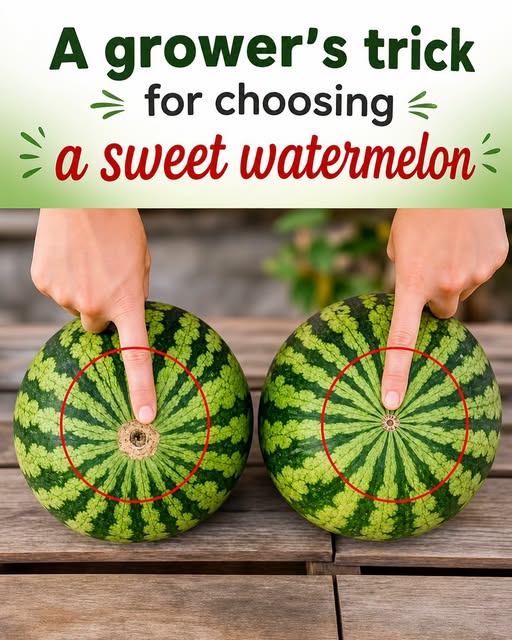
How to Choose a Sweet, Juicy Watermelon: Simple Things to Look For Before You Buy
There are few things more refreshing on a warm day than a perfectly ripe watermelon. When you cut into a good one, the flesh is bright, crisp, juicy, and naturally sweet. It can become an easy snack, a refreshing addition to a summer meal, or the perfect ingredient for fruit salads, drinks, and desserts.
But choosing a watermelon at the grocery store or farmers market can sometimes feel like a guessing game. Most watermelons have a thick green rind that hides the fruit inside, so you cannot simply look through the skin to see whether the flesh will be sweet and ripe.
Fortunately, you do not have to rely entirely on luck.
There are several simple characteristics you can check before buying a watermelon. The shape, weight, underside, surface markings, stem, and overall appearance can provide useful clues about how the fruit developed and when it may have been harvested.
No single sign can guarantee that a watermelon will taste exactly the way you prefer. However, combining several clues can help you make a more informed choice.
Here is a practical guide to choosing a watermelon that has a better chance of being flavorful, juicy, and enjoyable.
1. Start With the Overall Shape
One of the first things you can check is the shape of the watermelon.
Depending on the variety, watermelons can be round, oval, elongated, or slightly irregular. Therefore, there is no single shape that automatically means a watermelon will taste better.
Instead, look for a fruit that appears reasonably symmetrical and well developed.
A watermelon with a balanced shape may indicate that it had relatively consistent growing conditions. If one side is dramatically smaller, deeply indented, or unusually uneven, it may have developed under conditions that affected its growth.
That does not necessarily mean the fruit is bad. An oddly shaped watermelon can still be perfectly delicious. Shape is simply one clue among several.
When comparing several watermelons of the same variety, choose one that looks naturally full and evenly formed.
What to look for:
- A generally symmetrical appearance
- A full, well-developed shape
- No large sections that look unusually sunken
- No significant damage to the rind
- A shape appropriate for its variety
If two watermelons look similar in every other way, the one with a more balanced appearance can be a reasonable choice.
2. Pick It Up and Compare the Weight
One of the easiest tests requires nothing more than your hands.
Pick up the watermelon.
A good watermelon should feel substantial for its size. This is useful because water makes up a large portion of the fruit’s flesh.
If you are choosing between several watermelons that appear to be about the same size, compare their weight. The heavier one may contain a good amount of water and edible flesh.
This does not mean you should automatically choose the largest watermelon available. Size and weight should be considered together.
For example, imagine you have two watermelons that are approximately the same size. One feels noticeably heavier when you lift it. That can be a useful reason to consider the heavier fruit.
The important point is comparison.
You do not need a scale. Simply lift two or three watermelons and notice how they feel relative to their size.
A simple rule:
For similar-sized watermelons, look for one that feels surprisingly heavy for its size.
The fruit should not feel hollow or unusually light.
3. Examine the Yellow or Cream-Colored Field Spot
One of the most commonly discussed clues on a watermelon is the field spot.
This is the area of the rind that rested against the ground while the watermelon was growing. Because that portion received less sunlight, it often develops a different color from the rest of the rind.
Look for a noticeable creamy, yellow, or yellow-orange area on the underside.
The exact color can vary according to the watermelon variety and growing conditions, so you should not treat color as an absolute test.
However, a mature-looking field spot can be a useful indication that the watermelon spent time developing on the vine.
A very pale or nearly white spot may be less informative than a clearly developed cream-to-yellow area, although this is not a guarantee of flavor.
The field spot should also be considered together with the fruit’s other characteristics.
Why does the field spot exist?
Watermelons grow along the ground. The side touching the soil does not receive the same sunlight as the exposed side.
As the fruit develops, the rind in that area can become lighter and change color.
This creates the recognizable field spot.
When shopping, turn the watermelon over carefully and inspect this area.
4. Look at the Rind
The rind can provide several useful clues.
A watermelon should generally have a firm, intact outer surface. Avoid fruits with major cracks, deep cuts, leaking areas, or extensive bruising.
Small cosmetic marks are not necessarily a problem. Watermelons can develop harmless scratches and marks during transportation or handling.
What