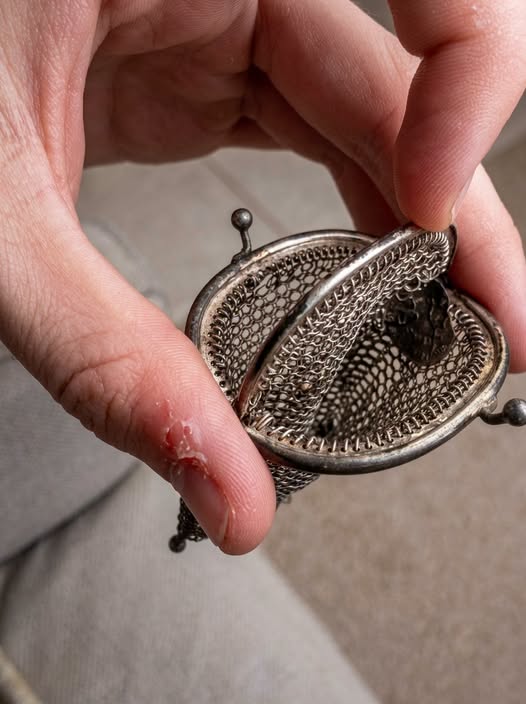
During the Victorian era, fashion was about much more than looking elegant. Clothing and accessories communicated identity, social position, taste, respectability, and financial comfort. A carefully chosen brooch, bracelet, handbag, necklace, or silver purse could reveal details about its owner’s lifestyle without a single word being spoken.
Among the most intriguing surviving objects from this period are antique Victorian silver purses. Small enough to fit comfortably in one hand, these beautifully crafted accessories combined practicality with decoration and social symbolism. They were designed to carry coins and personal necessities, but their importance went far beyond their everyday function.
A Victorian purse could be a fashion statement, a gift, a treasured possession, or a visible indication of prosperity. Its materials, workmanship, decoration, and condition could tell us something about the period in which it was created and the person who may have owned it.
Today, these objects attract collectors, historians, antique enthusiasts, and anyone fascinated by the details of everyday Victorian life. Their appeal comes partly from their beauty, but also from the stories they seem to preserve.
A small silver purse may look like nothing more than an antique accessory.
Look closer, however, and it becomes a window into an entire society.
Fashion Was a Language in Victorian Society
Victorian society placed enormous importance on appearance.
The nineteenth century witnessed dramatic changes in manufacturing, transportation, commerce, and urban life. As the middle class expanded and cities grew, more people gained access to fashionable goods.
At the same time, social expectations surrounding clothing became increasingly elaborate.
What a person wore could communicate whether they were attending church, visiting friends, shopping, traveling, attending a formal dinner, or participating in a special celebration.
Accessories played an especially important role because they could transform an otherwise simple outfit.
A modest dress could be accompanied by an elaborate brooch.
A formal gown could be paired with gloves, a fan, jewelry, and a beautifully decorated purse.
For wealthy women, accessories offered opportunities to display refined taste without necessarily relying on extravagant clothing alone.
This is one reason Victorian purses are so fascinating.
They existed at the intersection of fashion and practicality.
The Rise of the Small Handbag
Modern handbags are generally designed to carry a wide variety of belongings.
Victorian purses were often much smaller.
Many were intended primarily for coins and other small personal items. Some were made with fabric, while others incorporated metal frames, chains, beads, leather, or decorative elements.
The size of the purse was partly a reflection of how people used accessories during the period.
A woman attending a formal event didn’t necessarily need to carry everything she might take with her today.
Instead, a small purse could hold a few coins, perhaps a calling card or another tiny personal item.
Because these purses were visible accessories, manufacturers had an incentive to make them attractive.
The result was an extraordinary range of designs.
Some were understated.
Others were richly decorated.
Silver examples could be especially impressive because the metal itself provided a luxurious appearance while allowing artisans to create intricate surfaces.
Why Silver Was So Appealing
Silver has fascinated craftspeople for centuries.
It is relatively workable compared with many harder metals, allowing skilled artisans to create detailed patterns and textures.
Victorian silversmiths could produce decorative surfaces featuring flowers, leaves, scrollwork, geometric patterns, engraved initials, and other ornamental motifs.
A silver purse therefore had two distinct qualities.
It was useful.
And it was beautiful.
That combination made silver particularly appropriate for a fashionable personal object.
The metal could also develop a distinctive patina over time.
An antique silver purse that has survived for generations may no longer have the bright appearance it possessed when new. Instead, its surface might contain subtle variations in color and texture.
For collectors, these signs of age can contribute to the object’s character.
Craftsmanship Mattered
Before mass manufacturing transformed the marketplace, many decorative objects required considerable skilled labor.
Victorian manufacturing certainly included increasingly sophisticated machinery and standardized production, but craftsmanship remained important.
When examining an antique silver purse, collectors may notice tiny details that reveal how it was made.
Look closely at the clasp.
Examine the hinges.
Study the decoration.
Check how the individual sections fit together.
Look at the chain and frame.
Even apparently minor construction details can reveal information about the quality and method of production.
The most attractive antique accessories aren’t necessarily valuable simply because they are old.
Age alone doesn’t guarantee rarity or monetary worth.
Condition, materials, maker, design, provenance, rarity, and craftsmanship can all influence an object’s importance.
This is one of the most important lessons for anyone beginning to explore antique collecting.
Old does not automatically mean valuable.
But an unusual combination of age, craftsmanship, rarity, and historical context can make an everyday object extraordinarily interesting.
Decorative Designs Had Meaning
Victorian designers frequently drew inspiration from nature.
Flowers, vines, leaves, birds, insects, and other organic motifs appeared throughout nineteenth-century decorative arts.
These designs were not always intended to communicate a precise symbolic message, but flowers and natural imagery had long been associated with particular ideas and emotions.
Roses, for example, could evoke romance and affection.
Forget-me-nots could suggest remembrance.
Ivy was often associated with endurance and attachment.
Other designs simply reflected the Victorian enthusiasm for decorative complexity.
The same purse might combine several motifs into a dense ornamental pattern.
This decorative approach reflects a broader characteristic of Victorian design: a willingness to embrace detail.
Compared with many modern minimalist accessories, Victorian objects can appear almost wonderfully excessive.
Patterns overlap.
Textures contrast.
Borders frame central motifs.
Small decorative details reward close inspection.
A Purse Could Become a Personal Keepsake
An accessory doesn’t have to be expensive to become emotionally valuable.
People frequently attach memories to objects.
A purse might have been received as a birthday present.
It could have belonged to a mother or grandmother.
It might have been carried at a wedding.
Perhaps it traveled with someone during an important journey.
Or it may have been passed from one generation to another.
This personal history can make an antique object meaningful even when its market value is modest.
Imagine opening an old silver purse and discovering a few forgotten coins inside.
The coins themselves might be historically interesting.
But the real fascination comes from wondering who placed them there.
Where were they going?
What were they buying?
Who carried the purse?
What occasions did it accompany?
That sense of connection is one reason antique accessories continue to attract people today.
Victorian Gifts Were Often Highly Personal
During the Victorian period, gifts could carry considerable emotional significance.
Jewelry and accessories were particularly appropriate gifts because they were both useful and personal.
A silver purse could commemorate a birthday, wedding, anniversary, holiday, or other important occasion.
Some accessories were personalized through engraving.
Initials, dates, names, and short inscriptions could transform a commercially produced object into something unique.
An engraved purse can therefore provide a fascinating clue about its original owner.
Even when the person’s identity has been forgotten, an inscription can establish a connection between the object and a specific moment in time.
For historians and collectors, such details can be extremely valuable.
Social Class and Visible Wealth
Victorian society was strongly conscious of class.
The Industrial Revolution created new wealth while also producing significant economic inequality.
The growing middle class developed its own ideas about respectability and presentation.
Possessions could therefore serve as visible indicators of status.
Not every elegant accessory belonged to an aristocrat.
A prosperous middle-class woman could own fashionable goods that reflected her economic circumstances and social aspirations.
This is an important distinction.
Victorian accessories weren’t simply symbols of aristocratic wealth.
They were also part of a larger consumer culture in which increasingly diverse groups of people participated in fashion.
A well-made silver purse could communicate refinement without necessarily being an extravagantly expensive object.
The details mattered.
A carefully coordinated accessory suggested that its owner understood contemporary fashion and the social expectations surrounding it.
The Importance of Respectability
Victorian ideas about respectability influenced everything from clothing to behavior.
For women in particular, appearance could be closely associated with character.
Neatness, modesty, elegance, and appropriate dress were often treated as signs of good upbringing and respectable social standing.
Accessories contributed to this presentation.
A small, refined purse could complete an outfit in much the same way that gloves, jewelry, or a hat did.
It wasn’t merely about displaying wealth.
It was about appearing appropriate for a particular social environment.
This helps explain why seemingly minor objects deserve attention when studying Victorian history.
A purse may tell us something about expectations surrounding femininity, consumption, etiquette, and public appearance.
The Victorian Love of Innovation
The Victorian era was also a period of remarkable technological change.
Railways expanded.
Photography became increasingly accessible.
Factories transformed manufacturing.
New materials and production techniques changed consumer goods.
Communication accelerated.
People encountered new products and new forms of entertainment.
Fashion responded to these changes.
Manufacturers could produce decorative goods for an expanding market, while advances in production made certain items more accessible than they had been previously.
The Victorian purse sits comfortably within this story.
It is both a traditional object and a product of a rapidly modernizing consumer society.
Its design may look old-fashioned today, but its existence reflects a period of experimentation and commercial innovation.
From Practical Object to Historical Artifact
When an accessory is new, people usually think about its immediate purpose.
A purse is something you carry.
A spoon is something you eat with.
A watch tells time.
A chair provides a place to sit.
But after a century or more, everyday objects can acquire an entirely different significance.
They become historical artifacts.
A Victorian purse can tell us about manufacturing.
It can reveal changing fashion trends.
It can provide evidence of consumer habits.
Its materials can offer clues about technology and trade.
Its decoration can reflect artistic tastes.
An inscription can reveal a relationship.
Even damage can tell a story.
A worn clasp might indicate years of use.
A repaired chain might suggest that its owner valued the purse enough to fix it rather than replace it.
A faded lining may reveal how frequently it was carried.
In other words, wear isn’t necessarily a flaw from a historical perspective.
Sometimes it is evidence.
What Collectors Look For
Anyone interested in Victorian silver accessories should resist the temptation to judge an item solely by appearance.
Several factors deserve attention.
Maker and Hallmarks
Silver objects may contain marks identifying the maker, purity, assay office, or date.
These markings can be extremely useful when researching an antique.
However, interpreting hallmarks requires care because marking systems varied by country and period.
A collector should avoid assuming that every tiny symbol is a maker’s mark or date letter.
Condition
Condition is another important factor.
A purse with its original clasp, chain, lining, and decorative elements intact may be more desirable than one missing major components.
However, signs of age aren’t automatically negative.
Minor surface wear can be expected in an object that has been used for generations.
Rarity
A common Victorian purse and an unusual example may look similar to an inexperienced buyer.
Research can make the difference.
Rare designs, unusual construction, limited production, or documented provenance can increase historical and collector interest.
Provenance
Provenance refers to the documented history of an object.
If an antique can be reliably connected to a particular person, family, event, or collection, that history can significantly enhance its appeal.
But provenance should be documented whenever possible.
A family story can be fascinating without necessarily proving an object’s history.
Why Antique Purses Still Fascinate Us
Part of the appeal of Victorian accessories comes from their scale.
They are intimate objects.
A large building can tell us about architecture.
A railway can tell us about transportation.
A purse tells us about an individual.
Someone held it.
Someone carried it.
Someone decided that it was worth keeping.
That makes these objects unusually personal.
A Victorian silver purse may have traveled through streets crowded with horse-drawn vehicles.
It might have accompanied its owner to a theater, wedding, church service, railway station, or afternoon visit.
It could have rested on a dressing table at the end of a long day.
We can’t always know the details.
But the possibility makes the object compelling.
The Hidden Stories in Ordinary Things
History is often presented through famous people and major events.
Wars.
Political leaders.
Industrial breakthroughs.
Royal ceremonies.
But everyday objects can reveal another side of the past.
They show us how ordinary people lived.
What they carried.
What they purchased.
What they valued.
What they considered fashionable.
What they chose to preserve.
A Victorian purse is therefore much more than a decorative accessory.
It represents a small piece of social history.
Its metal, shape, decoration, and wear can help us imagine the world in which it was used.
From Victorian Fashion to Modern Collecting
Today, interest in Victorian accessories extends beyond traditional antique collectors.
Interior designers appreciate their decorative qualities.
Fashion enthusiasts study historical silhouettes and accessories.
Historians use surviving objects to understand everyday life.
Photographers incorporate antique pieces into period-inspired imagery.
And younger collectors increasingly appreciate the sustainability and individuality of vintage objects.
Unlike mass-produced modern accessories, antique pieces often possess imperfections that make them distinctive.
Two nearly identical items can age differently.
One may develop a darker patina.
Another may retain more of its original finish.
One may have a repaired clasp.
Another might still contain traces of its original lining.
Those differences make antique collecting personal.
A Small Object With a Large Story
The next time you see an antique Victorian silver purse, don’t look at it merely as an old handbag.
Look at the details.
Examine the pattern.
Study the clasp.
Search for markings.
Notice the wear.
Think about the hands that may have held it.
Consider the social world that produced it.
Victorian accessories were created for practical reasons, but they also became expressions of identity.
They could demonstrate taste.
They could suggest prosperity.
They could mark a special occasion.
They could carry sentimental meaning.
And, after generations of use, they can become historical treasures.
That is perhaps the most remarkable thing about antique accessories.
They don’t need to be enormous to preserve a fascinating story.
A tiny silver purse can tell us about fashion, manufacturing, economics, gender expectations, social class, craftsmanship, family traditions, and changing ideas about beauty.
It can remind us that history isn’t always hidden inside museums or written in enormous books.
Sometimes it is sitting quietly inside a display case.
Sometimes it is tucked away in an old family drawer.
And sometimes, it is a small silver purse that has survived long enough to become something its original owner could never have imagined: