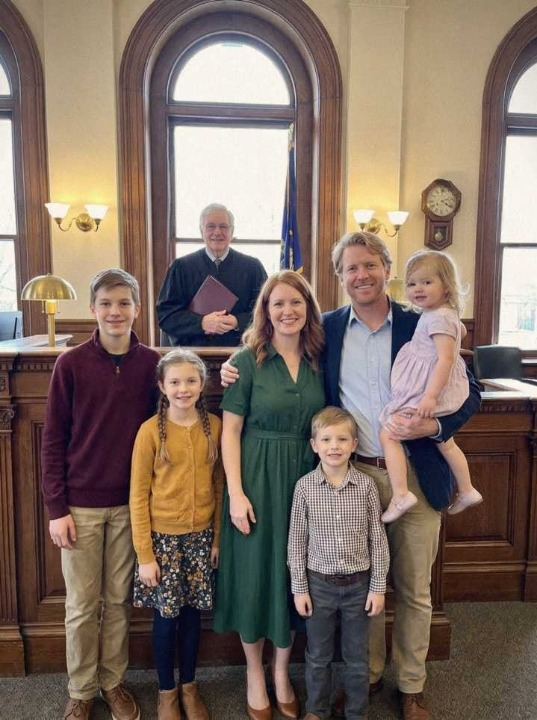
Let me tell you what I did not say in that courtroom.
Because there was the version I told Judge Miller, which was true, and then there was everything underneath it—the part I had been turning over in my mind for three weeks.
My name is Carter. I was twenty-nine years old, single, and working as a licensed electrician in Ohio. I owned a modest three-bedroom house and had about $22,000 in savings that I had spent four years building toward a larger property.
Then I saw the photograph.
Five children sat together on a vinyl bench.
Marcus, seven. Amara, five. Joel, four. Destiny, two. And Nina, eighteen months.
They weren’t posing for the camera.
They were holding on to each other.
Their mother had died suddenly from a stroke. Their father wasn’t in the picture. No relative was willing or able to take all five.
The plan was to place them in three different homes in three different counties.
I couldn’t stop thinking about that photograph.
I called the agency.
“Is there any way they can stay together?”
The social worker paused.
“If we found someone who could genuinely take all five, yes.”
“How long do I have?”
“Nine days.”
I hung up and sat in my kitchen for a long time.
Then I called my sister, Dana.
She listened to everything.
“Are you asking me if this is sane?” she finally said.
“Yes.”
“It’s not sane,” she replied. “But sane isn’t the same as wrong.”
That afternoon, I started converting my detached workshop into a bedroom.
I built bunk beds. I bought five car seats. I bought bedding in different colors and cleared out the savings account I had spent years building.
The home-study assessor asked me the obvious question.
“What don’t you know?”
I thought about it.
“I don’t know what it’s like to have five traumatized children under seven in my house,” I said. “I don’t know what each of them is going to need. I don’t know if I’ll do everything right.”
She waited.
“But I know the alternative,” I continued. “They’ll be separated. And Marcus is seven years old. He’s already been holding everyone together. He shouldn’t have to do that anymore.”
The agency recommended me.
Two days later, I stood before Judge Miller.
The state’s attorney spent twenty minutes explaining why I was too young, inexperienced, and financially unprepared.
He wasn’t entirely wrong.
Then the judge looked at me.
“Mr. Carter, what is your real motive?”
I looked back at the five children sitting behind me.
Marcus had his hand wrapped around Amara’s.
I told the judge about the photograph.
I told him about the bunk beds and the car seats and the money I had spent.
Then I told him about Marcus.
“That boy is seven years old,” I said. “He called 911 when his mother died. He’s been holding those children together ever since. I know what that costs because I watched my own sister carry responsibilities she shouldn’t have had as a child.”
My voice shook.
“I can’t undo what happened to them. But I can give Marcus a place where he doesn’t have to hold everyone together alone.”
The courtroom went silent.
Judge Miller studied me.
“Are you aware,” he asked, “that if this adoption is finalized, you will be legally, financially, and morally responsible for these children?”
“Yes, sir.”
“For years?”
“Yes, sir.”
“And you’re prepared for that?”
I looked at Marcus.
“Yes.”
Judge Miller signed the papers.
Then he looked at the children.
“You’re all going together.”
Marcus’s face changed.
For the first time since I had met him, he looked like a seven-year-old.
We drove home that afternoon.
The house was chaos within minutes.
Joel talked nonstop. Destiny cried. Nina wandered around in her pink boots. Amara immediately found her bed.
Marcus was the last one into the bedroom.
He looked at the bunk beds I had built.
“You made these?”
“Yeah.”
“They’re good.”
“Thanks.”
He stood there quietly.
Then he said something I wasn’t expecting.
“You don’t have to do this.”
I sat beside him.
“No,” I said. “I don’t have to.”
He looked at me.
“But I’m going to. Because you need someone to, and I can, and I want to.”
His eyes dropped to the floor.
“Is it because we’re getting split up?”
“That’s part of it.”
“What’s the other part?”
I looked at this seven-year-old who had been trying to be an adult for weeks.
“Because you’ve been holding everyone together,” I said. “And you’re seven. You shouldn’t have to do that alone.”
He was quiet for a long time.
Then he whispered:
“I’m tired.”
“I know.”
“Not sleep tired.”
“I know.”
He leaned against me.
And for the first time, he didn’t look like the oldest child.
He just looked like a kid.
Six months later, the adoption was finalized.
Judge Miller happened to be there again.
After we signed the papers, he looked at the five children and then at me.
“Well done, Mr. Carter.”
I almost laughed.
I hadn’t done anything that morning except sign my name.
The hard work had happened during the six months before.
The years after were harder.
Marcus had to learn that being the oldest didn’t mean being responsible for everyone. Amara drew pictures whenever she couldn’t find the words. Joel tested every boundary imaginable. Destiny went through a phase where she wore seven headbands at once.
And Nina eventually learned to call me Daddy.
She said it one morning over breakfast.
“Daddy.”
I looked at her.
She repeated it, impatiently.
“Yeah,” I whispered. “That’s me.”
Then she went back to her cereal.
A year after I brought them home, we sat around the kitchen table eating chocolate cake.
Marcus looked at me.
“You did a good thing.”
Amara nodded.
“A really good thing.”
Joel asked for more cake.
Destiny already had frosting on her face.
Nina looked around the table with the satisfied expression of a child who knew exactly where she belonged.
I thought about the $22,000 I had spent.
The larger house I never bought.
The plans I had put aside.
None of it felt like a sacrifice anymore.
Because I had something better.
This table.
These five children.
This family.
I had once been sitting alone in my kitchen when I saw a photograph of five siblings holding on to each other.
I thought I was choosing to save them.
The truth is, they gave me something to build my life around.
The papers were only the beginning.
The real adoption happened afterward—in the midnight wake-ups, the school lunches, the birthday parties, the drawings, the arguments, the bedtime stories, and all the ordinary mornings when someone needed me and I showed up.
That’s what family is.
You show up.
Then you show up again tomorrow.
And the next day.
And the day after that.
We ate our cake.
We laughed.
We cleaned up the mess.
And the next morning, we got up and did it all again.
That’s what families do.
We go on.