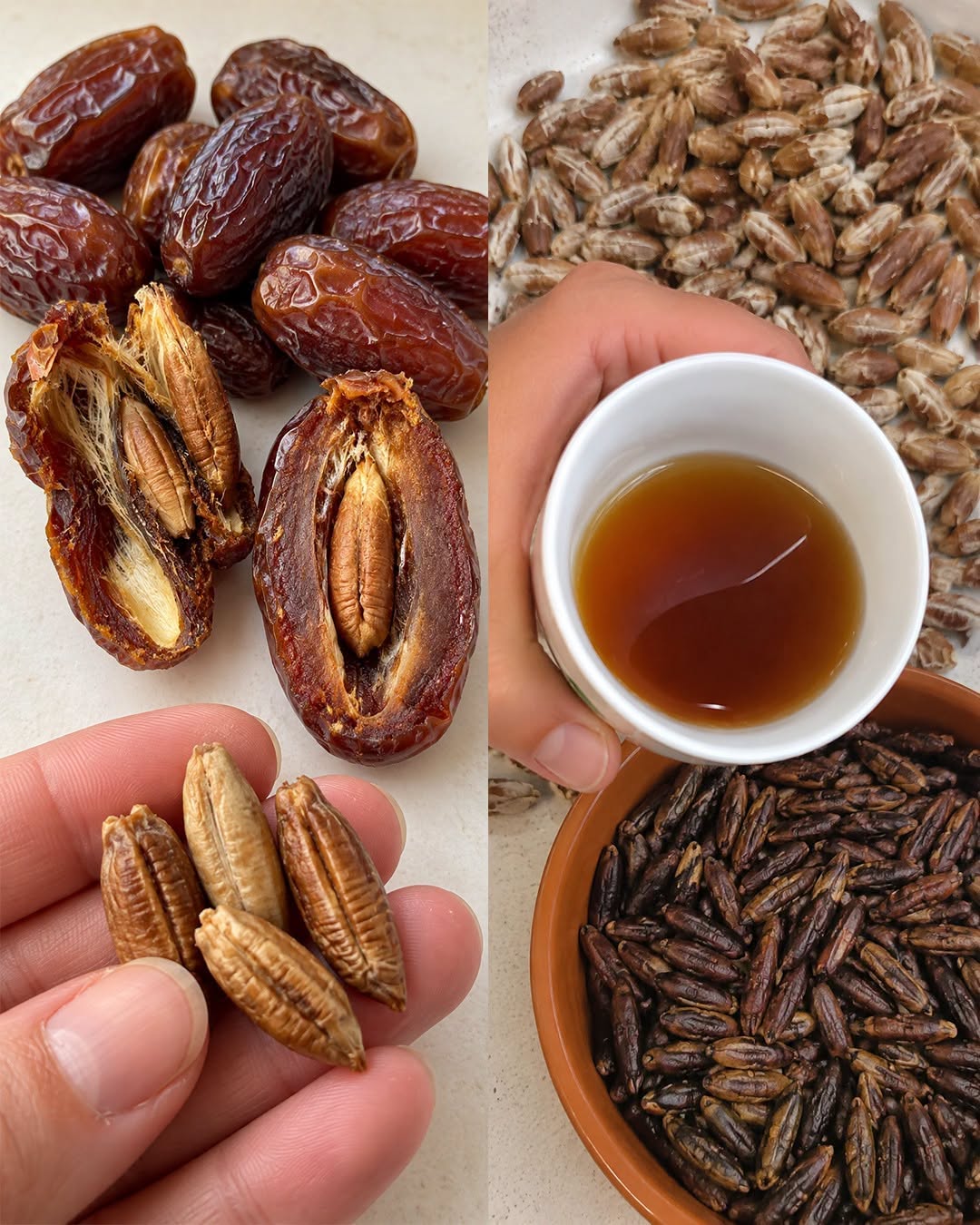
When most people eat dates, they enjoy the soft, naturally sweet fruit and immediately discard the hard seed in the center.
But there is an interesting part of the date that often receives very little attention: the seed.
Date seeds, sometimes called date pits, are the hard inner parts found inside many varieties of dates. For generations, people in date-growing regions have found different uses for them, including traditional food preparations and beverages.
Today, interest in date seeds has grown again as people look for creative ways to reduce food waste and make use of ingredients that are commonly thrown away.
One particularly interesting use involves roasting and grinding the seeds to create a coffee-like beverage.
However, it’s important to separate traditional culinary uses from exaggerated claims sometimes found online. Date seeds may be an interesting ingredient, but they should not be presented as a miracle food or as a substitute for medical treatment.
What Exactly Are Date Seeds?
A date seed is the firm, elongated pit found inside a date fruit.
Unlike the soft flesh surrounding it, the seed is extremely hard and isn’t normally eaten whole.
Date seeds contain plant compounds, fiber, and other naturally occurring components, which is one reason researchers and food producers have explored ways to make use of them.
Because dates are produced in large quantities around the world, their seeds can represent a significant amount of agricultural and food-processing waste.
Finding useful applications for those seeds can therefore be interesting from both a culinary and environmental perspective.
Why Are People Interested in Date Seeds?
There are several reasons date seeds have attracted attention.
First, they are widely available wherever dates are processed.
Second, they can be transformed into different products through drying, roasting, and grinding.
Third, using the seed can provide an additional way to make use of a part of the fruit that would otherwise be discarded.
This fits into a broader interest in reducing food waste.
Many foods contain parts that people traditionally throw away but that can sometimes be processed into useful ingredients.
Date seeds are one example.
The Coffee-Like Drink Made From Roasted Date Seeds
One of the most interesting traditional uses of date seeds is making a beverage from roasted and ground seeds.
The process generally involves thoroughly cleaning and drying the seeds before roasting them. Once roasted, they can be ground into a powder and brewed similarly to certain coffee alternatives.
The resulting drink can have a dark color and a roasted flavor.
Depending on how the seeds are prepared and roasted, the flavor can vary considerably.
Some people describe it as nutty, earthy, or similar to roasted grains.
It is important to remember that a coffee-like drink made from date seeds is not necessarily the same thing as coffee made from coffee beans.
The flavor, aroma, nutritional composition, and naturally occurring compounds are different.
Does Date-Seed Coffee Contain Caffeine?
One reason date-seed beverages attract attention is that roasted date-seed drinks are generally used as caffeine-free alternatives to conventional coffee.
However, the exact composition of a homemade or commercially prepared product can vary.
If you’re purchasing a packaged date-seed beverage, check the ingredient and nutrition information rather than assuming it contains no caffeine.
This distinction is particularly useful for people who are trying to reduce their caffeine intake.
How Are Date Seeds Prepared?
Preparation requires care because the seeds are extremely hard.
They should not simply be placed into a grinder while still whole.
A typical preparation process involves several stages.
First, the seeds are separated from the fruit and thoroughly cleaned to remove remaining pieces of date flesh.
They can then be dried completely.
After drying, the seeds can be roasted using an appropriate food-preparation method.
Once they have been roasted and cooled, they can be ground into smaller particles using equipment capable of handling the material.
The resulting powder can then be used for a beverage or incorporated into certain recipes where appropriate.
If you’re experimenting with date seeds at home, use a preparation method specifically intended for food use and avoid equipment that isn’t designed to process extremely hard ingredients.
Why Roasting Changes the Flavor
Roasting is responsible for much of the appeal of date-seed beverages.
Heat creates changes in flavor and aroma, producing toasted and roasted notes.
The longer or hotter the roasting process, the more pronounced those flavors can become.
However, excessive roasting can burn the material and create an unpleasant taste.
As with coffee beans, nuts, grains, and other roasted ingredients, temperature and timing can have a major influence on the final flavor.
This means two date-seed beverages prepared using different roasting methods may taste noticeably different.
Are Date Seeds Nutritious?
Date seeds contain various naturally occurring components, including dietary fiber and plant compounds.
Researchers have investigated date seeds for their composition and potential food applications.
However, it is important not to turn preliminary research into medical promises.
Finding antioxidants or other compounds in a food does not automatically mean that eating the food will prevent disease or produce a specific health outcome.
Nutrition is complex, and laboratory findings do not necessarily translate directly into proven benefits for people.
For that reason, date seeds are best viewed as an interesting food ingredient rather than a cure or treatment.
Don’t Believe Every “Miracle Ingredient” Claim
The internet is full of dramatic claims about foods that supposedly “detox” the body, burn fat, reverse disease, or dramatically improve health.
Date seeds are not exempt from this trend.
You may encounter claims that roasted date-seed powder can solve numerous unrelated health problems.
Such claims should be treated cautiously.
A food can be nutritious or interesting without being a medical treatment.
If you are considering date-seed products for a particular health condition, talk with a qualified healthcare professional rather than replacing prescribed treatment with an internet remedy.
Could Date Seeds Help Reduce Food Waste?
This may be one of the most practical reasons to be interested in them.
Food waste is a major issue, and finding additional uses for by-products can help make food production more efficient.
Instead of treating every discarded part of a food as useless, researchers and food manufacturers are exploring ways to turn certain by-products into ingredients, powders, beverages, animal feed, or other products.
Date seeds are particularly interesting because large quantities are produced during commercial date processing.
Turning some of this material into useful products could provide an additional application for something that would otherwise be discarded.
What Does Date-Seed Powder Taste Like?
Flavor depends heavily on preparation.
A lightly roasted powder may have a mild toasted character, while a darker roast may produce stronger, deeper flavors.
Some people enjoy it plain, while others add milk, plant-based beverages, cinnamon, cardamom, or other familiar flavorings.
Because it doesn’t taste exactly like conventional coffee, it is better to approach it as its own beverage rather than expecting an identical coffee experience.
That difference can actually be part of its appeal.
Can You Use Date Seeds in Other Ways?
Beyond beverages, date seeds have been explored for several food-related applications.
Researchers have investigated date-seed powders and extracts for use in different food products.
Depending on processing methods, they may potentially be incorporated into baked goods, nutritional formulations, or other products.
However, home cooks should distinguish between commercially processed ingredients and simply grinding whole date pits in a household kitchen.
Proper processing, cleanliness, and food safety matter.
If you’re purchasing a date-seed powder, look for a product specifically manufactured for food use and follow its preparation instructions.
Who Should Be Careful?
Most food choices depend on individual circumstances.
Anyone with food allergies or sensitivities should check the ingredients of commercial date-seed products carefully.
People who are pregnant, breastfeeding, taking prescription medication, or managing a chronic health condition should also discuss unfamiliar concentrated food products or supplements with a healthcare professional when there is uncertainty about safety.
This is particularly important if a product contains additional herbs, extracts, or other ingredients beyond date seeds.
The word “natural” should not automatically be interpreted as “risk-free.”
Don’t Eat the Seeds Whole
The hard structure of a date seed makes it unsuitable for simply chewing and eating like the soft fruit.
If date seeds are being used as a food ingredient, they need to be appropriately processed.
Trying to bite into a whole seed can be unpleasant and potentially dangerous for the teeth.
The hard seeds are better handled through an appropriate preparation process.
A Simple Way to Think About Date Seeds
Rather than thinking of date seeds as a secret cure or miraculous ingredient, consider them an example of an underused food by-product with interesting culinary possibilities.
They can be roasted, ground, and prepared as a coffee-style beverage.
They have also attracted research interest because of their chemical composition and potential applications in food products.
At the same time, more research is needed before making strong claims about specific health effects.
That balanced perspective makes the ingredient interesting without exaggerating what is known.
Final Thoughts
Date seeds may not receive nearly as much attention as the sweet fruit surrounding them, but they are far from an entirely useless part of the date.
Their traditional and modern uses demonstrate how an ingredient commonly considered waste can be repurposed.
One of the most interesting possibilities is a roasted, ground beverage that can serve as a coffee-style option for people looking to explore different flavors.
Date seeds also contain naturally occurring compounds that have attracted scientific interest, although that should not be confused with proof that they can treat or prevent specific diseases.
If you’re curious about them, start by learning how they are properly processed and look for food-grade products from reputable sources.
And remember that healthy eating is about the overall pattern of your diet, not finding one hidden ingredient that supposedly solves every problem.
Sometimes, the most interesting food discoveries aren’t about finding a miracle at all.
They’re simply about looking at a familiar ingredient from a different perspective—and discovering that something we once threw away may have another useful purpose.