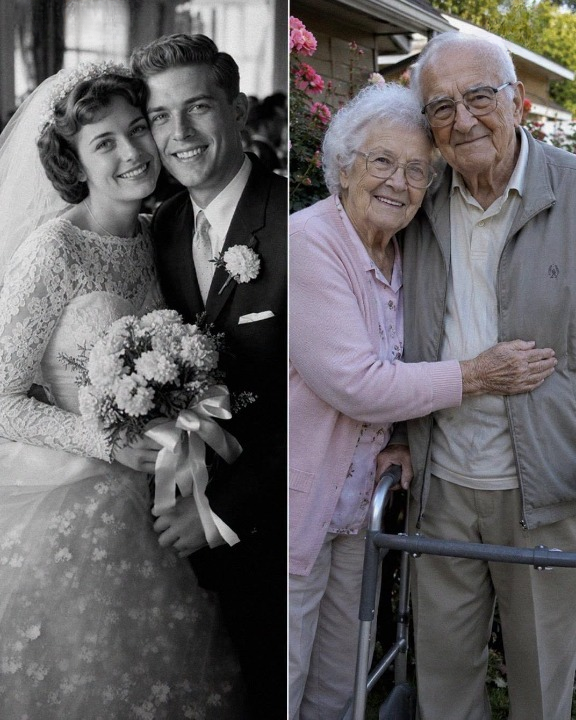
When my husband Walter died, we had been married for sixty-nine years.
Sixty-nine.
Sometimes even saying the number out loud seems impossible.
We met in college when we were both nineteen. Walter accidentally took the seat I’d saved for my roommate in a crowded lecture hall, and when I told him to move, he smiled and said, “I’ll move if you have coffee with me.”
I told him he was ridiculous.
Three days later, we had coffee.
Two years after that, we were married.
We built an ordinary life together.
Not a perfect one.
An ordinary one.
And I came to understand that ordinary could be incredibly beautiful.
We raised three children.
We welcomed five grandchildren.
We survived job losses, arguments, illnesses, leaky roofs, teenage rebellion, retirement, and more family holidays than I could count.
Walter was beside me through almost every important moment of my adult life.
So when he became seriously ill during his final year, there was nowhere else I wanted to be except beside him.
During those last months, I helped him dress.
I organized his medications.
I sat with him during appointments.
Sometimes, when he couldn’t sleep, we’d stay awake talking about people we had known fifty years earlier.
One evening, he took my hand and said, “You know I love you, don’t you?”
I laughed.
“After sixty-nine years, Walter, I should hope so.”
He didn’t laugh.
“I’m serious, Eleanor.”
I squeezed his fingers.
“I know.”
At the time, I thought he was simply frightened.
Now I know there was something else on his mind.
Walter passed away peacefully several weeks later.
I believed losing him would be the hardest thing I would ever experience.
Then came the reading of his will.
Our attorney, Mr. Bennett, asked our immediate family to gather in his office.
Walter’s younger sister, Margaret, came too.
She was eighty-seven and still somehow capable of making a room tense simply by entering it.
Margaret and I had never been close.
She’d tolerated me for nearly seven decades, but I’d always known she thought Walter had married beneath himself.
His family had been significantly wealthier than mine.
Walter rarely discussed it.
To him, money was something useful, not something interesting.
We sat around a long conference table while Mr. Bennett read Walter’s final instructions.
Several charitable organizations received donations.
Our children received portions of his investment accounts.
Each grandchild received money through a trust.
Walter’s small fishing cabin went to Margaret.
I smiled when I heard that.
She had always loved the place.
Then Mr. Bennett turned another page.
His voice became more careful.
“To my wife, Eleanor, I leave no assets under this will.”
For a moment, I thought I had misunderstood.
I looked at him.
“I’m sorry?”
Mr. Bennett didn’t repeat himself immediately.
My oldest son shifted uncomfortably.
My daughter reached for my hand.
Margaret, meanwhile, said nothing.
But I saw the slightest change in her expression.
Almost satisfaction.
I stared at the lawyer.
“Walter left me nothing?”
“Under the terms of this will, that is correct.”
My chest tightened.
I wasn’t thinking about luxury.
I didn’t need a mansion or jewelry.
But Walter and I had shared nearly seven decades.
We had built a life together.
Even a symbolic gift would have meant something.
A watch.
A book.
A dollar.
Anything.
Instead:
Nothing.
I barely heard the rest of the meeting.
When it ended, my children surrounded me.
“Mom, we’ll figure this out,” my son said.
“I’m fine.”
I wasn’t.
Margaret walked past me.
Before leaving, she touched my shoulder.
“Walter always was very particular about family property.”
There was something strange about the way she said it.
I looked at her.
“What is that supposed to mean?”
She smiled politely.
“Nothing.”
Then she left.
I was preparing to follow when Mr. Bennett closed the office door.
“Mrs. Hayes, would you stay for a few minutes?”
My daughter frowned.
“Should I stay with her?”
Mr. Bennett shook his head.
“Your father specifically requested that I speak with Eleanor privately.”
That worried me even more.
After everyone left, Mr. Bennett walked to a safe behind his desk and removed a cream-colored envelope.
My name was written across the front.
Walter’s handwriting.
I knew it instantly.
Mr. Bennett placed it in front of me.
“Your husband did leave you something.”
I looked at the envelope.
“Then why wasn’t it in the will?”
“Read the letter first.”
My hands trembled as I opened it.
The first words made my heart pound.
My love,
If you’re reading this, then everyone in that room believes I left you nothing.
That is exactly what I needed them to believe.
I stopped.
“What does this mean?”
Mr. Bennett simply said, “Keep reading.”
I lowered my eyes.
Walter’s letter continued.
There is something about my family that I should have told you many years ago. I convinced myself that keeping it from you was protecting you. Perhaps I was wrong. If so, I’m sorry.
Do not confront Margaret until you finish this letter.
My stomach twisted.
Walter explained that shortly before our wedding, his father had taken him aside.
The Hayes family fortune, apparently, came with conditions.
Walter’s grandfather had created a complicated family trust decades earlier.
Certain inherited properties and accounts were supposed to remain within what the documents called the “blood family line.”
I had never known that.
Walter hated the arrangement.
According to the letter, he’d told his father the whole idea was insulting.
But then came the part that truly shocked me.
Margaret had known about it too.
And for decades, she had monitored every major financial decision Walter made.
Not officially.
Not legally.
But constantly.
Whenever Walter wanted to sell inherited property, Margaret objected.
Whenever he discussed putting something jointly in my name, she reminded him of the trust.
I remembered several old arguments now.
Moments when Walter had returned from family meetings unusually quiet.
Times when Margaret had made strange comments about “protecting what belongs to the Hayes family.”
I had assumed it was ordinary sibling tension.
It wasn’t.
Then I reached the next paragraph.
Margaret believes that when I die, Eleanor will have a claim against certain family assets. She has been preparing for years to challenge anything I leave directly to you.
I froze.
“Challenge it?”
Mr. Bennett nodded.
“Keep reading.”
According to Walter, Margaret had openly warned him that if his will transferred significant family property to me, she would contest it.
Not because she needed the money.
Because she believed family assets should never pass to someone who had “married into” the family.
I felt anger rising.
After sixty-nine years, apparently I was still an outsider.
But Walter had anticipated all of it.
The letter continued.
So I stopped arguing with her.
That sentence almost made me smile.
It sounded exactly like Walter.
When Walter stopped arguing, it usually meant he had decided to do something quietly instead.
Over the final twenty-five years of our marriage, he had gradually separated everything he had personally earned from the inherited Hayes assets.
His salary.
Investment profits.
Income from a business partnership.
Money from consulting work after retirement.
None of it came from the old family trust.
And instead of waiting to leave it to me through his will, Walter had placed it into a separate legal trust years earlier.
A trust created specifically for me.
I looked at Mr. Bennett.
“How much?”
He slid a document across the desk.
When I saw the number, I thought there had been a mistake.
“This can’t be right.”
“It is.”
It was significantly more than the assets described during the will reading.
I stared at him.
“Walter had this much money?”
“He was a very disciplined investor.”
“Why didn’t I know?”
Mr. Bennett smiled.
“Your husband knew you weren’t particularly interested in financial statements.”
That was true.
Walter handled investments.
I handled household accounts.
As long as the bills were paid and we could help our children when necessary, I rarely asked about portfolio balances.
But there was still something I didn’t understand.
“Why all the drama? Why make everyone believe I received nothing?”
“Because the trust is outside the will.”
I slowly began to understand.
Margaret couldn’t challenge something Walter didn’t own when he died.
He had already legally transferred it.
To a trust whose only beneficiary was me.
“She can’t touch it?”
“No.”
“What about my children?”
“They’re protected too.”
I continued reading.
Then I reached the part Walter had called “the truth about me.”
I had spent my entire marriage believing Walter’s family wealth had supported us during the early years.
It hadn’t.
His father had cut him off financially three months after our wedding.
Why?
Because Walter refused to leave me.
My eyes filled with tears.
I read the sentence again.
My father told me that if I remained married to you, I should expect no financial assistance from him.
I chose you.
I never told you because I knew you’d blame yourself.
My hand covered my mouth.
All those early years.
Our tiny apartment.
Walter working nights while attending graduate school.
Me sewing curtains because we couldn’t afford proper ones.
Driving an old car that started only when it felt cooperative.
I had assumed Walter’s family simply wasn’t generous.
I never knew they had deliberately withdrawn support because of me.
Walter continued:
You once told me during our second year of marriage that you were sorry my family had to help us so much.
They weren’t helping.
You were.
We were.
Everything we built after that belonged to us.
I started crying.
Mr. Bennett quietly pushed a box of tissues toward me.
There was another page.
Walter explained that years later, his father had tried to reconcile.
Some inheritance eventually came to Walter despite their disagreement.
Walter accepted it because he intended to pass those family assets to our children and grandchildren.
But privately, he made a promise.
Whatever he personally built would one day belong to me.
Not because I needed to be rewarded for being his wife.
Because, as he wrote:
You were the only person who chose me before you knew whether I would ever become anything.
Then came the warning.
Do not trust Margaret when she tells you you’re taking something that belongs to the Hayes family.
She will almost certainly say that.
She’s wrong.
Nothing in your trust came from our grandfather, our father, or the family estate.
I built it after marrying you.
It exists because you built that life with me.
I had to stop reading again.
For sixty-nine years, Walter had never told me any of this.
Part of me was angry.
Another part understood exactly why.
If I’d known his father had disowned him because of our marriage, I would have carried that guilt for the rest of my life.
Walter knew me well enough to know that.
At the end of the letter was one final surprise.
The house.
Our actual home.
I had assumed Walter owned it.
Apparently, twenty-three years earlier, he had quietly changed the deed.
It had been mine for more than two decades.
“What?”
Mr. Bennett laughed softly.
“Walter said you’d react like that.”
“He put the house in my name without telling me?”
“He did.”
“How did I sign anything?”
“You signed a refinancing package years ago.”
I remembered.
Walter had put approximately a hundred tabs on documents and told me where to sign.
I stared at Mr. Bennett.
“That man.”
The attorney smiled.
“He was very thorough.”
When I finally reached the last paragraph, I could barely see through my tears.
Eleanor,
You may be angry that I kept this from you.
You have every right.
But please don’t spend your final years thinking I forgot you.
I have spent nearly seventy years choosing you.
My will changes none of that.
The best thing I ever inherited was nothing.
The best thing I ever chose was you.
Love always,
Walter.
I pressed the letter to my chest and cried.
Not because of the money.
Because suddenly dozens of moments from our marriage looked different.
Walter working late when we were young.
His father’s coldness.
Margaret’s comments.
The way Walter always insisted, “Everything we need, we’ll build ourselves.”
Now I understood.
Three days later, Margaret called me.
I almost didn’t answer.
“I understand Bennett spoke with you privately,” she said.
“He did.”
Her tone sharpened.
“About what?”
I remembered Walter’s warning.
“Personal matters.”
“Eleanor, if Walter attempted to move family assets—”
“He didn’t.”
She became quiet.
“What?”
“Nothing he left for me belonged to your family.”
“You don’t understand the trust.”
“I understand more than you think.”
I told her enough to make it clear that the lawyers had documented every source of the money.
Margaret had no claim.
There was a long silence.
Then she said, “He planned this.”
I looked at Walter’s letter lying beside me.
“Yes.”
He absolutely had.
But I didn’t feel victorious.
Mostly, I felt sad that after nearly seven decades, there had still been people keeping score over who belonged where.
Our children eventually learned the truth.
My oldest son was furious that his grandfather had once tried to break us apart.
My daughter cried when she read Walter’s letter.
My youngest simply laughed.
“Dad outsmarted everyone.”
That was one way to put it.
I kept the house.
I kept enough money to know I would never have to worry about my future.
But most of Walter’s trust will eventually go toward our children, grandchildren, and several causes we supported together.
I don’t need much.
At ninety years old, you begin to understand how little of what matters can be purchased.
The most valuable thing Walter left me wasn’t the trust.
It wasn’t the house.
It wasn’t investments.
It was the truth.
For several terrible minutes in that lawyer’s office, I believed that the man I’d loved for sixty-nine years had erased me from the final chapter of his life.
Instead, I learned he’d been protecting my place in it for decades.
Walter’s will said he left me nothing.
His letter told the real story.
He had already spent a lifetime giving me everything that mattered.