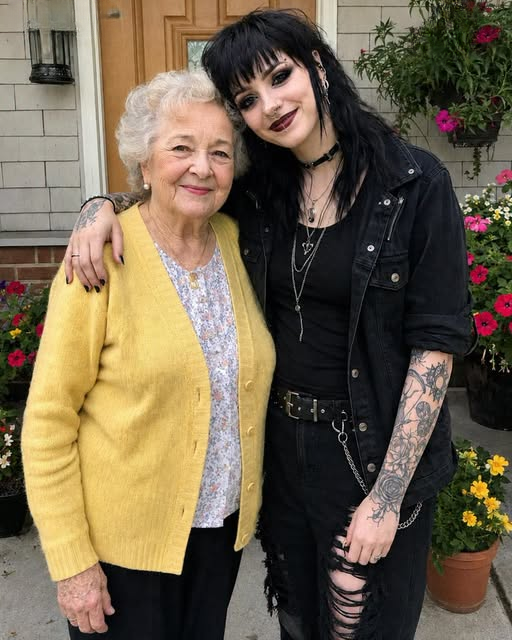
My mother, Doris, had always been one of the most predictable people I knew.
At seventy-three, she still lived in the same modest house where I had grown up. She woke early, made tea in the same chipped floral mug, spent mornings tending roses and tomatoes in her backyard, and rarely missed her Thursday book club.
She didn’t like crowds.
She didn’t care about trends.
And she had never been someone who made friends easily.
That was why I was so surprised the first time I met Raven.
I stopped by Mom’s house one Saturday afternoon with groceries.
Usually, when I opened the back door, I found Mom listening to the radio or doing a crossword puzzle at the kitchen table.
That afternoon, someone else was sitting across from her.
She looked to be in her early twenties.
Her black hair was cut sharply around her face. She wore dark clothes, heavy eyeliner, several facial piercings, and had colorful tattoos covering most of both arms.
At first glance, she and my mother looked like two people who would never have crossed paths.
Yet there they were, drinking tea and laughing together.
Mom looked up.
“Oh, you’re early.”
I raised an eyebrow.
“Apparently.”
She smiled.
“This is Raven.”
The young woman stood politely.
“It’s nice to meet you.”
“You too.”
I put the grocery bags down and looked at Mom.
“How do you two know each other?”
Mom answered far too quickly.
“Through town.”
“Through town?”
Raven glanced at her.
Mom changed the subject.
“Did you remember the coffee I asked for?”
I knew exactly what she was doing.
Mom had used that same technique on me since childhood.
Whenever she didn’t want to answer a question, she found something else to discuss.
I decided not to push.
But the following Saturday, Raven was there again.
And the Saturday after that.
Before long, her visits became completely normal.
She arrived shortly after lunch and usually stayed for two or three hours.
Sometimes she brought pastries.
Once, I found them planting herbs together in the backyard.
Another time, Raven was sitting on the floor helping Mom organize old photographs.
Mom clearly adored her.
That should have reassured me.
Instead, it made me more curious.
“Seriously,” I asked one evening after Raven had left. “Where did you meet her?”
Mom smiled.
“She’s a good girl.”
“That wasn’t my question.”
“I know.”
“Why is this such a secret?”
“It isn’t a secret.”
“Then tell me.”
Mom took a sip of tea.
“I enjoy her company.”
That was all I ever got.
Things became stranger when I tried staying during their visits.
Mom always found a reason to send me somewhere.
“Could you pick up milk?”
“We have milk.”
“Not the kind I like.”
Or:
“I forgot to collect my prescription.”
“You told me you got it yesterday.”
“Then perhaps I need something else from the pharmacy.”
By the time I returned, Raven was usually gone.
At first, I wondered if Mom was helping her financially.
Then I worried it might be something more serious.
I even asked Raven privately one afternoon as she was leaving.
“Is my mother okay?”
She stopped.
“What do you mean?”
“She’s acting secretive.”
Raven smiled faintly.
“Your mom is fine.”
“Are you sure?”
“Yes.”
Then she added, “She talks about you a lot.”
That surprised me.
“Good things, I hope.”
Raven laughed.
“Mostly.”
I liked her after that.
I still didn’t understand their friendship, but I stopped feeling suspicious.
If anything, I became grateful.
Mom had seemed lonely since my father died eight years earlier.
She never complained, but I could see the difference in her.
Raven made her laugh.
That was enough for me.
Then everything changed.
One Tuesday morning, Mom suffered a severe stroke.
A neighbor found her and called an ambulance.
By the time I reached the hospital, she was unconscious.
She died two days later.
There are some losses you’re never prepared for, even when the person you love has lived a long life.
I thought I’d have more time.
Another Christmas.
Another birthday.
Another Saturday afternoon sitting at her kitchen table.
Instead, I found myself choosing funeral flowers and answering phone calls from relatives.
The house became painfully quiet.
During the funeral, I noticed Raven standing alone near the back.
She wore a simple black dress.
For once, the dark clothes didn’t make her stand out.
She cried through most of the service.
Afterward, while relatives gathered outside, Raven approached me.
Her eyes were red.
“I’m sorry,” she said.
“Thank you.”
Then she reached into her coat pocket.
She removed a small old-fashioned brass key.
Before I could ask anything, she placed it in my palm.
I stared at it.
“What is this?”
Raven gently folded my fingers around it.
“Your mom told me to give you this only after she was gone.”
My stomach tightened.
“Give me what?”
“The key.”
“To what?”
Raven looked toward the cemetery.
“She made me promise not to tell you until now.”
I felt frustration rising.
“Raven, my mother just died. Please don’t make this mysterious.”
“I’m not trying to.”
She took a breath.
“Do you know the old train station storage building?”
I did.
It had been converted into private storage units years earlier.
Mom had never mentioned renting one.
“Unit seventeen,” Raven said. “The key opens it.”
“Why does my mother have a storage unit?”
Raven’s eyes filled again.
“Because of your father.”
I froze.
“My father?”
She nodded.
I drove there that afternoon.
Raven came with me.
The old building smelled like dust and wood.
We found Unit 17 near the end of a narrow hallway.
My hands trembled as I inserted the key.
The lock opened.
When I lifted the door, I expected boxes.
Maybe furniture.
Maybe some old family belongings.
Instead, I found what looked like a small room.
There was a desk.
Shelves.
Several large plastic containers.
And hundreds of letters.
I stepped inside slowly.
“What is all this?”
Raven stood behind me.
“Your mother’s project.”
I looked at her.
“My mother’s what?”
She pointed toward the shelves.
Each box had a handwritten label.
HOUSING.
FOOD ASSISTANCE.
JOB APPLICATIONS.
COLLEGE.
EMERGENCY FUNDS.
I opened one.
Inside were folders containing names, receipts, handwritten notes, and thank-you cards.
I recognized Mom’s handwriting everywhere.
“Raven, I don’t understand.”
She pulled out a chair.
Then she told me everything.
About five years earlier, Raven had been eighteen and living out of her car.
She’d left a difficult home situation and had almost no money.
One cold evening, she went into a small diner near Mom’s house simply because it was warm.
Mom was sitting at the counter.
Raven ordered tea because it was the cheapest thing on the menu.
Mom noticed she hadn’t ordered food.
So she bought her dinner.
At first, Raven refused.
Mom apparently said, “You can repay me someday by helping someone else.”
I smiled despite the tears in my eyes.
That sounded exactly like Mom.
The next week, Mom saw Raven again.
They talked.
Slowly, Raven told her what was happening.
Mom helped her find temporary housing.
Then work.
Then helped her apply to community college.
“But that’s not all,” Raven said.
She gestured around the room.
“Your mother has been helping people for years.”
I stared at the shelves.
“People like you?”
“Young people. Older people too. Anyone who needed something small enough that everyone else seemed to overlook it.”
Bus passes.
Groceries.
Application fees.
A month’s rent.
Work clothes.
Textbooks.
Sometimes just someone to sit with them while they filled out paperwork.
“Why didn’t she tell me?”
Raven smiled.
“She said you’d try to make a big deal about it.”
I laughed through my tears.
She was probably right.
Then Raven pointed toward the desk.
“There’s something for you.”
A sealed envelope rested beside a photograph of my father.
My name was written across the front.
I opened it.
Sweetheart,
If Raven has given you the key, then I suppose I’m no longer there to explain this badly in person.
Your father started this.
I stopped reading.
Dad?
I looked at Raven.
She nodded.
I continued.
Years before he died, my father had quietly created a small emergency fund.
He had grown up poor and never forgot what it felt like to need fifty dollars and not have anyone to ask.
After retirement, he started helping people anonymously.
Mom continued after his death.
At first, she only managed the fund.
Then she expanded it.
She began meeting people.
Listening to them.
Helping personally.
The Saturday meetings with Raven weren’t just tea.
Raven had begun helping Mom run the program.
“Why Raven?” I asked.
“Because she understood what it felt like to need help,” Raven replied.
Mom’s letter continued.
I did not tell you because I wanted this to be something freely chosen, not something you felt obligated to inherit.
If you want to close it, close it.
If you want to continue it, Raven knows how everything works.
But before you decide, open the blue box.
I looked around.
There was a blue container beneath the desk.
Inside were photographs.
Dozens.
People standing beside Mom.
A young man holding a college diploma.
A woman with two children in front of a new apartment.
An elderly man holding groceries.
Raven beside Mom at what appeared to be a graduation ceremony.
On the back of each photograph, Mom had written a date and one sentence.
FIRST MONTH’S RENT.
STARTED NURSING SCHOOL.
NEW JOB.
SAFE HOUSING.
CAR REPAIRED.
I sat on the floor and cried.
All those Saturdays, I’d worried that Mom was hiding something strange from me.
She was.
But not for the reason I’d imagined.
She had built an entire quiet network of kindness.
“How much money is left?” I asked.
Raven handed me a folder.
Not a fortune.
But enough to continue helping people in small, practical ways.
Then she said, “There’s another account.”
I looked up.
“Another?”
“Your mom left part of her estate to it.”
Of course she had.
I laughed.
“She really planned all of this.”
Raven smiled.
“Your mother planned everything.”
For the next several weeks, I went through the files.
At first, I intended only to organize them before deciding what to do.
Then I began reading letters.
One was from a single mother thanking Mom for paying a utility bill during a difficult winter.
Another was from a student thanking her for buying a laptop.
One man wrote that Mom had been the first person in years to ask him what he needed instead of assuming she knew.
The letter that affected me most came from Raven.
It had been written three years earlier.
Mrs. Doris,
You told me I’m not a problem that needs fixing.
I don’t think anyone had ever said that before.
Thank you for seeing a person when everyone else saw my clothes, my piercings, or my mistakes.
I understand now why Mom never cared what Raven looked like.
She hadn’t seen a goth girl covered in tattoos.
She had seen a frightened eighteen-year-old who needed dinner.
That was Mom.
She looked past surfaces.
Eventually, I decided not to close the program.
Raven and I renamed it the Doris and Henry Fund after my parents.
We kept it small.
Quiet.
Practical.
Exactly the way Mom would have wanted.
Every Saturday afternoon, Raven and I now meet at the same kitchen table where I first saw her years earlier.
Sometimes we review applications.
Sometimes we make phone calls.
Sometimes we simply drink tea.
I kept Mom’s floral mug.
Raven says I’m not allowed to use it because I’ll eventually break it.
She’s probably right.
A year after Mom died, a nineteen-year-old young man came to us because he needed money for a certification exam.
We paid the fee.
Before he left, he said, “I don’t know how I’ll repay you.”
I almost cried when I heard myself answer with Mom’s words.
“You don’t have to repay us. Someday, help someone else.”
After he left, Raven smiled at me.
“Now you sound like her.”
I looked at the old brass key hanging beside the kitchen door.
For months, I had thought Mom’s greatest secret was whatever that key opened.
I was wrong.
The key only opened a storage room.
Her real secret was much bigger.
She had spent years proving that kindness doesn’t have to be loud to change someone’s life.
Sometimes it looks like a seventy-three-year-old woman drinking tea with a tattooed young stranger every Saturday afternoon.
And sometimes it leaves behind a key, waiting for the next person to open the door.