A Veterinarian Freed a Chained Wild Horse in Romania—What Happened Next Was Unforgettable
In a quiet part of Romania, a frightened wild horse was living under conditions that made even the simplest movement dangerous.
A mare stood with chains wrapped around her front legs, unable to move naturally.
Every step was restricted.
Every attempt to walk carried the possibility of injury.
She had no way to understand why the metal restraints were there or why she couldn’t move the way a horse was meant to move.
Then veterinarian Ovidiu Roșu arrived.
What happened next became a powerful reminder of how much a single act of compassion can change an animal’s life.
A Wild Animal Trapped by Metal
Horses are built to move.
They walk long distances.
They graze.
They run when frightened.
They interact with other horses and respond naturally to their surroundings.
For a wild or semi-wild horse, freedom of movement is especially important.
So seeing a mare restrained by chains around her front legs was deeply concerning.
The heavy metal limited her ability to take normal steps and created a serious risk of falling, becoming entangled, or suffering additional injuries.
Even a seemingly simple restraint can become dangerous when an animal struggles against it.
And this mare was understandably frightened.
She didn’t know that help had arrived.
From her perspective, unfamiliar people were approaching her while she was already trapped.
Approaching a Frightened Horse
Rescuing an animal in distress isn’t always as simple as walking up and removing the problem.
A frightened horse can be unpredictable.
Even an animal that normally appears calm can react suddenly when it feels threatened.
Horses are powerful animals, and when fear takes over, their instinct is often to escape.
But this mare couldn’t simply run away.
The chains prevented her from moving normally.
That created a difficult situation for everyone involved.
The rescue team had to balance speed with safety.
The priority was to prevent the mare from hurting herself while also protecting the people trying to help her.
The Decision to Sedate Her
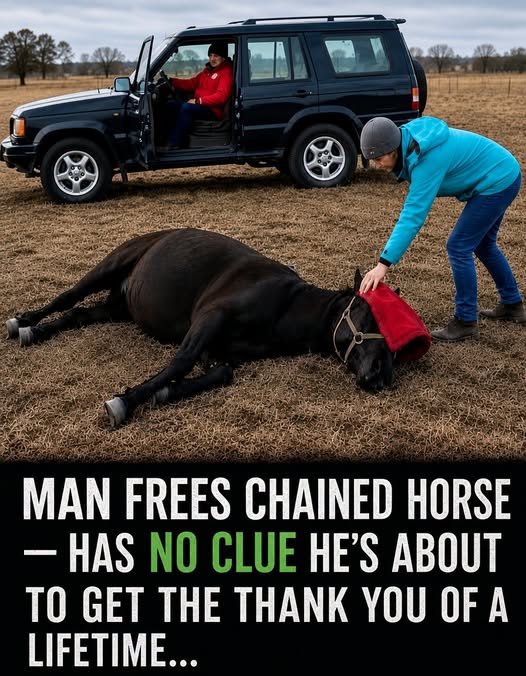
Because the animal was frightened and the restraints were dangerous, the veterinarian made the decision to sedate her.
Sedation can allow veterinary professionals to work more safely around an animal that is stressed, injured, or difficult to handle.
For the mare, it meant temporarily reducing her fear and movement so the chains could be removed without causing additional harm.
This was not about controlling her for convenience.
It was about creating a safer environment for the rescue.
Once she was safely sedated, the veterinarian could begin examining the situation more carefully.
The chains had to be removed with precision.
A rushed movement could cause another injury.
Every step required attention.
Removing the Chains
The moment the metal restraints were finally removed was more than a physical procedure.
It represented the return of something the mare had been denied:
Freedom of movement.
The veterinarian carefully worked to release the chains from her legs.
Once they were gone, the mare no longer had the same restriction around her front limbs.
She could eventually stand and move without dragging metal along with every step.
For the people involved in the rescue, it was a deeply emotional moment.
After seeing an animal trapped and frightened, watching the restraint disappear must have felt like an enormous relief.
Treatment Was Only the Beginning
Removing the chains was an important step, but it wasn’t necessarily the end of the mare’s problems.
When an animal has been restrained for an extended period, veterinary assessment is essential.
The legs need to be checked for wounds, swelling, pressure injuries, infection, or other complications.
The veterinarian examined the mare and provided the necessary care.
The goal wasn’t simply to take away the chains.
It was to give the animal a genuine chance to recover.
That distinction matters in animal rescue.
Freeing an animal is only the first part.
Proper treatment, monitoring, and rehabilitation may also be necessary.
Imagine the First Unrestricted Steps
One of the most powerful parts of a rescue like this is imagining what those first free movements must have felt like.
For an animal accustomed to restrictions, freedom can be confusing at first.
The mare had to adjust.
Her body needed time.
Her muscles and joints had to move naturally again.
But eventually, she could begin taking steps without the metal restraints limiting her.
A simple walk can become something extraordinary when an animal has previously been denied that basic freedom.
The difference between being chained and being free isn’t just physical.
It changes how an animal interacts with the world.
Why Wild Horses Need Special Care
Wild horses live very differently from domesticated animals.
They rely on movement, social relationships, grazing, and environmental awareness.
Their behavior is shaped by instincts that have developed over generations.
When humans interfere with those natural behaviors, the consequences can be serious.
Restraining a horse in a way that prevents normal movement can increase stress and create physical risks.
That is why responsible handling is so important.
Animals that are frightened or injured need knowledgeable care.
Veterinary professionals understand how to approach them while minimizing additional distress.
The Importance of Veterinarians in Rescue Work
Stories like this also highlight the broader role veterinarians can play outside traditional clinics.
Veterinary medicine isn’t limited to household pets.
Professionals may work with horses, livestock, wildlife, and rescued animals.
In difficult situations, their expertise can mean the difference between further suffering and recovery.
A veterinarian knows how to assess injuries.
They understand animal behavior.
They can determine when sedation is appropriate.
They know how to treat wounds and monitor recovery.
And perhaps most importantly, they can make decisions based on the animal’s welfare rather than fear or convenience.
Compassion Requires More Than Good Intentions
Rescue stories can sometimes make the process look simple.
Someone finds an animal.
They remove the danger.
Everything becomes better.
Reality is often much more complicated.
Animals don’t always understand that humans are trying to help them.
A frightened horse may resist.
An injured animal may panic.
A rescue attempt can become dangerous if the people involved don’t have the right knowledge or equipment.
That’s why professional intervention is so valuable.
Compassion is important.
But compassion combined with expertise is even more powerful.
A Lesson in Respecting Animals
The mare’s story also raises a broader question about how humans treat animals.
Domesticated animals have lived alongside people for thousands of years.
But domestication doesn’t remove their basic physical and behavioral needs.
Horses still need movement.
They need appropriate nutrition.
They need safe environments.
They need veterinary care.
And they need to be handled with respect.
When an animal is unable to protect itself, humans have a responsibility to minimize unnecessary suffering.
That responsibility becomes especially important when the animal is frightened or vulnerable.
The Mare Wasn’t “Bad”—She Was Afraid
It’s easy to misinterpret an animal’s behavior.
A frightened horse might pull away.
It might attempt to kick.
It might panic when someone approaches.
But those behaviors don’t necessarily mean the animal is aggressive.
They may simply mean the animal is terrified.
This distinction is critical during rescue operations.
The mare had been placed in a situation she couldn’t understand.
Her reactions were driven by fear and instinct.
The veterinarian’s approach recognized that.
Instead of treating the horse as a problem, the rescue team treated her as an animal in distress.
That change in perspective can make all the difference.
The Moment Freedom Returned
After the chains were removed and the necessary treatment provided, the mare had something she hadn’t been able to experience properly before:
The ability to move without being restrained.
That may sound like a small thing.
It isn’t.
For a horse, movement is fundamental.
Walking from one place to another.
Turning around.
Grazing.
Moving away from danger.
Standing comfortably.
Interacting with other horses.
These are basic parts of life.
The removal of the chains gave the mare the opportunity to begin experiencing those things again.
Why This Story Resonates With People
Animal rescue stories often affect us deeply because they demonstrate a simple idea:
Suffering can sometimes be reduced when someone chooses to intervene.
The veterinarian didn’t know this horse’s entire history.
He couldn’t undo everything that had happened before he arrived.
But he could change what happened next.
That is one of the most meaningful aspects of rescue work.
You may not be able to rewrite an animal’s past.
You can still give it a better future.
One Rescue Can Start a Larger Conversation
Stories like this can also encourage people to think about animal welfare more broadly.
How are working animals treated?
What should proper horse care look like?
What happens when people encounter neglected or restrained animals?
When should authorities or veterinarians be contacted?
How can communities respond when an animal appears to be suffering?
These questions matter.
Awareness can help prevent similar situations.
People who recognize signs of injury or neglect are more likely to seek professional assistance rather than ignoring the problem.
The Human Side of the Rescue
There is also something deeply human about watching a professional dedicate time to an animal that cannot say what hurts.
The mare couldn’t explain where she was injured.
She couldn’t ask for the chains to be removed.
She couldn’t tell the veterinarian that she was frightened.
Her condition had to be understood through observation.
That is part of what makes veterinary medicine so remarkable.
Professionals must interpret behavior, physical signs, movement, and other clues.
They become the animal’s advocate when the animal cannot advocate for itself.
A Second Chance
The mare’s rescue ultimately represents more than the removal of a few pieces of metal.
It represents a second chance.
A chance to heal.
A chance to move naturally.
A chance to experience less fear.
A chance to live without the restraints that had placed her at risk.
We often use the phrase “second chance” when talking about people.
But animals deserve second chances too.
They deserve the opportunity to recover when recovery is possible.
What We Can Learn From Her Story
There are several lessons hidden inside this remarkable rescue.
First, animals in distress need careful professional attention.
Second, fear can dramatically change an animal’s behavior.
Third, removing an obvious danger doesn’t necessarily eliminate every problem; proper treatment and recovery matter.
And finally, small acts of intervention can have enormous consequences.
For this mare, the difference between before and after was profound.
Before the rescue, metal restricted her movement.
Afterward, she had the possibility of moving freely again.
Before, approaching humans likely meant fear.
Then someone approached with the intention of helping.
Freedom Is Sometimes the Greatest Gift
We often think of rescue as providing food, shelter, medicine, or protection.
All of those things matter.
But sometimes the most important thing an animal needs is simply the removal of what is hurting it.
For this mare, freedom of movement was exactly that.
The chains were not just objects attached to her legs.
They represented a constant physical limitation.
Once they were removed, a new chapter could begin.
Her recovery might take time.
There could still be challenges ahead.
But at least she was no longer trapped in the same way.
A Powerful Reminder
The story of this Romanian mare is a reminder that compassion can take many forms.
Sometimes it means stopping to help.
Sometimes it means calling a professional.
Sometimes it means patiently approaching a frightened animal.
And sometimes it means giving an animal enough care and space to recover.
Veterinarian Ovidiu Roșu’s intervention gave this horse an opportunity she desperately needed.
The mare could not tell anyone what she had endured.
She couldn’t ask for help.
But someone noticed.
Someone intervened.
And someone had the knowledge to safely remove the restraints and provide care.
That is what makes the story so memorable.
The rescue didn’t erase the past.
It simply changed what came next.
And for an animal that had been living with chains around her legs, that change meant everything.
The mare was no longer defined by the restraints that had held her.
She had been given another chance to stand, walk, heal, and experience the freedom that every horse should have the opportunity to enjoy.