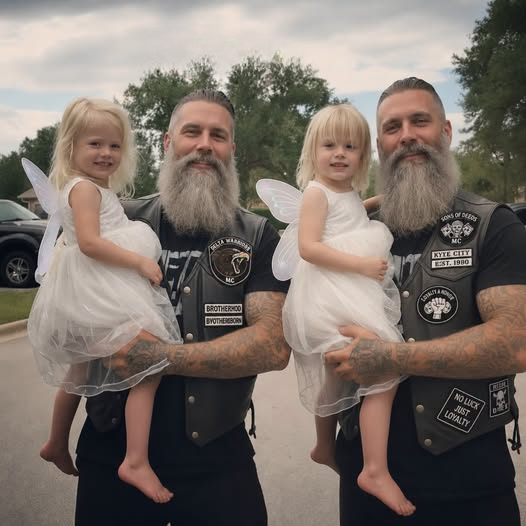
I was standing at the grocery-store checkout with my three-year-old twins when I realized I had made a mistake.
Not a small mistake.
A $5 mistake.
My bank account had forty-seven dollars in it, and the total on the register was fifty-two.
Behind me, a line of customers was getting longer.
Anna was crying because I wouldn’t buy the cookies she’d picked up.
Ethan had dropped his stuffed dog on the floor for the third time.
And I was exhausted.
I’d worked until three that morning and had barely slept before the twins woke me.
All I wanted was to buy diapers, milk, and bread and get everyone home.
I stared at the screen.
$52.18.
My checking account balance flashed through my mind.
$47.03.
I swallowed hard.
“I’m sorry,” I told the cashier. “I need to put something back.”
I reached for the bread.
“We can manage without this.”
The cashier nodded.
Then a deep voice behind me said:
“Please don’t.”
I turned around.
Four men stood several feet away.
They were dressed in motorcycle jackets, and each had the weathered appearance of someone who spent a lot of time on the road.
The man who had spoken stepped forward.
“Let me cover the difference.”
I immediately shook my head.
“No, thank you.”
He smiled.
“It’s five dollars.”
“I know.”
“You’ve got two little ones who need diapers. Let me help.”
I looked at the twins.
Then at him.
Something about accepting money from a stranger made me uncomfortable.
“I appreciate it, but we’ll be okay.”
He didn’t argue.
Instead, he pulled out his wallet and handed the cashier a twenty-dollar bill.
“Then consider it a gift.”
I stared at him.
“You don’t even know me.”
“No,” he said.
“Not yet.”
Something about that answer made me pause.
He paid the difference and stepped back.
I thanked him quietly.
Then I gathered the bags, took one child by the hand, lifted the other into my arms, and headed toward the parking lot.
I thought that was the end of the encounter.
I was wrong.
The Life Nobody Saw
My name is Sarah.
I’m a single mother raising three-year-old twins, Anna and Ethan.
Their father left when they were six months old.
There wasn’t a dramatic goodbye.
There wasn’t a long explanation.
One day, he simply admitted that fatherhood was more than he could handle.
Then he disappeared.
I haven’t heard from him since.
Since then, I’ve done whatever I could to keep our little family together.
I work two jobs.
During the day, I’m a receptionist at a medical clinic.
At night, I clean offices.
My mother helps with the children when she can, but most evenings I’m responsible for everything myself.
Meals.
Baths.
Laundry.
Bedtime.
Bills.
Appointments.
Everything.
Some months are easier than others.
That month wasn’t easy.
I had less than fifty dollars in my account and five days until payday.
That’s why the grocery-store checkout had embarrassed me so much.
I wasn’t asking anyone for help.
I was simply trying to make the numbers work.
After the stranger paid, I loaded the groceries into my car.
The twins climbed into their seats.
As I started the engine, I noticed the motorcycles leaving the parking lot.
The same men.
For some reason, the man who had helped me looked toward my car before riding away.
I didn’t think much of it.
Three Days Later
On Friday evening, someone knocked on my apartment door.
I wasn’t expecting anyone.
When I opened it, I found the same man from the grocery store standing outside.
I immediately became cautious.
“Can I help you?”
He lifted both hands.
“I’m sorry. I should have introduced myself properly.”
“My name is Marcus.”
He nodded toward the twins, who were playing on the living-room floor.
“I wanted to make sure you all got home safely that day.”
I frowned.
“We did.”
“Good.”
He started to leave.
Then Anna looked up.
“Motorcycle!”
Marcus smiled.
“You like motorcycles?”
She nodded enthusiastically.
“Big one!”
He laughed.
“Yes. Very big.”
Ethan came running over.
“Can we see?”
I hesitated.
Then I remembered something important.
Marcus hadn’t asked for anything.
He hadn’t tried to come inside.
He hadn’t pressured me.
He had simply checked that we were okay.
“Maybe another day,” I said.
“That’s fine.”
He handed me a small paper bag.
“What’s this?”
“Nothing important.”
I opened it after he left.
Inside were two children’s books and a box of crayons.
There was also a note.
For Anna and Ethan. Every kid deserves something to look forward to.
I stared at it for a long time.
The Motorcycle Club
Over the next few weeks, I learned that Marcus wasn’t alone.
The men I’d seen at the grocery store belonged to a local motorcycle club.
I’d always had assumptions about people like them.
I thought of loud engines, leather jackets, and rough-looking men.
But I slowly discovered another side.
They organized food drives.
They collected winter coats.
They helped repair bicycles for children.
They raised money for local families who were struggling.
They weren’t perfect.
They were simply people.
People who had decided they could use their resources to help others.
Marcus never asked me to join anything.
He never expected anything in return.
Sometimes he’d see me outside with the twins and wave.
Sometimes he’d bring them a book.
Once, he helped me carry a broken piece of furniture down the stairs.
Little things.
Nothing dramatic.
But consistency matters when you’re raising children alone.
Then One Afternoon, Everything Changed
I was leaving work when I received a phone call from my mother.
“Sarah, don’t panic.”
Whenever someone starts a sentence like that, you immediately panic.
“What happened?”
“It’s Ethan.”
My heart stopped.
“What about him?”
“He fell at the playground. He’s okay, but he hit his head.”
I left work immediately.
At the clinic, Ethan was sitting beside my mother with an ice pack against his forehead.
He was crying.
But he was awake and talking.
The doctor said he appeared fine but wanted to keep an eye on him.
I sat beside my son and held his hand.
Then someone knocked on the examination-room door.
Marcus.
I stared at him.
“How did you know?”
My mother answered.
“I called him.”
I looked at her.
“You called Marcus?”
“He was helping me with the groceries when I saw you rush inside.”
Marcus stepped closer.
“I don’t want to intrude.”
“You’re not.”
He looked at Ethan.
“Little man, you doing okay?”
Ethan nodded.
Marcus smiled.
“Good.”
Then he turned to me.
“Kids are tougher than we think.”
I smiled weakly.
“They’re also expensive.”
He laughed.
“That too.”
For the first time since the accident, I relaxed.
The Question I Finally Asked
A few weeks later, I finally asked Marcus something that had been bothering me.
“Why do you keep helping us?”
He looked at me for a moment.
“Because I know what it’s like to struggle.”
I waited.
“My mother raised me alone.”
That surprised me.
“She worked two jobs too.”
He looked down.
“When I was a kid, there were people who helped us. Sometimes it was groceries. Sometimes it was a winter coat. Sometimes it was just somebody showing up.”
“What happened to your mother?”
“She passed away years ago.”
“I’m sorry.”
“Thank you.”
He paused.
“She always told me something.”
“What?”
“If you ever become fortunate enough to help somebody else, don’t make them feel small for needing it.”
I didn’t know what to say.
Marcus smiled.
“So when I saw you at that checkout, I didn’t see a woman who couldn’t afford five dollars.”
“What did you see?”
“A tired mother trying to take care of her kids.”
That sentence stayed with me.
Because that was exactly what I had been doing.
Trying.
Every day.
The Following Christmas
By December, Marcus and his friends had become familiar faces in our neighborhood.
They organized a holiday donation drive.
Families could receive toys, coats, groceries, and other essentials.
I didn’t want to accept anything.
Marcus looked at me.
“Sarah.”
“What?”
“Let somebody help you.”
I looked at my twins.
Anna was holding a stuffed rabbit.
Ethan was carrying a toy truck.
They were smiling.
So I stopped arguing.
I accepted the gifts.
Not because I was helpless.
Because sometimes accepting kindness is simply another way of allowing people to be generous.
A Different Kind of Family
Over time, Marcus became someone the twins trusted.
They still called him “the motorcycle man.”
Whenever they heard an engine outside, they’d run to the window.
“Is Marcus here?”
Sometimes he was.
Sometimes he wasn’t.
But he always seemed to appear when there was a neighborhood event, a charity drive, or a chance to help someone.
One afternoon, I watched him teach Ethan how to properly hold a small bicycle helmet.
“Safety first,” Marcus said.
Ethan nodded seriously.
Anna stood nearby.
“Can I ride a motorcycle?”
Marcus laughed.
“Maybe when you’re about ninety.”
She frowned.
“That’s too old.”
Everyone laughed.
For a moment, everything felt normal.
And normal was something I had missed.
What I Finally Understood
I used to think strength meant doing everything alone.
I thought asking for help meant I’d failed.
I thought accepting kindness meant I was admitting I couldn’t provide for my children.
I don’t believe that anymore.
Being strong doesn’t mean refusing every helping hand.
Sometimes strength is knowing when to accept one.
Marcus never rescued me.
He never tried to take responsibility for my children.
He never treated me like someone who couldn’t take care of herself.
He simply reminded me that people can help one another without expecting something in return.
The five dollars at that grocery-store checkout wasn’t really about five dollars.
It was about dignity.
It was about someone noticing that I was struggling and choosing to help without making me feel ashamed.
And perhaps the greatest lesson my children learned wasn’t about motorcycles at all.
It was about kindness.
Years later, Anna still remembers that grocery store.
She tells people:
“That’s where we met Marcus.”
And whenever she does, I smile.
Because I remember standing at that checkout with forty-seven dollars in my account, wondering how I was going to make it through the week.
I had no idea that a stranger’s small act of kindness would eventually become the beginning of a friendship that changed the way our family understood community.
Sometimes the people who look intimidating from a distance are carrying the gentlest intentions.
Sometimes help arrives from the person you least expect.
And sometimes five dollars can remind a tired parent that she doesn’t have to carry everything alone.