My Neighbor Removed My Fence While I Was Away — So I Had the Property Line Professionally Marked
When I returned home after a week away, the first thing I noticed was not the house, the trees, or even my dog waiting inside.
It was the empty space along the side of my property.
Something was missing.
At first, I couldn’t quite process what I was seeing. The backyard looked unusually open, almost as though someone had changed the landscape while I was gone.
Then I realized what had happened.
My fence was gone.
It hadn’t fallen during a storm.
It hadn’t been damaged by an animal.
It hadn’t been partially repaired or moved.
Nearly 200 feet of fencing that had stood along the edge of my property for years had been removed.
The discovery immediately raised an important question:
Who had removed it, and why?
Before I could answer that question, however, I had to remind myself not to react emotionally.
Property disputes can become complicated very quickly. A conversation between neighbors can turn into a disagreement, and a disagreement can become much more difficult when people begin making decisions without checking the facts.
So instead of confronting anyone immediately, I went inside and started gathering the documents I already had.
That decision ended up making a significant difference.
A Quiet Property in Western North Carolina
I live outside a small town in western North Carolina.
It’s the kind of area where people generally recognize their neighbors. People wave when they drive past. You might have a short conversation at the mailbox or stop to talk about the weather.
At the same time, privacy is important.
My property sits at the end of a gravel road and includes several wooded acres.
I purchased it after spending years working in construction management in Charlotte.
The work was rewarding, but the constant traffic, noise, and fast pace eventually made me want something different.
I wanted trees.
I wanted quiet mornings.
I wanted enough land that I didn’t have to look directly into another house from every window.
Most importantly, I wanted a place where I could create a home that felt comfortable and private.
The property wasn’t luxurious.
It didn’t need to be.
The peaceful surroundings were the main attraction.
Why I Built the Fence
A few years after purchasing the property, I decided to install a wooden fence along one of the boundaries.
The fence was approximately six feet tall and constructed from pressure-treated wood.
The posts were set securely, and the fence extended for nearly 200 feet along the boundary between my property and the neighboring lot.
I didn’t build it as some kind of statement.
There were practical reasons.
I had a Labrador named Daisy who loved exploring.
A fence gave her a defined area where she could spend time outside without wandering toward the road or neighboring properties.
I also had a garden that occasionally attracted deer.
The fence helped create a little separation between the garden and the surrounding woods.
And, of course, there was privacy.
After years of living in busy areas, having a private backyard was something I valued.
I built much of the fence myself.
A friend helped me on some weekends, and the project took considerably more effort than I had originally expected.
We measured.
We dug post holes.
We set posts.
We checked levels.
We attached panels.
Then we did it all again.
When the work was finally complete, I remember standing in the backyard and feeling satisfied.
It wasn’t just a fence.
It represented the home I had worked toward for years.
The Previous Neighbors
For several years, there were no problems.
The neighboring property was quiet.
An older couple eventually moved in and lived there for some time.
They were friendly but kept mostly to themselves.
We exchanged greetings when we saw each other, occasionally talked about the neighborhood, and generally respected one another’s space.
There were no disagreements about the fence.
There were no arguments about the property line.
There was simply an understanding that each household had its own yard.
Eventually, the couple moved away.
The property was sold.
That’s when things began to change.
Meeting the New Neighbors
The new owners were Ethan and Mara Carter.
They appeared friendly when they first moved in.
Ethan introduced himself, and we had a short conversation.
They talked about settling into the area and getting to know the neighborhood.
Mara mentioned that they were looking forward to spending more time outdoors.
At first, I had no reason to think anything would be different.
New neighbors are normal.
People have different lifestyles and different ideas about how they want to use their property.
I assumed we would eventually establish the same comfortable relationship I had with the previous owners.
Then, several weeks later, Ethan brought up the fence.
“Have You Ever Thought About Removing It?”
I was outside with Daisy when Ethan approached the property line.
He looked at the fence for a moment before asking whether I had ever considered taking it down.
I told him that I hadn’t.
He explained that he thought the yards might feel more open without the fence.
From his perspective, removing it could create a larger shared outdoor area.
He talked about the children having more room and neighbors being able to move between the properties more easily.
I understood the idea.
But understanding someone’s preference doesn’t mean you have to agree with it.
I explained that I had built the fence for privacy, for Daisy, and for practical reasons.
I also reminded him that the fence was on the boundary of my property.
He seemed disappointed, but the conversation remained polite.
I assumed that was the end of it.
I was wrong.
Returning Home to an Empty Boundary
About a week later, I returned from a trip.
I had been away for several days and was still thinking about the trip when I pulled into the driveway.
Then I noticed the backyard.
Something immediately looked different.
The fence was gone.
I walked toward the area where it had stood.
There was no partial section remaining.
No loose boards.
No fallen panels.
No obvious storm damage.
The entire stretch had been removed.
I walked the boundary slowly.
The post holes had been disturbed.
Some of the ground showed clear signs that the posts had been pulled out.
The more I looked, the clearer it became that this hadn’t happened naturally.
Someone had removed the fence intentionally.
My First Reaction
My first instinct was anger.
Anyone would probably feel upset after discovering that something they had built and maintained for years had been removed without permission.
But I also knew that reacting emotionally could make the situation worse.
I didn’t want to walk over to the neighbor’s house and start an argument.
I didn’t want to make accusations before documenting what had happened.
And I certainly didn’t want a disagreement between two households to become a long-term neighborhood conflict.
So I went inside.
I opened a folder containing the documents I had kept from when I purchased and improved the property.
That folder turned out to be much more useful than I expected.
The Documents I Had Saved
Over the years, I had accumulated paperwork relating to the property.
There were old photographs.
There were survey documents.
There were records from when I purchased the land.
There were notes about improvements.
And there was documentation showing the location of the property boundaries.
I had never expected to need those records because of a disagreement with a neighbor.
But this was exactly the kind of situation where documentation mattered.
Instead of relying on memory, I could look at actual records.
That distinction is important in property disputes.
People can remember boundaries differently.
Landscaping can create confusion.
Old fences may not always correspond perfectly with legal boundaries.
Trees, driveways, sheds, gardens, and other improvements can make a property line difficult to identify by simply looking at the ground.
A document provides something more reliable than memory.
Calling a Professional
The next step was to contact a licensed surveyor.
I wanted the boundary professionally confirmed rather than relying on my own measurements.
A surveyor can review relevant records, examine the property, locate boundary evidence, and mark the line according to applicable standards and records.
That was important to me.
I didn’t want to rebuild the fence based on an assumption.
I wanted to know exactly where the boundary was.
I also wanted to avoid making the situation more complicated than necessary.
The surveyor came to the property and examined the area.
Markers were placed along the boundary so that the line could be clearly identified.
Seeing those markers gave me something I hadn’t had before: certainty.
Why Professional Boundaries Matter
Property boundaries can be surprisingly complicated.
A fence isn’t automatically proof of a legal property line.
Neither is a row of trees.
Neither is a driveway.
Neither is someone’s recollection of where the line has always been.
Land records, surveys, deeds, easements, and local requirements can all matter depending on the situation.
That’s why property owners dealing with a serious boundary disagreement may benefit from obtaining professional advice rather than relying on assumptions.
The goal isn’t necessarily to “win” an argument.
The goal is to establish what is actually documented.
Rebuilding the Boundary
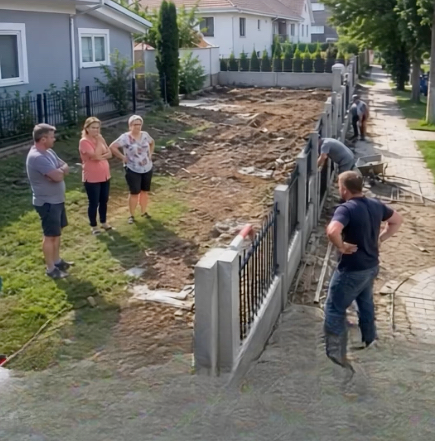
Once the boundary was confirmed, I decided to install a new fence.
This time, I wanted the construction to be especially clear and properly documented.
The new project was discussed with the appropriate professionals and contractors.
The boundary markers remained visible during the work.
Posts were installed along the confirmed line.
The design was more substantial than the original fence, partly because I wanted something durable and partly because I wanted to eliminate ambiguity about where the boundary was located.
I wasn’t trying to make a dramatic statement.
I simply wanted my property clearly separated from the neighboring property.
When Ethan Came Outside
During the work, Ethan eventually noticed what was happening.
He approached the area and asked why I was installing another fence.
I explained that I had hired a surveyor to confirm the property line and that I was rebuilding the fence along the documented boundary.
He questioned whether the new structure was necessary.
I told him that it was necessary for me because I wanted privacy, security for my dog, and a clearly defined property boundary.
The conversation was considerably calmer than I had expected.
There was no shouting.
There was no dramatic confrontation.
There was simply a disagreement between two property owners with different preferences.
And that was exactly how I wanted it to remain.
The Important Difference Between Preference and Property Rights
Ethan preferred an open yard.
I preferred a fenced yard.
Neither preference was inherently unreasonable.
But a preference about how your own property looks is different from making a decision about someone else’s property.
That distinction became the central issue.
If someone wants an open yard, that’s their choice.
If someone wants a fence, that’s also their choice, subject to applicable local rules and property restrictions.
The challenge begins when one person’s preference is imposed on another person’s property without agreement.
What I Learned From the Experience
The situation taught me several lessons that I hadn’t expected to learn.
The first was the importance of documentation.
When everything is peaceful, paperwork can feel unnecessary.
You buy a house.
You sign the documents.
You put them in a drawer.
Then you forget about them.
But years later, those records can become extremely useful.
The second lesson was the importance of professional measurements.
When there’s uncertainty about a property line, guessing can create additional problems.
A professional survey can provide clarity.
The third lesson was about communication.
I wish the situation had been handled through a conversation before the fence was removed.
If Ethan had explained his concerns and asked whether I would consider changing the fence, I could have explained why I preferred to keep it.
We might still have disagreed.
But the disagreement would have remained a conversation.
Why Neighbor Disputes Can Escalate
Small disagreements between neighbors can become surprisingly stressful.
A tree branch crosses a boundary.
A driveway is placed slightly differently.
A fence is installed.
A dog wanders into another yard.
A property owner starts a landscaping project.
Each situation may appear minor.
But when people feel that their property or privacy has been disregarded, emotions can become stronger.
That’s why calm communication is valuable.
It is also why documentation is important.
The more clearly everyone understands the facts, the less room there is for assumptions.
Avoiding the “Revenge” Mindset
Stories about property disputes are often presented as revenge stories.
One person does something.
The other person responds with an even bigger action.
The audience is encouraged to wait for a dramatic confrontation.
Real life is usually more complicated.
A property dispute doesn’t have to become a competition.
The best outcome is often a clear understanding of the boundary, compliance with applicable rules, and enough communication to allow neighbors to live next to one another without constant conflict.
That’s what I wanted.
I didn’t need to make the neighboring yard look different.
I didn’t need to embarrass anyone.
I just needed my own property to remain clearly defined.
A Fence Is More Than Wood
Before this experience, I thought of my fence as a practical structure.
It kept Daisy inside.
It protected the garden.
It provided privacy.
It looked good enough.
After it was removed, I realized how much a physical boundary contributes to the feeling of having a private home.
There is psychological comfort in knowing where your space begins and ends.
That doesn’t mean neighbors have to be distant.
You can be friendly while still having boundaries.
You can wave to someone from across the road and still want a fence between your yards.
You can have a good relationship with a neighbor without sharing every part of your property.
Privacy and community aren’t opposites.
What I Would Do Differently
If I could go back, I would probably document the fence and property line even more carefully from the beginning.
I’d keep photographs of the completed project.
I’d maintain cop