I Sent My Wife’s Son Away After She Died — Ten Years Later, I Learned What She Had Asked Him to Keep
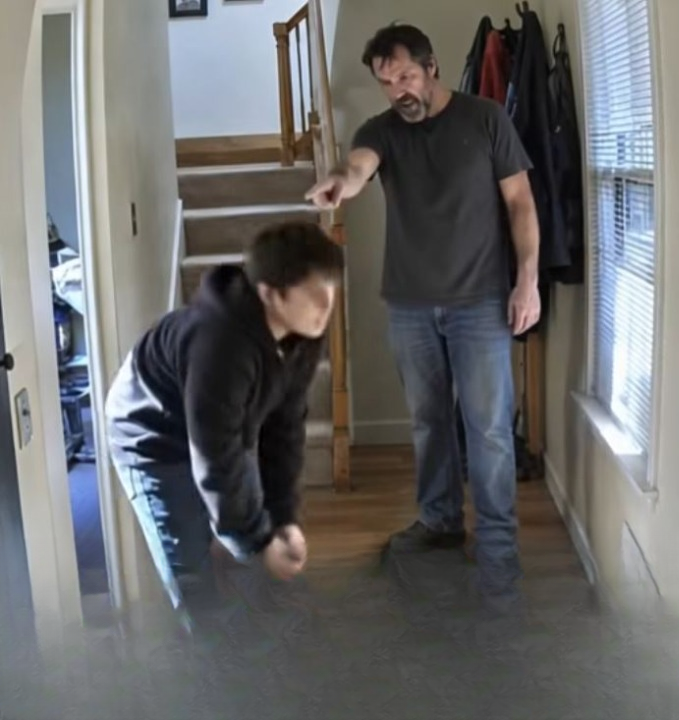
The day I told my wife’s son to leave the house, he was twelve years old.
He stood in the hallway with an old backpack hanging from one shoulder.
The bag had a broken zipper and a strap that had been repaired more than once.
I remember looking at him and feeling something I am ashamed to admit even now.
I felt nothing.
My wife had been gone for only a few weeks.
The house still smelled like her.
Her favorite mug was still in the kitchen cabinet.
Her coat was still hanging near the front door.
There were unopened letters on the table addressed to her.
Everywhere I looked, I saw reminders of a woman who was no longer there.
And somehow, instead of grieving properly, I had turned my anger toward the child she had left behind.
He wasn’t my biological son.
I had never legally adopted him.
And during the years I had been married to his mother, I had always kept a certain emotional distance.
I provided for him.
I paid for his school expenses.
I bought clothes when he needed them.
I made sure there was food in the refrigerator.
But I had never truly allowed myself to think of him as my child.
That distinction had always existed somewhere in the back of my mind.
After my wife died, it became impossible to ignore.
One evening, after an argument that I barely remember, I finally said the words that would define the next ten years of my life.
“You need to leave.”
The boy looked at me.
He didn’t argue.
He didn’t ask why.
He simply nodded.
Then he picked up his backpack.
Before walking through the door, he stopped for a second.
I thought he might say something.
He didn’t.
He walked away.
The door closed.
And I let him go.
At the time, I thought I was ending a responsibility.
I had no idea I was also turning my back on someone who would eventually teach me more about family, forgiveness, and love than anyone else ever had.
The Woman I Married
My wife, Anna, had been a strong and independent woman long before I met her.
She had already experienced a difficult relationship before we became acquainted.
Her son, Daniel, was born from that earlier chapter of her life.
She rarely talked about his biological father.
I knew there had been problems.
I knew Anna had raised Daniel largely on her own.
And I knew that by the time I entered their lives, she had become accustomed to handling everything herself.
When we married, Daniel was still young.
People told me I was doing something admirable.
“You’re giving that boy a father,” some relatives said.
“You’re giving Anna a real family.”
I accepted the compliments.
But privately, I knew the truth.
I loved Anna.
I wanted to build a life with her.
I wanted a comfortable home and a stable future.
But I never made the same emotional commitment to Daniel.
I told myself that providing for him was enough.
Maybe I even believed it.
I was wrong.
A Child Notices More Than Adults Realize
Daniel was quiet.
Not unhappy, necessarily.
Just observant.
He rarely demanded anything.
He didn’t complain when I was busy.
He didn’t ask for expensive things.
When I came home from work, he usually gave me a polite greeting and went back to his room.
I interpreted that as good behavior.
Looking back, I wonder if it was something else.
Perhaps he had learned to be careful.
Perhaps he had already noticed that I wasn’t completely comfortable being called his stepfather.
Maybe he understood that his place in the family depended on circumstances he couldn’t control.
Children are often more aware of emotional tension than adults realize.
They may not understand every reason behind it.
But they notice tone.
They notice distance.
They notice when someone looks at them differently.
I wish I had understood that then.
Anna Tried to Bring Us Closer
My wife occasionally encouraged me to spend more time with Daniel.
She would ask me to help him with school projects.
Sometimes she suggested that we go somewhere together.
I usually found an excuse.
There was always work.
There was always a meeting.
There was always something that seemed more urgent.
Anna never pushed too hard.
But once, shortly before she died, she said something I remember clearly.
“You don’t have to be his father in the way his biological father should have been.”
I looked at her.
“What do you mean?”
“You just have to be someone he knows he can trust.”
I didn’t answer.
She continued.
“He doesn’t need perfection. He needs consistency.”
At the time, I didn’t realize how important those words would become.
The Day Anna Died
Anna’s death was sudden.
One moment she was part of our ordinary life.
Then she wasn’t.
There were doctors.
Phone calls.
Family members arriving at the house.
Arrangements that needed to be made.
People telling me to stay strong.
I remember almost none of it clearly.
Grief doesn’t always arrive as tears.
Sometimes it feels like exhaustion.
Sometimes it feels like anger.
Sometimes it feels like being unable to recognize your own home.
For me, grief became resentment.
And Daniel became an easy target.
Every time I saw him, I remembered Anna.
Instead of letting that memory comfort me, I allowed it to make me angry.
That was my failure.
Not his.
The Evening I Sent Him Away
A few weeks after the funeral, Daniel came into the kitchen.
He asked whether he could stay with me.
I remember his exact words.
“I don’t want to leave.”
Instead of hearing a frightened child asking for security, I heard another responsibility I didn’t want.
I told him I couldn’t do it.
He asked where he was supposed to go.
I didn’t have an answer.
That should have stopped me.
It didn’t.
I told him that he needed to find somewhere else to stay.
He stood there silently.
Then he went upstairs.
A few minutes later, he came back downstairs with his old backpack.
I expected anger.
There was none.
I expected tears.
There were none.
He simply walked toward the door.
I remember thinking that perhaps he had never been attached to me anyway.
That thought made it easier to let him leave.
It also made it easier to ignore what I had done.
The Years That Followed
I sold the house.
I moved.
I changed jobs.
Eventually, my business became successful.
My financial situation improved considerably.
I met another woman.
She was kind, intelligent, and independent.
We built a comfortable life together.
From the outside, everything looked fine.
I had a nice home.
A successful business.
Good friends.
Vacations.
Restaurants.
A life that appeared complete.
But occasionally, usually late at night, I remembered Daniel.
I would wonder where he was.
I told myself that someone must have helped him.
Perhaps a relative had taken him in.
Perhaps a social service organization had found a safe place for him.
I didn’t know.
And I never made the effort to find out.
That was the part I couldn’t forgive myself for later.
I could have searched.
I could have asked questions.
I could have made sure he was safe.
Instead, I chose not to know.
Ten Years Passed
A decade can change almost everything.
People move.
Children become adults.
Old memories become quieter.
At least that’s what I thought.
Then, one afternoon, I received a phone call.
The caller introduced himself as the director of a local arts organization.
He invited me to an exhibition.
I told him I didn’t think he had the right person.
He said my name again.
Then he mentioned someone I hadn’t heard about in ten years.
Daniel.
My entire body became still.
“Why are you calling me about him?”
There was a pause.
“He asked us to invite you.”
I didn’t know what to say.
“Is he okay?”
Another pause.
“Yes.”
That single word affected me more than I expected.
He was alive.
He was safe.
And apparently, he was the reason someone had contacted me.
The Gallery
I almost didn’t go.
Part of me wanted to ignore the invitation.
Another part of me needed answers.
On the evening of the exhibition, I drove to the gallery alone.
The building was modest.
Inside were paintings, photographs, and sculptures created by local artists.
People moved from one room to another, talking quietly.
I felt completely out of place.
Then I saw him.
For several seconds, I didn’t recognize him.
He was no longer the twelve-year-old boy with the worn backpack.
He was a grown man.
He stood near a large painting, speaking with several visitors.
His posture was confident.
His expression was calm.
And then he turned.
Our eyes met.
I knew immediately.
It was Daniel.
“You Came”
He walked toward me.
I expected anger.
I expected questions.
Instead, he simply said:
“You came.”
I nodded.
“I almost didn’t.”
“I know.”
That surprised me.
“How?”
He smiled faintly.
“I know you.”
I didn’t deserve the confidence in those words.
We stood there in silence.
Then he introduced me to someone standing nearby.
“This is the man I told you about.”
The phrase struck me.
Not “my father.”
Not “my stepfather.”
Just “the man I told you about.”
It was accurate.
And painful.
Daniel Had Built a Life
I learned that Daniel had eventually been taken in by Anna’s older sister.
She had known what happened.
She had been furious with me.
But she had decided that Daniel needed stability more than another adult argument.
She helped him stay in school.
She encouraged him to pursue his interest in art.
Over the years, Daniel had developed into a talented artist.
The gallery exhibition was his first major public showing.
I walked through the rooms.
There were landscapes.
Portraits.
Images of family homes.
Paintings of ordinary kitchens and empty chairs.
One painting stopped me.
It showed a small boy standing beside a doorway.
A backpack rested on his shoulder.
I knew immediately what it represented.
I couldn’t speak.
Daniel came to stand beside me.
“You remember that day?”
“Yes.”
“I do too.”
The Truth About Anna
I thought the conversation was going to be about what I had done.
Instead, Daniel told me something else.
After Anna died, he had found an envelope she had left with her sister.
It contained letters.
Photographs.
School records.
And a note addressed to him.
Anna had apparently written it before her death.
She knew that Daniel and I had never become as close as she hoped.
She also knew that grief might make things difficult.
Her message was simple.
She wanted Daniel to know that he was loved.
She wanted him to understand that her choices had never been his fault.
And she asked him to remember that family isn’t always defined by biology.
Then Daniel told me something I had never known.
Anna had also written a letter to me.
Her sister had kept it.
She had not given it to me immediately because she was angry about what had happened.
Years later, she decided that I needed to see it.
The Letter
Daniel handed me an envelope.
My name was written on the front.
The handwriting was unmistakably Anna’s.
I sat down.
My hands were shaking.
Inside was a short letter.
Anna wrote that she knew I struggled to understand my role in Daniel’s life.
She said she never expected me to replace his biological father.
She had only hoped that I would become someone Daniel could trust.
Then came the sentence that broke through every excuse I had built over the years.
She wrote that Daniel had never been a burden.
He had been the most important responsibility she had ever chosen.
And she hoped that one day I would understand that loving a child wasn’t about biology.
It was about showing up.
I read the letter twice.
Then a third time.
The Truth Wasn’t About His Father
For ten years, I had assumed the great secret behind my wife’s first relationship was something dramatic.
It wasn’t.
The truth was much simpler.
Anna had never wanted Daniel to grow up believing that being someone else’s biological child made him less worthy of love.
She had spent years protecting him from that idea.
And I had reinforced it.
That realization hurt more than any accusation could have.
Because there was no mystery left to hide behind.
I hadn’t abandoned Daniel because I didn’t have a choice.
I had abandoned him because I chose the easier path.
“Why Did You Invite Me?”
I finally asked Daniel the question.
“Why did you want me here?”
He looked at the painting of the boy by the door.
“Because I didn’t want to spend my whole life wondering what would happen if we talked.”
I looked at him.
“Are you angry with me?”
“Yes.”
The honesty surprised me.
“But I’m not interested in staying angry forever.”
I lowered my head.
“I don’t know how to apologize for what I did.”
“You don’t have to make the apology perfect.”
“What do I do?”
“Start by telling the truth.”
So I did.
I told him I had been selfish.
I told him I had failed him.
I told him that grief wasn’t an excuse.
I told him that I had thought about him many times but had been too ashamed to search for him.
And finally, I told him something I should have said when he was twelve.
“I should have treated you like family.”
Daniel looked at me for a long time.
Then he nodded.
Forgiveness Wasn’t Immediate
I wish I could say everything changed that evening.
It didn’t.
Daniel didn’t suddenly call me Dad.
We didn’t hug and erase ten years.
There was no perfect ending.
Real relationships don’t usually work that way.
Trust takes time.
Sometimes forgiveness does too.
Daniel told me he didn’t know what kind of relationship we could have.
I told him I understood.
He said he needed boundaries.
I agreed.
He said he didn’t want money.
I respected that.
He wanted something much harder to give.
Consistency.
He wanted me to show up.
Not once.
Not because I felt guilty.
But because I genuinely cared.
We Started Slowly
Our first conversation after the exhibition lasted about twenty minutes.
The next one lasted an hour.
Then we had coffee.
Later, he invited me to another exhibition.
I began learning about his work.
He showed me paintings he had created years earlier.
He told me about his aunt.
He talked about school.
He told me about people who had helped him.
He also told me about the years when he wondered why I hadn’t come looking for him.
Those conversations were difficult.
But I listened.
For once, I didn’t try to defend myself.
What I Learned About Fatherhood
For years, I had believed that being a father was primarily about providing.
Food.
Clothing.
School fees.
A safe home.
Those things matter.
But they aren’t enough.
Children also need emotional security.
They need to know that they belong.
They need adults who will remain present when life becomes difficult.
They need someone who will listen.
I had provided things for Daniel.
But I hadn’t provided the one thing he needed most from me.
A sense that I would stay.
What I Learned About Grief
I also learned something about grief.
I had blamed Daniel for reminding me of Anna.
But he wasn’t the reason she was gone.
He was one of the people who had lost her too.
For years, I had thought of my grief as though it belonged exclusively to me.
I forgot that a twelve-year-old boy had lost his mother as well.
Perhaps he had needed me then just as much as I needed someone.
Instead of supporting each other, I pushed him away.
That