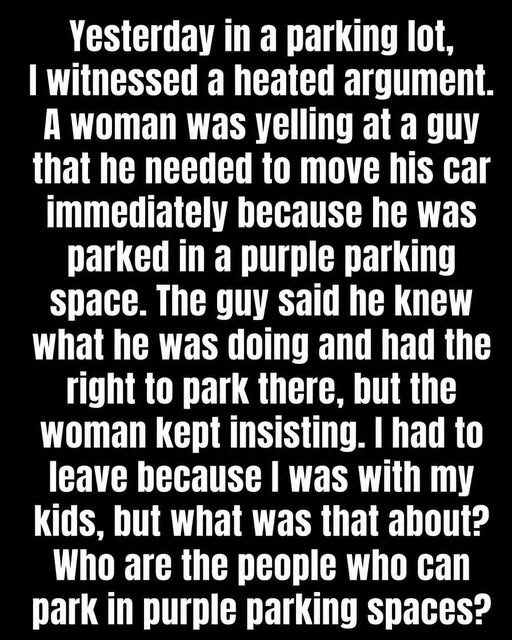
A parking space painted bright purple can catch your attention immediately.
In a sea of ordinary white lines, faded asphalt, and familiar blue accessible-parking markings, a purple space looks unusual. It may be positioned close to a store entrance, outside a public building, beside a business, or in another highly visible part of a parking lot.
For drivers who have never encountered one before, the natural question is simple:
Why is that parking space purple?
The answer is more complicated than many social-media posts suggest.
There is no single nationwide rule stating that every purple parking space has one universal meaning. Parking-lot colors can be used by individual property owners, municipalities, organizations, event organizers, and other authorities for different purposes.
In some locations, unusual colors are used to identify spaces reserved for a particular group or purpose. In others, the color may be part of a temporary campaign, community event, fundraising effort, or local parking-management system.
That is why the safest rule is also the simplest:
Don’t rely on the color alone. Read the sign and any pavement markings before parking.
Understanding why these spaces exist can help drivers avoid confusion and, in some circumstances, an unnecessary parking violation.
Why Parking Lots Use Different Colors
Parking lots are designed to communicate information quickly.
Drivers often have only a few seconds to recognize where they can park, where pedestrians may cross, which spaces are reserved, and where traffic is supposed to move.
Paint is one of the easiest ways to make those distinctions visible.
White lines can define ordinary parking spaces.
Yellow markings may identify curbs, restricted areas, loading zones, or other locations depending on local rules.
Blue markings are commonly associated with accessible parking, although the exact legal requirements vary by jurisdiction.
Other colors may be used for additional purposes.
Purple is one of the less common colors, which is precisely why it attracts attention.
But unusual does not automatically mean illegal.
The important question is what the markings and signs at that particular location actually indicate.
There Is No Universal Meaning for Purple
One of the biggest misconceptions about unusual parking colors is the belief that a particular color must mean exactly the same thing everywhere.
Parking regulations don’t necessarily work that way.
A private shopping center may use colored pavement to identify spaces connected with a special program.
A hospital may use specific colors as part of its own parking system.
A university may use colored spaces to distinguish permits or designated areas.
A city may have regulations that differ from those of another city.
An event organizer may temporarily designate spaces for a particular purpose.
Because of these differences, a driver shouldn’t assume that a purple space automatically means one specific thing.
The sign beside the space is usually much more important than the color itself.
Look for the Sign First
If you see an unusual parking space, don’t immediately decide whether you can use it based solely on the pavement.
Look around the space.
Is there a vertical sign?
Does the sign contain a symbol?
Does it mention a permit?
Does it identify a particular group?
Does it specify certain hours?
Does it indicate that the space is reserved?
Does it contain information about payment or parking restrictions?
These details can tell you much more than the paint.
Even two purple spaces located in different parking lots could have completely different purposes.
Private Parking Lots Can Have Their Own Markings
Many parking spaces are located on privately owned property.
Shopping centers, apartment complexes, office buildings, hotels, hospitals, universities, and entertainment venues may establish parking arrangements for their properties, subject to applicable laws and regulations.
A private property owner may use distinctive colors to make certain spaces easier to identify.
For example, a property might designate certain spaces for customers, employees, residents, visitors, deliveries, or another specific category.
The color itself isn’t necessarily the legal rule.
The posted signs, property rules, and applicable local regulations are what determine what drivers are expected to do.
Temporary Parking Changes Can Also Cause Confusion
Parking arrangements aren’t always permanent.
A space that is normally available to the public may become temporarily restricted because of construction, maintenance, an event, roadwork, or another change.
Temporary signs may be installed.
Cones or barriers may be placed around certain areas.
Freshly painted markings may appear.
A space may also be temporarily reserved for a particular activity.
This is another reason drivers should check the current signs rather than relying on what they remember from a previous visit.
Parking lots can change.
What was permitted last month may not necessarily be permitted today.
Why Some Colors Attract Attention
From a practical standpoint, unusual colors can make certain spaces easier to notice.
Imagine a large parking lot with hundreds of nearly identical spaces.
A person looking for a particular reserved area might have difficulty locating it if every space looked the same.
A distinctive color can create an immediate visual cue.
Purple is especially noticeable because it contrasts strongly with ordinary asphalt and white parking lines.
That doesn’t automatically tell a driver who is allowed to use the space.
It simply makes the space easier to identify.
What About Accessible Parking?
This is an important distinction.
Accessible parking spaces are governed by specific laws and requirements in many jurisdictions.
In the United States, accessible parking is commonly associated with blue markings and recognizable accessibility symbols.
However, drivers should not assume that color alone determines whether a space is legally reserved for accessible parking.
Signs and required markings matter.
A space that is not blue should not automatically be assumed to be ordinary parking, and a space that is blue should not be treated as available simply because the paint looks faded.
When in doubt, read the sign.
Don’t Assume Every Unusual Space Is a Special Permit Space
Another common mistake is assuming that every brightly colored parking space is reserved for a special permit holder.
That isn’t necessarily true.
A color might be decorative.
It could be connected to a community campaign.
It could be part of an organization’s branding.
It could mark a temporary parking arrangement.
It could identify a specific customer program.
The appearance of the space alone doesn’t provide enough information.
That is why articles or social-media posts claiming that a particular color always has one meaning should be treated cautiously unless they identify the relevant jurisdiction or property.
Read the Entire Sign
Drivers sometimes glance at a sign and notice only one word.
That can be risky.
A sign may contain several important details.
For example, a space could be reserved only during certain hours.
A permit might be required.
The restriction could apply only on particular days.
The space could be available to a certain group but open to everyone at other times.
A sign might also direct drivers to another area.
Taking a few seconds to read the entire sign can prevent misunderstandings.
Parking Rules Can Depend on Location
One reason parking questions are difficult to answer with a single sentence is that rules vary by jurisdiction.
A parking restriction in New York may not be identical to one in California.
A private business may have rules that differ from a public street.
A university campus may have its own permit system.
A residential complex may have rules established through property management.
Local laws can also change over time.
Therefore, if you’re trying to determine whether a particular purple space is legal to use, the relevant question isn’t simply:
“Is purple parking allowed?”
Instead, ask:
“What does this particular purple space mean at this particular location?”
That’s a much more useful question.
Why Social Media Can Create Confusion
Unusual parking spaces are perfect subjects for viral posts.
Someone sees a purple space, takes a photograph, and uploads it with a caption claiming that drivers who park there will receive a massive fine.
The post spreads.
People share it.
Soon, thousands of readers believe the claim applies everywhere.
But parking rules are highly location-specific.
A photograph from one city doesn’t necessarily explain a parking space in another state.
Even within the same city, a private parking lot may operate differently from a public street.
This doesn’t mean every viral parking story is false.
It means the original location and the actual signage matter.
The Color Is a Clue, Not the Whole Rule
Think of parking colors as visual clues.
They help drivers identify areas that may require additional attention.
But the color shouldn’t replace reading the instructions.
It’s similar to seeing a sign with an unfamiliar symbol.
The correct response isn’t necessarily to guess what it means.
It’s to stop and examine the information provided.
That approach is particularly useful when parking spaces are unusual.
What If There Is No Sign?
Suppose you encounter a purple space and there doesn’t appear to be a sign nearby.
What should you do?
First, check carefully.
Look around the immediate area.
Some signs may be positioned at the entrance to the parking section rather than directly beside every space.
Look for pavement symbols or text.
Check whether there are posted parking instructions at the entrance.
If the meaning remains unclear, consider asking the property manager, parking attendant, security staff, or another responsible authority before using the space.
It’s better to spend a minute finding out than to assume.
What If Other Cars Are Parked There?
This is another situation where drivers can make a misleading assumption.
You may see several vehicles parked in purple spaces and conclude that the spaces must be open to everyone.
But other drivers don’t necessarily establish the legal status of a parking space.
They may have permits.
They may have permission.
They may be violating the rules.
They may be parked there temporarily.
Their behavior doesn’t tell you what you’re allowed to do.
Always look for the official information.
What If the Paint Is Faded?
Outdoor pavement doesn’t remain perfect forever.
Sunlight, rain, snow, traffic, oil, cleaning, and general wear can gradually change the appearance of painted markings.
A purple space may eventually look gray, blue, pink, or nearly colorless.
That’s another reason not to depend entirely on color.
If the pavement is difficult to interpret, look for signs and other markings.
In many cases, the sign will remain more informative than the paint.
Parking Enforcement Can Be Location-Specific
If a space is subject to a local parking restriction, enforcement may depend on the authority responsible for that location.
On public property, enforcement may be handled by a municipal parking authority, police department, transportation agency, or another designated organization.
On private property, enforcement arrangements can be different.
The consequences of parking improperly can also vary.
Depending on the circumstances and jurisdiction, a violation could result in a warning, citation, towing, or other consequences.
That is why it’s unwise to assume that an unusual space is simply decorative.
Don’t Confuse Reserved Spaces With Accessible Spaces
This distinction is particularly important.
A space reserved for a particular group is not automatically an accessible parking space.
Likewise, a brightly colored space isn’t automatically accessible parking simply because it is located close to a building entrance.
Accessible parking has specific legal requirements.
Drivers should look for the appropriate accessibility symbol and required signage rather than relying on unusual colors.
If a space is designated as accessible, only vehicles meeting the applicable requirements should use it.
Why Parking Spaces Are Sometimes Placed Near Entrances
You may notice that unusual or reserved spaces are often located in convenient areas.
There is a practical reason for this.
Parking spaces can be assigned based on accessibility, customer convenience, loading needs, employee access, security considerations, or other operational requirements.
A business may choose a particular location because it serves a specific purpose.
That convenience is not necessarily an invitation for everyone to use the space.
In fact, the closer a space is to an entrance, the more important it may be to check its designation before parking.
What Drivers Should Do When They See a Purple Space
A simple process can help.
1. Slow down
Don’t pull into the space immediately.
Give yourself a moment to inspect the markings.
2. Look for signs
Check the space itself and the surrounding area.
3. Read the wording
Don’t rely solely on symbols or colors.
4. Check for hours or conditions
Some restrictions apply only during certain times.
5. Look for permit requirements
If a permit is required and you don’t have one, choose another space.
6. Check local rules if necessary
If the situation remains unclear, consult the relevant parking authority or property management.
7. Choose another space when in doubt
If there is a reasonable alternative, avoiding an ambiguous space is often the simplest solution.
Why “Think Twice” Is Better Than “Never Park There”
The phrase “think twice” is useful because it doesn’t make an unsupported universal claim.
A purple space isn’t necessarily forbidden.
It isn’t necessarily reserved for one particular group.
It isn’t necessarily a special enforcement area.
Its meaning depends on the circumstances.
The responsible approach is therefore not to tell drivers that purple spaces always mean one thing.
Instead, drivers should treat unusual markings as a reason to pay closer attention.
Parking Lot Design Is More Complicated Than It Looks
A parking lot may appear simple.
Rows of cars.
Painted lines.
A few signs.
But behind that simple appearance can be a surprisingly complex system.
Parking areas may need to accommodate pedestrians, emergency access, deliveries, accessible parking, employees, customers, residents, visitors, bicycles, electric vehicles, loading activity, and traffic flow.
Colored markings can be one tool used to organize all of those competing needs.
Understanding that context makes unusual spaces easier to appreciate.
Why Drivers Should Avoid Guessing
Guessing is rarely a good strategy when a parking restriction is unclear.
A driver might think:
“It’s purple, so it must be reserved.”
Another might think:
“It’s not blue, so anyone can use it.”
Both assumptions could be wrong depending on the location.
The correct answer is usually available through the posted information.
That’s why the best habit is to observe first and park second.
A Useful Rule for Any Unfamiliar Parking Space
There’s a simple rule that works in almost every unfamiliar parking situation:
If the space looks different, stop and find out why.
It could be a reserved space.
It could be accessible parking.
It could be a loading area.
It could be temporary.
It could be part of a private-property parking program.
Or it could simply be decorative.
The important point is that the unusual appearance tells you that you should pay attention.
Why This Matters More Than a Paint Color
At the end of the day, the color isn’t the most important part.
The important part is communication.
Parking markings are intended to communicate information to drivers.
When those markings are unfamiliar, drivers need to look for the information that explains them.
That may be a sign.
A symbol.
A permit requirement.
A posted notice.
A local parking regulation.
Or instructions from the property owner.
The more clearly you understand the system, the less likely you are to make an avoidable mistake.
Final Thoughts
Seeing a purple parking space for the first time can be confusing.
It stands out from the rest of the parking lot, and it’s natural to wonder whether it has a special meaning.
But there isn’t a single universal rule that makes every purple parking space mean exactly the same thing.
The purpose can vary depending on the location, property owner, local regulations, organization, or temporary circumstances.
That’s why the safest approach is simple:
Don’t guess based on color alone.
Look for signs.
Read the markings.
Check for permit requirements.
Pay attention to hours and restrictions.
And if the purpose of the space isn’t clear, choose another location or ask the appropriate authority.
A few extra seconds of attention can save you from confusion and, depending on the situation, an unnecessary parking problem.
So the next time you see a bright purple parking space, don’t assume that the color itself tells the entire story.
Instead, treat it as a signal to look closer.
Because when it comes to parking, the sign beside the space is often more important than the color beneath your tires.