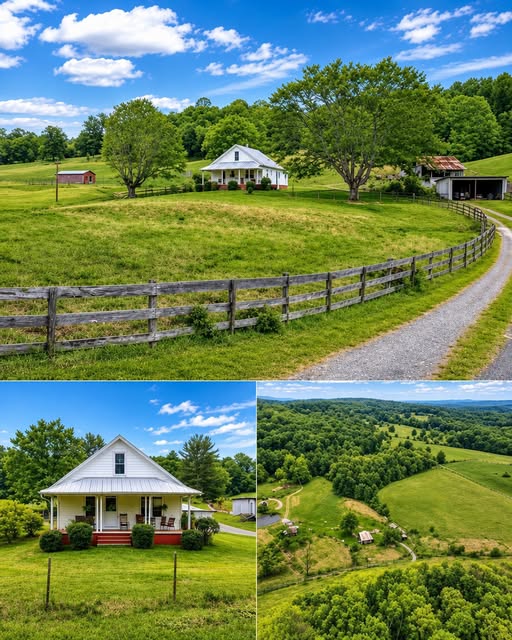
For people who dream of exchanging busy streets, crowded neighborhoods, and a fast-paced routine for a quieter lifestyle, a small rural property can be an appealing alternative.
A home with open land, mature trees, water nearby, and enough outdoor space for gardening or small-scale projects offers something that can be difficult to find in a conventional suburban neighborhood: room to slow down.
A creekside mini farm in the Galax, Virginia area represents that kind of possibility.
Rather than focusing only on the appearance of a country property, however, it is worth looking at what rural living actually involves. Land, water, outbuildings, access roads, utilities, maintenance, weather, local regulations, and the condition of the home can all have a significant effect on the experience of owning a rural property.
Southwest Virginia is known for its scenic landscapes, mountain communities, forests, agricultural areas, and outdoor recreation. Galax provides a small-city setting while remaining closely connected to the surrounding countryside.
That combination can appeal to buyers who want more space without moving completely away from basic community amenities.
What Makes a Creekside Property Appealing?
Water is one of the features that immediately changes the character of rural land.
A creek can provide visual interest, wildlife habitat, shade, and the sound of moving water. Depending on the property, it may also contribute to the overall landscape and create opportunities for walking, gardening, photography, or simply enjoying the outdoors.
But a creek is also a natural feature that needs to be understood rather than treated purely as an amenity.
Water levels can change.
Heavy rain can affect banks and drainage.
Low areas may remain wet for extended periods.
Some portions of a property may be subject to flood-related considerations.
For that reason, buyers should investigate the actual location of the creek, the property’s elevation, drainage patterns, and applicable flood information before making assumptions about how every part of the land can be used.
Understanding the Mini-Farm Concept
The term “mini farm” can mean different things to different people.
It does not necessarily mean a commercial agricultural operation.
For one homeowner, a mini farm might consist of a large vegetable garden and fruit trees.
For another, it might mean chickens, goats, a few other small livestock animals, or a hobby orchard.
Someone else might simply want enough land for a workshop, greenhouse, garden, or outdoor recreation.
The important point is that the property itself does not automatically determine what activities are permitted.
Local zoning, deed restrictions, homeowners’ association rules if applicable, animal regulations, building requirements, and other local rules can affect what a property owner can do.
Anyone considering a rural property for agricultural or livestock purposes should verify those requirements before purchasing.
The Appeal of Galax, Virginia
Galax is a small independent city in southwestern Virginia near the North Carolina border.
The area is associated with the cultural and natural character of the southern Appalachian region.
Its surroundings offer a very different environment from a large metropolitan area.
Instead of dense development, residents can find wooded hills, open countryside, farms, streams, and rural roads throughout the broader region.
For buyers considering a property outside the center of town, this can provide a balance between rural surroundings and access to a small community.
The precise location of any property remains important, however.
A home described as being “near Galax” could be considerably different from one located within the city itself.
Travel times to stores, schools, medical services, employment centers, and recreational destinations should therefore be evaluated using the property’s exact address.
A Quiet Lifestyle Comes With Responsibilities
Country living is often described in terms of peaceful mornings and open space.
Those benefits can be real, but rural ownership also comes with responsibilities that may be less visible in photographs.
A larger property generally requires more maintenance.
Grass may need regular mowing.
Trees may require inspection or trimming.
Driveways may need grading or repairs.
Fences can deteriorate.
Outbuildings require upkeep.
Water drainage can become an issue after major storms.
These responsibilities aren’t necessarily disadvantages, but they should be part of the purchasing decision.
A property that appears inexpensive compared with a suburban home may require more time, equipment, and maintenance.
The Importance of Land Size
The amount of land is one of the most important factors in evaluating a mini farm.
A few acres can feel remarkably spacious compared with a typical residential lot.
However, the usable portion of the property may be smaller than the total acreage suggests.
Steep slopes, wooded areas, wetlands, creek corridors, easements, and other features can limit practical use.
For example, a property might contain several acres, but only part of that land may be suitable for gardening or keeping animals.
This is why acreage should never be considered in isolation.
The shape and topography of the property matter just as much.
Examine the Terrain Carefully
Southwest Virginia has varied terrain.
A property that looks gently rolling in photographs may contain steeper sections that become difficult to navigate with equipment.
Walking the property in person can reveal details that aren’t obvious from an online listing.
Pay attention to:
-
Slopes and elevation changes
-
Drainage patterns
-
Areas that remain wet
-
Access to different sections of the land
-
Tree cover
-
Existing paths
-
Fence lines
-
Creek banks
-
Potential erosion
-
Locations suitable for gardens or outbuildings
If possible, inspect the land under different weather conditions or ask questions about how it behaves after heavy rain.
Creek Banks Require Attention
Living beside a creek can be beautiful, but creek banks are dynamic.
Water moves soil.
Storms can increase water flow.
Vegetation can affect erosion.
Changes in drainage upstream can influence conditions downstream.
Property owners should therefore understand the condition of the creek bank and whether any erosion has occurred.
A qualified professional may be appropriate if there are signs of significant bank instability or drainage problems.
It is also important to determine whether any structures, fences, driveways, septic systems, or other improvements are located near areas that could be affected by water.
Flood Information Matters
A creekside property deserves careful attention to flood risk.
A property being near water does not automatically mean that the home itself is located in a flood-prone area.
Likewise, being outside a commonly recognized flood area does not mean that flooding is impossible.
Flood conditions depend on local geography, drainage, rainfall, and other factors.
Buyers should review current flood maps and obtain property-specific information rather than relying solely on a listing description.
Insurance considerations should also be discussed with an appropriate insurance professional.
What About the House?
The surrounding land may attract attention, but the condition of the home remains one of the most important factors.
A country property can have beautiful scenery while still requiring substantial work.
A careful inspection should consider the major systems of the house.
Depending on the property, these may include:
-
Roof
-
Foundation
-
Plumbing
-
Electrical system
-
Heating and cooling
-
Windows and doors
-
Insulation
-
Attic
-
Crawl space or basement
-
Septic system
-
Well or other water supply
-
Drainage around the structure
A professional home inspection can identify issues that are difficult for a buyer to see during a normal showing.
Rural Water Systems
Not every country property is connected to a municipal water system.
Private wells are common in many rural areas.
If a property uses a well, buyers should learn as much as possible about the system.
Important questions include:
-
How old is the well?
-
Where is it located?
-
Has the water been tested recently?
-
What is the well’s reported production?
-
Is the pump functioning properly?
-
Are there records of previous repairs?
-
Is the well shared with another property?
Water quality and quantity can be separate issues.
A well can produce sufficient water while still requiring treatment for certain water-quality concerns.
Professional testing can provide more useful information than assumptions based on appearance or taste.
Septic Systems Deserve Equal Attention
Rural homes may also use private septic systems.
A septic system can function reliably for many years when properly designed, installed, and maintained.
But its condition and capacity are important considerations for a property purchase.
Buyers should determine whether documentation exists for the system and whether it has been inspected or serviced.
The location of the septic system and its drain field can also affect future plans.
For example, someone hoping to build an additional structure, plant certain trees, or install other improvements may need to account for the septic layout.
Outbuildings Can Add Practical Value
A mini farm becomes considerably more versatile when the property includes usable outbuildings.
Depending on the property, these might include:
-
Barns
-
Sheds
-
Workshops
-
Garages
-
Storage buildings
-
Animal shelters
-
Greenhouses
-
Equipment buildings
However, an outbuilding should be evaluated in terms of condition rather than appearance alone.
A weathered barn may look charming while requiring significant structural repairs.
A shed may need a new roof.
An older workshop may have electrical limitations.
If an outbuilding is intended for livestock, equipment, or storage, its suitability should be evaluated for that specific purpose.
Gardening Opportunities
One of the attractions of rural property ownership is the possibility of growing food.
A larger property may provide space for vegetables, herbs, berries, fruit trees, or other plants.
But successful gardening depends on more than acreage.
Soil quality matters.
Sun exposure matters.
Drainage matters.
Water availability matters.
Wildlife pressure matters.
A garden located in a low, poorly drained area may be less productive than a smaller garden on well-drained soil.
Before creating a large garden, consider testing the soil and observing how sunlight moves across the property during the growing season.
Keeping Animals
Some buyers may be interested in raising chickens, goats, or other small livestock.
The feasibility of doing so depends on local regulations and the property’s physical characteristics.
Fencing is an important consideration.
So is shelter.
Water access, feed storage, predator protection, waste management, and veterinary care also become part of the responsibility.
Potential livestock owners should investigate applicable local rules before assuming that animals can be kept on the property.
Privacy and Road Access
Privacy is one of the most attractive aspects of many rural properties.
A home surrounded by trees can feel considerably more secluded than a home in a conventional subdivision.
But privacy should be evaluated alongside access.
How is the property reached?
Is the road public or private?
If it is private, who maintains it?
Are there recorded easements?
How does the driveway perform during heavy rain or winter weather?
These questions can become especially important for rural homes.
A beautiful property is much more practical when year-round access is reliable.
Internet and Cell Service
Modern rural living is not necessarily disconnected living.
Many people work remotely or depend on internet access for school, business, entertainment, banking, and communication.
That makes connectivity an important part of evaluating a country property.
Internet availability can vary significantly even between nearby locations.
Potential buyers should verify available providers, expected speeds, installation requirements, and service reliability at the exact property.
Cellular coverage should also be tested rather than assumed based on general coverage maps.
Heating in a Rural Home
Heating systems deserve particular attention in older or rural homes.
A property may use electricity, propane, oil, wood, or another heating method.
Each system has different maintenance requirements.
If the home includes a wood-burning stove or fireplace, the condition of the chimney and related components should be professionally evaluated before regular use.
Likewise, fuel tanks and heating equipment should be inspected as appropriate.
The goal is not simply to determine whether the system turns on.
It is to understand its condition, efficiency, maintenance requirements, and likely future costs.
Four-Season Considerations
Southwest Virginia experiences seasonal changes, and rural property owners need to account for weather throughout the year.
A property that looks beautiful in summer may present different challenges in winter.
Leaves can cover drainage areas.
Heavy rain can affect creeks and unpaved roads.
Cold temperatures can create risks for exposed plumbing.
Snow and ice can affect access depending on the location and road conditions.
Seasonal inspection is therefore valuable when evaluating a rural property.
What Makes This Lifestyle Attractive?
Despite the additional responsibilities, rural living offers qualities that many people actively seek.
There can be more outdoor space.
There may be fewer nearby neighbors.
Gardening becomes more practical.
Outdoor projects can be easier to accommodate.
Children may have more room to play.
Homeowners may have greater flexibility in how they use their land, subject to local rules.
And there is the simple appeal of waking up surrounded by trees, fields, hills, or flowing water.
For someone who values space and privacy, those qualities can be difficult to replicate in a conventional neighborhood.
A Rural Property Can Be a Long-Term Project
One useful way to think about a mini farm is as an evolving property rather than a finished product.
The land may already have the basic features a buyer wants, but improvements can happen gradually.
A homeowner might begin with a garden.
Later, they could improve fencing.
An existing outbuilding might become a workshop.
A neglected area might be turned into an orchard.
A walking path could be maintained through the property.
This gradual approach can make rural ownership rewarding, but it also requires realistic expectations about time and expense.
Don’t Judge a Property Only by Photographs
Real-estate photography is designed to show a property attractively.
That isn’t necessarily a problem.
But photographs cannot tell you everything.
They may not show the steepest portion of a driveway.
They may not reveal water collecting near a foundation.
They may not show neighboring properties beyond the trees.
They may not communicate road noise, drainage, odors, insects, or the condition of distant outbuildings.
For a property purchase, an in-person visit remains extremely valuable.
Walking the land can reveal details that photographs simply cannot capture.
Consider the Surrounding Community
The property itself is only part of rural living.
The surrounding community matters too.
Potential buyers should consider the distance to grocery stores, pharmacies, restaurants, schools, healthcare facilities, fuel stations, hardware stores, and other services they regularly use.
They should also consider commuting requirements.
A property that feels pleasantly remote during a weekend viewing may feel very different if the owner must drive a long distance every weekday.
The right level of rural living depends on the buyer.
Some people want complete seclusion.
Others prefer to be within a short drive of town.
The Financial Side of Rural Ownership
The purchase price is only one part of the financial picture.
Potential expenses can include:
-
Property taxes
-
Homeowners insurance
-
Flood-related insurance if applicable
-
Well maintenance
-
Septic maintenance
-
Driveway maintenance
-
Tree care
-
Fencing
-
Equipment
-
Outbuilding repairs
-
Landscaping
-
Heating fuel
-
Pest control
-
Agricultural or livestock expenses
Some of these costs may be lower than expected.
Others can be surprisingly significant.
A realistic budget should therefore include both routine maintenance and occasional major repairs.
Property Taxes and Land Classification
Depending on the property’s characteristics and how the land is used, there may be different considerations regarding taxation or agricultural programs.
However, buyers should never assume that a property qualifies for a particular tax treatment simply because it is described as a farm or mini farm.
Current local requirements should be verified with the appropriate county or city authority.
The same principle applies to claims about agricultural use, development potential, subdivision, or other property rights.
Verify Every Important Listing Claim
Real-estate descriptions are useful starting points, but buyers should independently verify important facts.
If a listing says the property contains a certain acreage, verify the recorded information.
If it describes a creek, determine where the waterway actually crosses the property.
If it mentions an outbuilding, inspect its condition.
If it suggests development potential, investigate zoning and applicable restrictions.
If it describes a property as suitable for livestock, confirm the relevant regulations.
This approach helps separate marketing language from verifiable property characteristics.
Who Might Enjoy This Type of Property?
A creekside mini farm may appeal to people who want:
-
More outdoor space
-
Greater privacy
-
Gardening opportunities
-
A quieter environment
-
Room for hobbies
-
A workshop or outbuilding
-
A connection with nature
-
A small-scale agricultural lifestyle
-
Space for outdoor recreation
It may be less suitable for someone who wants minimal maintenance, immediate access to urban amenities, or a property that requires little ongoing work.
The right choice depends on lifestyle rather than simply the appearance of the property.
The Beauty of Southwest Virginia
One of the strongest attractions of the region is its landscape.
Southwest Virginia has a distinct Appalachian character, with wooded hills, valleys, streams, farms, and small communities.
For someone accustomed to urban living, the difference can be substantial.
Instead of looking out at neighboring buildings, a homeowner may have trees or open land in view.
Instead of traffic noise, they may hear birds, insects, wind, or flowing water.
These details can create a sense of connection to the surrounding environment.
At the same time, rural living should be approached realistically.
Nature is beautiful, but it also brings insects, wildlife, mud, fallen branches, changing weather, and seasonal maintenance.
A Property Like This Is More Than a House
The appeal of a mini farm isn’t limited to the building itself.
The land becomes part of the lifestyle.
A porch can become a place for morning coffee.
A garden can provide seasonal produce.
A creek can become part of the landscape.
An outbuilding can become a workshop.
A wooded section can, home, infrastructure, location, and ongoing responsibilities match the owner’s buyers should verify its current price, acreage, boundaries, utilities, zoning, flood information, condition, taxes, and other material country living can be rewarding—but the best rural property decisions begin when the dream is matched with careful provide a private walking area.
An open field can create space for recreation or carefully planned agricultural use.
Those possibilities are part of what makes rural property ownership attractive.
Take Time Before Making a Decision
A rural property can create an emotional reaction, particularly when the landscape matches a long-held dream.
But an emotional connection should be followed by careful investigation.
Visit more than once if possible.
Walk the entire property.
Ask questions.
Review available records.
Inspect the home.
Understand the water and septic systems.
Check access.
Research zoning.
Investigate flood information.
Estimate maintenance costs.
Consider internet and cell service.
And think about how the property will fit into your daily life five or ten years from now.
Final Thoughts
A creekside mini farm in the Galax area can represent many of the qualities people associate with country living: open space, natural scenery, privacy, outdoor opportunities, and a slower pace.
But the most important feature of a rural property isn’t simply how attractive it looks in photographs.
It is whether the land, home, infrastructure, location, and ongoing responsibilities match the owner’s expectations.
A creek can be beautiful while requiring careful attention to drainage.
A large acreage can provide freedom while requiring more maintenance.
An old barn can add character while also needing repairs.
A secluded home can provide privacy while placing everyday services farther away.
That combination of opportunity and responsibility is what makes rural property ownership different from buying a typical suburban home.
For the right buyer, however, those responsibilities may be part of the appeal.
A piece of land can become a garden, a workshop, a place for outdoor projects, or simply a peaceful retreat from a busy world.
And in a region such as Southwest Virginia, the surrounding landscape can become just as important as the house itself.
Before purchasing any specific property, prospective buyers should verify its current price, acreage, boundaries, utilities, zoning, flood information, condition, taxes, and other material details through the listing agent, official records, inspections, and appropriate local authorities.