The Wrong-Number Text That Set a Stranger in Motion
At 9:47 on an ordinary Tuesday night, Marcus was sitting in the back office of a motorcycle repair shop when his phone vibrated.
He almost ignored it.
The number was unfamiliar.
At that hour, an unexpected message usually meant advertising, a wrong number, or someone trying to reach somebody else.
Then he read the message.
“Please help. He hurt my mom. She won’t wake up. I’m scared.”
Marcus read it twice.
The wording was simple.
There were spelling mistakes.
There was no explanation.
Just a few frightened words from someone who sounded very young.
He immediately called the number.
A child answered.
“Hello?”
Her voice was barely above a whisper.
“Hi,” Marcus said carefully. “I think you may have sent me a message by mistake. My name is Marcus. Are you safe right now?”
The girl didn’t answer immediately.
Then she asked:
“Are you Aunt Lisa?”
“No,” he said. “I’m not. But I received your message, and I want to make sure you’re okay.”
There was silence on the other end.
Then the child began crying.
Marcus sat forward.
“What’s your name?”
“Meera.”
“Okay, Meera. I’m going to stay on the phone with you. But first, we need to get emergency help. Do you know your address?”
She gave him an address.
Marcus wrote it down.
He immediately contacted emergency services and provided the information he had received.
He didn’t know who was inside the house.
He didn’t know exactly what had happened.
And he certainly wasn’t going to assume that he could handle the situation himself.
The only thing he knew for certain was that a frightened child had asked for help.
A Message That Almost Went Unanswered
Marcus had spent most of his adult life working around motorcycles.
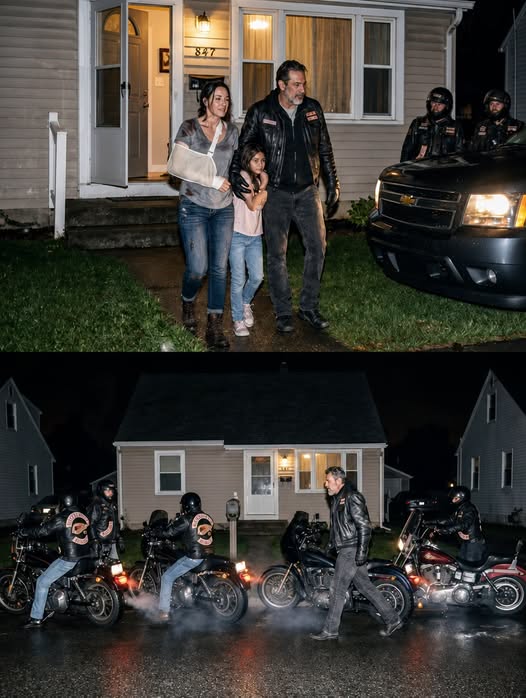
The repair shop where he worked also had a small social group of longtime riders who regularly met there.
People who saw them from the outside sometimes made assumptions.
The motorcycles were loud.
Some of the riders wore leather jackets and heavy boots.
They looked intimidating.
But appearances didn’t tell the whole story.
That evening, Marcus had been finishing paperwork when the message arrived.
If his phone had been charging across the room, he might not have seen it.
If he had been outside working on a motorcycle, he might have noticed it later.
If he had assumed the message was spam, he might have deleted it.
Instead, he answered.
That decision changed the course of the night.
Staying on the Phone
Marcus kept Meera talking while emergency responders were contacted.
He knew she was frightened.
He also knew that giving a child complicated instructions would only make the situation more confusing.
“Are you somewhere safe?” he asked.
“I’m on the stairs.”
“Okay. Stay where you are if you can do so safely.”
“Mom is downstairs.”
Marcus could hear the fear in her voice.
“Is there another adult with you?”
“No.”
“Okay. The emergency team is being contacted. Stay on the phone with me.”
Meera began crying again.
Marcus lowered his voice.
“You did the right thing by asking for help.”
She didn’t respond.
After a few seconds, she whispered:
“I thought nobody would answer.”
That sentence stayed with him.
The Importance of Staying Calm
Marcus was frightened too.
He didn’t know the people involved.
He didn’t know whether the person who had hurt Meera’s mother was still nearby.
He didn’t know what the emergency responders would find when they arrived.
But he understood something important.
Meera needed an adult who sounded calm.
So he focused on that.
He asked simple questions.
He reminded her not to approach anyone who might be dangerous.
He encouraged her to remain in a safe location.
Most importantly, he kept the conversation going.
Sometimes helping someone in an emergency doesn’t mean personally rushing into danger.
Sometimes it means making the right call, providing accurate information, and helping someone remain calm until trained responders arrive.
The Other Riders
A few people at the shop noticed that something was wrong.
Marcus briefly explained that a child had contacted him by mistake and that emergency services were being sent to the address.
Nobody treated it like an adventure.
Nobody suggested confronting the person involved.
They understood that the safest course was to let trained professionals handle the emergency.
One of the riders offered to stay with Marcus while he remained on the phone.
Another brought him a bottle of water.
It was a small moment, but it reminded Marcus that helping someone isn’t always dramatic.
Sometimes it is simply being present.
Waiting for the Responders
The minutes seemed unusually long.
Meera occasionally whispered.
Marcus continued reassuring her.
At one point, she asked:
“Are they coming?”
“Yes,” he told her. “They’re on their way.”
“How do you know?”
“Because I’ve given them the information they need.”
She was quiet.
Then she said:
“Okay.”
Marcus could hear distant sounds through the phone.
He wasn’t sure what they were.
He didn’t ask her to investigate.
He didn’t want her moving around unnecessarily.
He simply told her to stay where she felt safest and to follow instructions from emergency personnel when they arrived.
The Emergency Call
When the first responders reached the home, Marcus heard activity in the background.
A voice called out.
There were footsteps.
Meera began crying again.
“It’s okay,” Marcus told her. “You’re not alone now.”
The responders located the mother and began assessing the situation.
Marcus remained on the line until it was clear that professionals were handling the emergency.
Eventually, one of them spoke with Meera.
Marcus could finally relax.
He ended the call only after he was confident that the child had adult assistance.
He sat down at his desk.
For several minutes, he didn’t say anything.
The Message Was From a Child
Marcus kept thinking about those original words.
They had been short.
There was no detailed explanation.
No dramatic story.
Just a frightened child trying to get someone’s attention.
She had accidentally sent the message to the wrong person.
But the wrong number happened to belong to someone who took the time to respond.
That was the part Marcus couldn’t stop thinking about.
What if he hadn’t answered?
What if he had deleted the message?
What if he had assumed it was a prank?
There was no way to know what would have happened.
But there was one thing he did know.
A person had reached out for help.
And someone had listened.
Why Emergency Services Matter
The experience also reinforced something Marcus already understood.
When there is an immediate threat to someone’s safety, trained emergency professionals are the appropriate people to contact.
Friends, neighbors, strangers, and community members may be able to provide support, but they shouldn’t place themselves in unnecessary danger or attempt to replace emergency responders.
In situations involving violence, a safer response is usually to move to a secure location when possible and contact the appropriate emergency service.
Children especially need clear, simple instructions.
They should know that if they are in immediate danger, they can seek help from a trusted adult or emergency service.
A Child Doesn’t Need Perfect Words to Ask for Help
Meera’s message wasn’t written like an adult’s emergency report.
It didn’t contain a detailed timeline.
It didn’t explain exactly what had happened.
It didn’t provide every piece of information a responder might need.
It was simply a frightened child’s attempt to communicate.
That matters.
Children may not always know what information is important during a crisis.
They may misspell words.
They may leave out details.
They may become confused.
They may cry or stop speaking altogether.
Adults receiving such a message should focus first on safety and getting appropriate help rather than criticizing how the message was written.
The Power of a Simple Response
Marcus later said he didn’t consider himself a hero.
He had simply answered his phone.
He recognized that the message appeared serious.
He asked where the child was.
And he contacted emergency services.
That distinction is important.
People sometimes imagine that helping in an emergency requires extraordinary courage or dramatic action.
Often, the most useful thing someone can do is much simpler.
Pay attention.
Take the person seriously.
Gather the information you can.
Contact the appropriate professionals.
Stay calm.
And don’t put yourself or the person you’re helping in greater danger.
What Happened Next
The immediate emergency was handled by professionals.
Because this was a private family situation, Marcus never learned every detail of what happened afterward.
He didn’t need to.
His role had been limited.
He received a message.
He responded.
He helped connect a frightened child with people who could provide appropriate assistance.
That was enough.
A few days later, Marcus received another message.
It was from Meera’s aunt.
She thanked him for answering the phone that night.
Marcus didn’t know what to say.
He told her that anyone would have done the same.
She disagreed.
“Not everyone would have answered,” she wrote.
Marcus looked at the message for a long time.
He thought about how close the situation had come to being ignored.
The Importance of Community
The story also changed how Marcus thought about the people around him.
He had always believed that communities were built through large acts of generosity.
Donations.
Fundraisers.
Volunteer work.
Organized events.
But that night reminded him that community can also appear in very small moments.
A person answers a call.
A neighbor notices something unusual.
Someone contacts emergency services.
A stranger stays on the phone with a frightened child.
None of those actions is necessarily dramatic.
Together, however, they can make a meaningful difference.
The Wrong Number Wasn’t the Point
It would be easy to focus on the coincidence.
A child intended to contact her aunt.
Instead, the message went to Marcus.
That certainly made the story unusual.
But the more important part wasn’t the wrong number.
It was what happened after the mistake.
Marcus could have ignored the message.
Instead, he responded.
The child’s mistake became an opportunity for an adult to recognize that something was wrong and connect her with professional assistance.
That is a much more useful lesson than treating the incident as a dramatic coincidence.
What Parents Can Teach Children
Parents and caregivers can also take something practical from the situation.
Children should know who they can contact when they feel unsafe.
Depending on their age, they can learn how to:
-
Contact a trusted adult.
-
Call the appropriate emergency service.
-
Give their name and location.
-
Explain briefly what is happening.
-
Move to a safer place if possible.
-
Follow instructions from emergency responders.
-
Avoid confronting someone who may be dangerous.
Children don’t need to memorize complicated emergency procedures.
They need simple information they can remember under stress.
What Adults Can Do When a Child Reaches Out
If an adult receives an unexpected message from a child claiming that someone is hurt or in danger, the safest approach is to take the message seriously.
The recipient should avoid encouraging the child to confront the suspected person.
Instead, they should focus on immediate safety and contact the appropriate emergency service.
If possible, the adult can remain available to the child while professionals respond.
It is also important not to make promises that cannot be kept.
A calm statement such as “I’m going to get help” is more useful than making unrealistic promises about exactly what will happen next.
Why Small Details Matter
Marcus noticed that Meera’s message contained very little information.
That didn’t make it less important.
Sometimes the smallest details are enough to begin an emergency response.
A location.
A name.
A description of someone who may be injured.
A statement that the child is frightened.
Each piece of information can help professionals understand what they may be dealing with.
This is another reason people should avoid assuming that a short or poorly written message is meaningless.
The Night Marcus Didn’t Forget
Weeks later, Marcus returned to his ordinary routine.
He repaired motorcycles.
He answered customers.
He drank coffee.
He complained about paperwork.
The world continued as usual.
But the sound of his phone vibrating at night never felt quite the same.
He remembered Meera’s first question.
“Are you Aunt Lisa?”
And he remembered the moment when she realized that the person who answered wasn’t the person she intended to contact.
He wondered how frightened she must have been to keep trying.
He wondered how much courage it had taken for her to send the message at all.
Most of all, he hoped she would remember something else.
Someone answered.
A Quiet Lesson
The story doesn’t need a dramatic ending to be meaningful.
There was no confrontation.
No movie-style rescue.
No heroic speech.
There was simply a frightened child, an accidental message, and an adult who decided that ignoring it wasn’t an option.
That may be the most important part.
In emergencies, people don’t always have perfect information.
They don’t always know exactly what to say.
They don’t always know whether the message they’re receiving is genuine.
But when something appears to indicate that a child or another vulnerable person may be in immediate danger, taking it seriously and contacting trained professionals can be the responsible choice.
Final Thoughts
The message arrived at 9:47 on a Tuesday night.
It was sent to the wrong number.
The person who received it wasn’t the person the child intended to contact.
Yet instead of dismissing the message, Marcus listened.
He asked where she was.
He helped keep her calm.
And he contacted the people equipped to respond.
The motorcycles outside the repair shop didn’t matter nearly as much as the phone in Marcus’s hand.
The leather jackets didn’t matter.
The intimidating appearance of the riders didn’t matter.
What mattered was a simple human response to another person’s fear.
Someone asked for help.
Someone else answered.
And sometimes, that’s where a difficult night begins to turn in a safer direction.