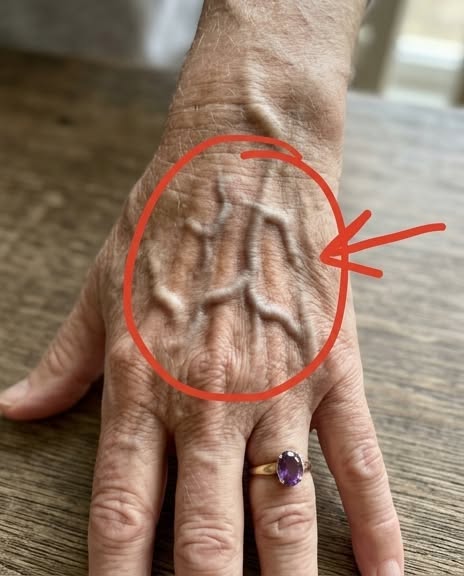
Have you ever looked at your hands, arms, legs, or feet and suddenly noticed that your veins seem much more visible than they used to be?
For some people, prominent veins have always been a normal feature of their appearance. For others, veins may become more noticeable at certain times, such as after exercise, during hot weather, or when the body changes with age.
Seeing visible veins can sometimes cause concern, especially when the change seems to have appeared unexpectedly.
But visible veins don’t automatically mean that something is wrong.
Veins naturally vary in size and visibility from one person to another. Skin thickness, body composition, genetics, physical activity, temperature, hydration, age, and other factors can all influence how prominent they appear.
At the same time, a sudden or unusual change in a vein—particularly when accompanied by pain, swelling, redness, warmth, or other symptoms—may deserve medical attention.
The key is to look at the bigger picture rather than assuming that visible veins have one specific meaning.
Why Are Some People’s Veins More Visible?
Veins sit beneath the skin and carry blood back toward the heart.
How visible they are depends partly on the distance between the vein and the surface of the skin.
People with naturally thinner skin or less tissue covering the veins may notice them more easily.
Genetics also play a role.
Some people simply have more prominent superficial veins than others.
This can be completely normal.
Two people with similar levels of physical fitness can have very different-looking veins.
Exercise Can Make Veins More Noticeable
One of the most common reasons veins become temporarily more prominent is physical activity.
During exercise, blood flow to working muscles increases.
Muscles also become temporarily fuller during activity, and superficial veins may become easier to see.
This is especially noticeable during strength training or intense exercise.
You may notice prominent veins on your arms after lifting weights, for example.
In many cases, the veins become less noticeable after you cool down and your circulation returns to its usual resting pattern.
This temporary change is generally different from a persistent vein that suddenly becomes painful, swollen, or otherwise unusual.
Heat Can Affect Vein Visibility
Temperature can also change the appearance of veins.
When you’re in a warm environment, blood vessels near the skin can widen as part of the body’s normal efforts to regulate temperature.
As a result, veins may appear more prominent.
This can happen after a hot shower, during warm weather, or after spending time in a heated environment.
Once your body cools down, the appearance may return closer to normal.
Again, this can be a normal physiological response rather than a sign of disease.
Changes in Body Composition Can Reveal Veins
A person’s body composition can influence how visible veins appear.
When there is less tissue between the skin and superficial veins, the veins may be easier to see.
This is one reason people who have lost weight or who have a naturally lean body composition may notice more visible veins.
However, unexpected or unexplained weight loss is different.
If you’ve lost a significant amount of weight without intentionally changing your diet or activity level, it is worth discussing with a healthcare professional.
The important issue in that situation isn’t simply the visibility of the veins but the unexplained change in body weight.
Aging Can Change the Appearance of Veins
Skin changes as we get older.
It may become thinner and lose some of its elasticity, while the underlying tissues can also change.
As a result, veins on the hands, arms, and other areas may become more noticeable with age.
This can be a normal part of aging.
Some older adults become concerned when veins that were barely noticeable decades earlier become much more prominent.
In the absence of other concerning symptoms, this can simply reflect normal changes in the skin and tissues.
What About Visible Veins on the Hands?
Prominent veins on the backs of the hands are particularly common.
As skin becomes thinner and the tissues beneath it change, the veins can become easier to see.
Hand veins may also become temporarily more noticeable after exercise or when the hands are warm.
If the veins have been gradually becoming more visible over many years without pain or other symptoms, the change may simply be part of normal variation or aging.
Visible Veins on the Legs Are Different
Veins in the legs can become prominent for several reasons.
Standing for long periods can make leg veins more noticeable because gravity affects blood returning from the lower limbs.
Some people develop small surface veins known as spider veins.
Others may develop larger, twisted, or bulging veins known as varicose veins.
Varicose veins can sometimes cause symptoms such as aching, heaviness, itching, or swelling.
If leg veins are increasingly prominent and uncomfortable, a healthcare professional can determine whether they require evaluation.
When Visible Veins May Need Attention
Visible veins by themselves are often harmless.
However, certain accompanying symptoms deserve more attention.
Contact a healthcare professional if a vein becomes newly prominent and is associated with:
-
Pain or tenderness.
-
Swelling in the surrounding area.
-
Redness or unusual warmth.
-
Significant skin discoloration.
-
A hard or tender area along the vein.
-
A sudden difference between one limb and the other.
-
Symptoms that continue or worsen.
These features can have multiple possible causes, so they shouldn’t be used to diagnose yourself.
A healthcare professional can determine whether examination or further testing is appropriate.
Sudden Leg Swelling Should Not Be Ignored
A particularly important situation is sudden swelling in one leg, especially if it is accompanied by pain, warmth, redness, or tenderness.
There are several possible explanations for these symptoms, and some require prompt medical assessment.
If significant leg swelling occurs together with sudden chest pain, difficulty breathing, coughing up blood, fainting, or another severe symptom, seek emergency medical attention.
These symptoms should not be attributed simply to “visible veins.”
Are Prominent Veins a Sign of Dehydration?
You may see claims online that visible veins automatically indicate dehydration.
That’s too simplistic.
Hydration status can influence how a person looks and feels, but vein visibility depends on many factors.
Body composition, temperature, exercise, genetics, skin thickness, and circulation all contribute.
Instead of trying to diagnose dehydration by looking at your veins, pay attention to more relevant signs such as thirst and other changes in fluid balance.
If you are concerned about your hydration or have a medical condition that affects fluid requirements, ask a healthcare professional for personalized guidance.
Can Diet Make Veins More Visible?
There is no single food that makes veins appear or disappear in a predictable way.
However, significant changes in body weight or body composition can influence their visibility.
Extreme dieting or rapid weight loss should not be used as a strategy for making veins more prominent.
Healthy body composition is about overall well-being rather than achieving a particular visual appearance.
If you’re changing your diet, aim for adequate nutrition and sustainable habits rather than trying to manipulate your appearance through restrictive eating.
What About “Vascularity”?
Fitness communities sometimes use the term “vascularity” to describe highly visible veins.
It can be influenced by muscle size, body composition, exercise, genetics, and temporary changes in blood flow.
Some people naturally have more visible veins than others.
Having prominent veins doesn’t necessarily mean that someone is healthier or fitter than someone whose veins are less visible.
Likewise, less-visible veins don’t indicate poor fitness.
Appearance is not a reliable measurement of cardiovascular health.
Don’t Compare Your Veins With Pictures Online
Social media often presents highly edited or carefully staged images.
Lighting, camera angles, exercise immediately before photography, hydration status, and body composition can dramatically affect how veins look.
Comparing your body with photographs online can therefore create unrealistic expectations.
A person may look significantly more vascular in one photograph than they do just an hour later.
Your goal should be good health and physical function rather than matching another person’s appearance.
What Can a Doctor Do?
If a vein appears unusual or you’ve developed symptoms, a healthcare professional can examine the area.
They may ask when you first noticed the change, whether it is getting worse, whether you have pain or swelling, and whether there are relevant medical conditions or risk factors.
In some circumstances, imaging may be used to examine blood flow or the structures beneath the skin.
The appropriate evaluation depends on the symptoms and clinical findings.
When Is It Probably Just Normal?
A visible vein is more likely to represent ordinary variation when it:
-
Has been present for a long time.
-
Appears on both sides in a similar way.
-
Becomes more visible during exercise or heat.
-
Isn’t painful.
-
Isn’t associated with swelling.
-
Hasn’t undergone a sudden unexplained change.
That doesn’t provide a diagnosis, but it helps illustrate why context matters.
Final Thoughts
So, what does it mean if your veins are visible?
There isn’t one universal answer.
Visible veins can be completely normal and may reflect genetics, skin thickness, body composition, age, physical activity, or temperature.
Exercise and warmth can temporarily make veins more prominent, while natural changes in the skin can make them easier to see as people get older.
Visible veins therefore shouldn’t automatically be described as a warning sign or proof of a particular health condition.
However, a new or rapidly changing vein accompanied by pain, swelling, redness, warmth, significant discoloration, or other symptoms deserves professional attention.
Sudden swelling of one limb, particularly when accompanied by serious symptoms such as chest pain or difficulty breathing, requires urgent medical evaluation.
The most important thing is not how prominent your veins look in the mirror.
Instead, pay attention to changes, symptoms, and how you feel overall.
If you’re uncertain about a new change, taking a photograph and discussing it with a healthcare professional can provide much more reliable information than trying to diagnose the cause from appearance alone.
Your veins are part of your normal anatomy, and for many people, seeing them more clearly is simply another example of how the body changes over time.