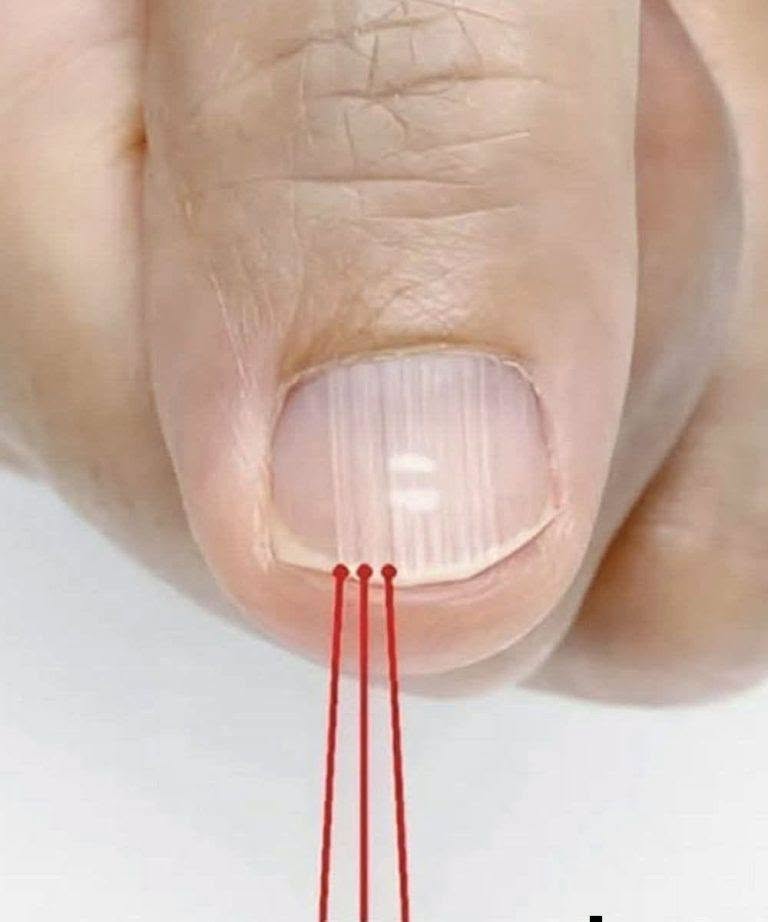
Have you ever looked closely at your fingernails and noticed that they aren’t completely smooth?
Perhaps you have seen fine vertical lines running from the base of the nail toward the tip. Maybe one nail has developed a noticeable ridge, a shallow groove, or another change that wasn’t there years ago.
It can be tempting to search online and assume that a particular line on a nail must be a warning sign of a serious health problem.
But the truth is more reassuring—and more complicated.
Nails naturally change as we get older, and many ridges or lines are harmless. At the same time, certain nail changes can occasionally be associated with nutritional deficiencies, injuries, skin conditions, medications, or underlying medical problems.
The important point is that a line or ridge on a nail cannot, by itself, provide a reliable diagnosis.
Instead of assuming that every nail change is a warning sign, it is more useful to understand the different types of changes, what can cause them, and when it makes sense to have them checked.
Vertical Ridges Are Often Common With Age
One of the most common changes people notice as they get older is the appearance of vertical ridges.
These lines generally run from the cuticle toward the tip of the nail.
They can be very subtle at first.
Over time, they may become more noticeable, particularly as the nails become drier or their growth pattern changes.
Vertical ridges can occur in healthy people and are often associated with normal changes in the nail as people age.
That means seeing a few vertical lines after 40 does not automatically indicate that something is wrong.
If the ridges are present on several nails, have developed gradually, and aren’t accompanied by other unusual symptoms, they may simply be a normal variation.
Not All Nail Lines Are the Same
When people talk about “lines on the nails,” they may actually be describing several different things.
A vertical ridge is different from a horizontal groove.
A white line is different from a dark streak.
A shallow indentation is different from a deep split.
The location, direction, color, number of nails affected, and speed of development can all provide useful information.
That’s why a photograph or short description isn’t always enough to determine what a nail change means.
Horizontal Grooves Can Have Different Causes
Some people notice grooves that run across the nail rather than from the base toward the tip.
These are sometimes called Beau’s lines.
They can develop when nail growth is temporarily interrupted.
A number of things can potentially affect nail growth, including significant illness, injury, severe physical stress, or certain treatments.
Because fingernails grow slowly, a groove may become visible some time after the event that affected nail growth.
This can make it difficult to connect the line with its original cause.
If you notice a pronounced horizontal groove, especially if it affects several nails, mentioning it to a healthcare professional can help determine whether further evaluation is appropriate.
Injuries Can Leave Temporary Nail Changes
Nails can also change after physical trauma.
You might accidentally hit a finger in a door, injure the nail during sports, or experience repeated pressure from manicures or other activities.
Even an injury that seemed minor at the time can sometimes affect the nail as it grows.
The nail may develop a ridge, discoloration, or other temporary change.
As the nail continues growing, the affected area generally moves toward the tip.
This is one reason observing the nail over time can be helpful.
What About White Spots?
Small white marks on fingernails are extremely common.
They are often associated with minor trauma to the nail rather than a serious disease.
For example, a small injury to the nail matrix can result in a white mark that becomes visible as the nail grows.
These spots generally move toward the tip as the nail grows and eventually disappear when the nail is trimmed away.
Because white nail changes can have multiple causes, however, persistent or extensive changes should be discussed with a healthcare professional if you’re concerned.
Dark Lines Deserve More Attention
A dark streak running lengthwise along a nail is different from ordinary pale vertical ridges.
Dark nail pigmentation can have several causes.
It may occur because of harmless pigmentation, previous injury, certain medications, or other conditions.
In some situations, however, a new or changing dark streak can require medical assessment.
Pay particular attention if a dark band:
-
Appears for the first time.
-
Becomes wider.
-
Develops irregular coloring.
-
Has an uneven or blurred border.
-
Changes over time.
-
Extends onto the surrounding skin.
-
Appears on only one nail without an obvious explanation.
These characteristics do not mean that a serious condition is definitely present.
They simply provide reasons to have the nail examined rather than attempting to diagnose it yourself.
Can Nail Changes Be Related to Nutrition?
Nutrition can influence the health of nails.
The body requires adequate amounts of protein and various nutrients to maintain normal tissues, including nails.
Significant nutritional deficiencies can sometimes affect nail appearance.
However, it is important not to assume that every ridge or line means you have a vitamin or mineral deficiency.
Taking supplements without knowing whether you actually need them isn’t always beneficial and can sometimes be harmful.
If your nails have changed along with other symptoms—such as unexplained fatigue, changes in weight, digestive problems, hair changes, or dietary restrictions—it may be worth discussing the situation with a healthcare professional.
They can determine whether nutritional testing is appropriate.
Don’t Automatically Blame Aging
Age can certainly influence nail appearance, but not every nail change should be dismissed as “just getting older.”
If a nail changes suddenly, becomes painful, separates from the nail bed, changes color dramatically, or develops a significant deformity, it is worth getting professional advice.
The same applies if the change occurs together with symptoms elsewhere in the body.
Aging can explain many ordinary changes, but it shouldn’t be used as a reason to ignore something that is new or unusual.
Nail Changes Can Also Occur With Skin Conditions
Some dermatological conditions can affect the nails as well as the skin.
For example, people with certain inflammatory skin conditions may develop changes in nail texture, color, thickness, or shape.
Fungal infections can also change the appearance of nails, often causing thickening, discoloration, brittleness, or separation from the nail bed.
These conditions generally require a different approach from ordinary age-related ridges.
If you’re unsure what you’re seeing, a dermatologist or other qualified healthcare professional can examine the nail and surrounding skin.
What You Can Do to Keep Your Nails Healthy
Regardless of your age, simple nail-care habits can help protect your nails.
Keep nails clean and reasonably trimmed.
Avoid repeatedly biting or picking at them.
Be careful when cutting the cuticles because damage to the surrounding skin can increase the risk of infection.
If your hands are frequently exposed to water, detergents, or cleaning products, consider protecting them appropriately.
Moisturizing your hands and nails can also help reduce dryness.
If you regularly get manicures, give your nails a chance to recover if they become thin, brittle, or irritated.
Healthy nails don’t need to look perfectly smooth.
Small ridges, variations in shape, and minor imperfections are common.
Should You Take Vitamins for Nail Ridges?
It’s easy to find advertisements and social media posts claiming that a particular supplement can make ridged nails disappear.
Be cautious with these claims.
If a person has a confirmed nutritional deficiency, correcting it may be appropriate.
But taking large amounts of vitamins or minerals without a demonstrated need isn’t a guaranteed solution for ordinary nail ridges.
Some nutrients can become harmful when taken in excessive quantities.
If you’re considering supplements because of a nail change, discussing your diet and symptoms with a healthcare professional is a more reliable approach.
When Should You Have a Nail Checked?
Consider making an appointment with a healthcare professional if a nail change is new, persistent, worsening, or difficult to explain.
It’s particularly reasonable to seek advice if you notice:
-
A rapidly changing nail.
-
A new dark streak.
-
Significant nail thickening.
-
Persistent pain or swelling.
-
Bleeding around the nail.
-
Separation of the nail from the nail bed.
-
A major change affecting only one nail.
-
Repeated nail changes alongside other unexplained symptoms.
-
A growth or lesion around the nail.
Again, these features do not automatically mean that something serious is happening.
They simply make professional assessment more useful.
Don’t Try to Scrape Away an Unusual Mark
If you see a line or discoloration, avoid aggressively filing, scraping, cutting, or otherwise trying to remove it.
A nail change may originate beneath the visible nail surface, so damaging the nail won’t necessarily solve the underlying issue.
It can also cause additional trauma and make the nail more difficult to assess.
If you’re concerned about an unusual change, let a professional examine it.
Your Nails Can Provide Clues—but They Aren’t a Medical Test
There is some truth behind the idea that nails can sometimes reflect aspects of health.
Nail changes may occasionally provide clues about injury, infection, inflammation, nutritional problems, medication effects, or other conditions.
But this doesn’t mean nails can be used as a simple diagnostic chart.
A single line does not tell you exactly what is happening inside your body.
Healthcare professionals consider the whole picture: your symptoms, medical history, medications, examination findings, and sometimes laboratory or other testing.
That broader context is what makes an accurate assessment possible.
Final Thoughts
If you’ve noticed lines or ridges on your nails after the age of 40, there’s no need to assume that the change is automatically a warning of serious illness.
Vertical ridges are common and can become more noticeable with age. Minor injuries, nail dryness, normal variations, skin conditions, infections, medications, and other factors can also influence nail appearance.
At the same time, a new or changing nail should not simply be ignored because you’re getting older.
Pay attention to the type of change, whether it is affecting one nail or several, and whether it is evolving over time.
A new dark streak, significant deformity, persistent pain, rapid change, or other unusual feature deserves professional evaluation.
Most importantly, don’t rely on a social-media checklist or a dramatic headline to diagnose yourself.
Your nails can offer useful observations, but they are only one small part of your overall health.
If something looks different and you’re unsure about it, taking a clear photograph, monitoring the change, and discussing it with a qualified healthcare professional can give you much more reliable information than trying to interpret the line yourself.
Sometimes the explanation is simply normal nail variation.
And when there is an underlying problem, getting the right assessment is far more useful than guessing what a particular line means.