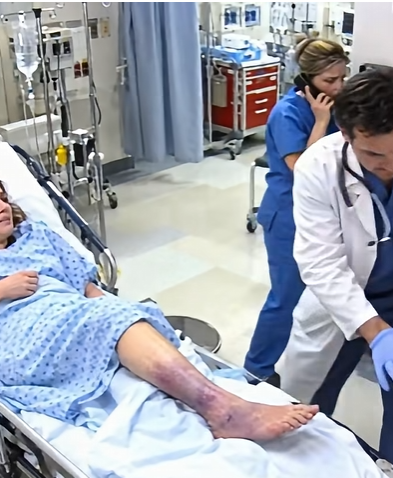
My Husband Told Me to Wait Another Day While I Burned With a 104-Degree Fever — Then the Doctor Examined My Ankle and Called the Police
Chapter 1: Seven Days of Waiting
By the seventh day of my fever, I had stopped asking my husband to take me to the hospital.
Not because I felt better.
Not because the pain had disappeared.
But because I had finally understood something terrifying: Luca was never going to take me unless I made the decision myself.
My temperature had reached 104 degrees Fahrenheit. My sheets were soaked with sweat, my head throbbed continuously, and my entire body shook whenever I tried to sit up.
Even swallowing water had become difficult.
I had spent seven days moving between the bedroom and the bathroom, barely able to stand without holding onto the furniture.
And every time I asked my husband for help, he gave me the same answer.
“Let’s wait until tomorrow, Jessi.”
Tomorrow.
That word had become the most frightening part of my marriage.
The first time he said it, I thought he was simply being practical.
The second time, I became frustrated.
By the fourth day, I was beginning to feel frightened.
But by the seventh day, I was too weak to argue.
Luca stood in the doorway of his home office, wearing his usual gray sweatshirt. The blue light from his computer monitors illuminated his face.
He looked at me for several seconds.
“You’re still running a fever?”
I tried to nod.
“One hundred and four.”
He sighed.
“Have you taken the medication?”
“Yes.”
“Then give it time.”
“Luca, I can’t keep doing this.”
He rubbed his forehead.
“Jessi, we’ve already discussed it. Emergency rooms are crowded. You’ll sit there for hours, and they’ll probably tell you to take antibiotics and rest.”
“I can barely walk.”
“You’re weak because you haven’t been eating properly.”
I stared at him.
“I need a doctor.”
He shook his head.
“Tomorrow morning. I promise.”
Then he returned to his computer.
I lay back against the pillows.
For a moment, I listened to the familiar sounds of his office: the keyboard, the computer fan, and the occasional notification.
It was strange how ordinary everything sounded when my life was beginning to feel anything but ordinary.
My name is Jessica Miller.
I was thirty-two years old, married to Luca for four years, and until recently, I believed we had built a comfortable life together.
We lived in a two-story house in a quiet neighborhood outside the city. Luca worked remotely in technology consulting, while I managed administrative operations for a small architectural firm.
We weren’t wealthy, but we were comfortable.
We had plans.
We had savings.
We had talked about having children someday.
And I had never imagined that the person I trusted most would become the reason I was afraid to close my eyes.
The problem had started with a small injury.
Six days before my fever became severe, I had scraped the inside of my ankle against the sharp edge of a metal garden planter.
It wasn’t a serious-looking injury.
There was a small cut, a little bleeding, and some swelling.
I washed it with water and covered it with a clean dressing.
Luca noticed it that evening.
“Let me take care of that.”
He brought a first-aid kit from the bathroom.
I allowed him to clean the wound.
At the time, it seemed like an ordinary act of kindness.
But the following morning, the area was more painful.
By the second day, I had developed chills.
By the third, my fever had become difficult to control.
And Luca insisted on changing the dressing himself.
“You’re making it worse by touching it,” he told me.
“Let me see it.”
“No. You need to leave it alone.”
He began keeping the medical supplies in his office.
When I asked why, he said he didn’t want me accidentally using the wrong product.
I believed him.
That was my first mistake.
Chapter 2: The Wound Beneath the Bandage
That evening, after Luca returned to his office, I tried to get comfortable.
The fever made everything feel distant.
The ceiling seemed to move whenever I opened my eyes, and the light from the hallway hurt.
I reached for my water glass.
My fingers trembled so badly that I nearly dropped it.
Then I noticed something.
A strange sensation was coming from my ankle.
It wasn’t ordinary soreness.
It felt as though something beneath the dressing was burning.
I shifted my leg.
Pain shot upward.
I gasped.
For several minutes, I simply stared at the bandage.
Luca had told me not to touch it.
He had told me that the wound looked worse because I kept disturbing it.
But something inside me was telling me that I needed to see what was happening.
I reached for the edge of the dressing.
My fingers stopped.
Then I pulled it back carefully.
What I saw made my stomach turn.
The skin surrounding the injury had become dark and badly discolored.
There were areas of deep purple, patches of redness, and unusual dark streaks extending beyond the original scrape.
The swelling was much worse than I remembered.
I touched the skin beside the wound and immediately pulled my hand away.
It was painfully warm.
I stared at my ankle.
Then I looked toward the doorway.
“Luca?”
No answer.
I tried again.
“Luca, I need you.”
I heard his voice from the office.
“What?”
“Something’s wrong with my leg.”
He appeared several seconds later.
His expression changed when he saw the uncovered wound.
“Why did you take that off?”
“Look at it!”
“I told you not to touch it.”
“Luca, it’s getting worse.”
He walked closer but didn’t examine it properly.
“You’re making yourself anxious.”
“Look at the color!”
He glanced at my ankle.
Then he looked away.
“Put the dressing back on.”
I felt tears gathering in my eyes.
“I want to go to the hospital.”
He shook his head.
“Not tonight.”
Something about his response frightened me more than the wound itself.
I had expected concern.
I had expected him to call an ambulance.
Instead, he was angry that I had removed the bandage.
“Please,” I whispered. “I’m scared.”
He stood silently for a moment.
Then he said something I would remember for the rest of my life.
“You’re always imagining the worst.”
He turned and returned to his office.
I looked down at my ankle.
For the first time, I understood that I could not depend on him to make the decision for me.
If I wanted to survive, I needed to get medical help myself.
Chapter 3: The Decision That Saved My Life
It took nearly twenty minutes for me to sit up.
I moved slowly, gripping the edge of the mattress.
The room spun.
I waited until the dizziness passed.
Then I reached for my phone.
My hands were shaking.
I opened the emergency transport application and requested a vehicle.
The nearest hospital was approximately fifteen minutes away.
I didn’t know whether I could make it to the front door.
But I knew I couldn’t stay where I was.
From the office, I heard Luca laughing.
He was speaking to someone through his gaming headset.
I had no idea how he could sound so relaxed while his wife was lying upstairs with a dangerously high fever.
I pulled on a loose sweater and reached for my slippers.
My ankle hurt so badly that putting weight on it was almost impossible.
I held onto the wall.
Step by step, I moved through the hallway.
At the staircase, I stopped.
For a moment, I considered calling Luca again.
Perhaps he would finally understand.
Perhaps seeing me struggling would make him realize how serious the situation had become.
Then I remembered his expression when I showed him the wound.
I continued.
The front door felt impossibly far away.
When I finally reached it, I leaned against the wall and unlocked it.
The driver was waiting outside.
“Are you all right, ma’am?”
I shook my head.
“No. Please take me to the emergency department.”
He looked at my face.
Then at my leg.
“Should I call an ambulance?”
“Please just help me get inside the car. I need medical attention.”
He helped me into the back seat and drove toward the hospital.
I kept my phone in my hand.
Luca hadn’t noticed I was gone.
Not yet.
As we approached the hospital entrance, my phone began vibrating.
His name appeared on the screen.
I stared at it.
Then I answered.
“Where are you?” he demanded.
“I’m going to the hospital.”
There was silence.
Then his voice became sharper.
“What?”
“I’m getting medical help.”
“Jessi, turn around.”
I closed my eyes.
“I can’t do this anymore, Luca.”
“You don’t understand. You’re going to make everything worse.”
I looked at the hospital entrance approaching through the windshield.
“I think things are already bad enough.”
I ended the call.
And for the first time in seven days, I felt that I had made the right decision.
Chapter 4: The Doctor Who Stopped Smiling
The emergency department was busy.
People occupied nearly every chair in the waiting area.
A child was crying near the reception desk, an elderly man was speaking quietly to a nurse, and a television mounted above the entrance played the evening news.
But when the triage nurse checked my temperature and examined my ankle, everything changed.
She looked at the thermometer.
Then at my leg.
“How long have you had this fever?”
“Seven days.”
“Seven days?”
I nodded.
“Has anyone examined the wound?”
“My husband has been changing the dressing.”
She looked up.
“Has a doctor seen it?”
“No.”
The nurse immediately called another staff member.
Within minutes, I was taken into an examination bay.
A nurse attached monitoring equipment while another prepared supplies for blood tests.
I was asked several questions.
My symptoms.
My medications.
My allergies.
My medical history.
Then a physician entered.
His name was Dr. Marcus Reed.
He appeared to be in his early forties and spoke with the calm confidence of someone accustomed to emergencies.
“Jessica? I’m Marcus. I’ll be examining you.”
He reviewed my temperature and other vital signs.
Then he looked at my ankle.
His expression changed.
“How did this happen?”
“I scraped it against a metal planter.”
“When?”
“About a week ago.”
“Did it look like this immediately?”
“No.”
“Has it been getting worse?”
I nodded.
“Much worse.”
He carefully examined the surrounding skin.
Then he asked something that made me uncomfortable.
“Who has been treating this wound?”
“My husband.”
“What has he been using?”
“I’m not sure. He said it was antiseptic.”
Dr. Reed looked at me.
“Did you see the product?”
“Not clearly.”
“Did you apply anything yourself?”
“No. He handled everything.”
The doctor exchanged a brief glance with the nurse.
Then he asked me to describe the dressing.
I explained that Luca had been using a white gauze covering and something from a small container.
I didn’t know its name.
Dr. Reed became serious.
He immediately requested additional testing and asked the nursing team to involve the appropriate hospital specialists.
Then he stepped outside the examination bay.
I heard him speaking to the head nurse.
A few moments later, he returned.
“Jessica, I need you to remain calm.”
My heart began racing.
“What’s wrong?”
“We are concerned about a potentially serious infection. Some of the discoloration also raises questions about possible tissue injury.”
“What does that mean?”
“It means we need to investigate the wound carefully. We cannot assume this is an ordinary scrape.”
He paused.
Then he asked another question.
“Do you feel safe at home?”
I looked at him.
The question seemed completely unrelated to my medical condition.
But something about his expression told me he was asking for a reason.
“I don’t know,” I whispered.
He nodded.
“All right. You don’t have to answer everything immediately. We’re going to focus on getting you treated.”
Chapter 5: The Call Nobody Expected
The next hour passed in a blur.
Blood samples were collected.
An IV was started.
The medical team ordered additional examinations and began treatment for the suspected infection.
A specialist was contacted because of the unusual appearance of the wound.
I was given medication to help manage my symptoms.
But my thoughts kept returning to Luca.
Why had he refused to take me to the hospital?
Why had he insisted on handling the dressing himself?
And why had he become so angry when I tried to examine my own injury?
Dr. Reed returned.
“Jessica, I want to ask you something important.”
I looked at him.
“Did your husband ever explain exactly what he was putting on the wound?”
“No.”
“Did you see the label?”
“No.”
“Did he ever tell you not to seek medical attention?”
I hesitated.
“He kept saying we should wait until tomorrow.”
“Every day?”
I nodded.
The doctor looked toward the nurse.
Then he made a phone call.
He explained that the medical team had concerns about the circumstances surrounding the injury and wanted the appropriate authorities notified.
I heard the word police.
My stomach tightened.
“Doctor?”
He turned toward me.
“Yes?”
“Why are you calling the police?”
He pulled a chair closer.
“Because we have a responsibility to take concerns about possible intentional injury seriously. We don’t yet know exactly what happened, and I don’t want to make assumptions. But we need to protect you while the medical investigation continues.”
I began crying.
“I don’t understand.”
“I know. Let’s take this one step at a time.”
He handed me a tissue.
“Right now, your health comes first.”
I nodded.
But before I could say anything else, my phone began vibrating.
Luca.
I watched it ring.
Then it stopped.
A message appeared.
WHERE ARE YOU?
Another followed.
YOU SHOULD HAVE TOLD ME BEFORE LEAVING.
Then another.
COME HOME. YOU DON’T NEED TO BE THERE.
I stared at the screen.
Dr. Reed noticed my expression.
“Is that your husband?”
I nodded.
“Would you like us to help you manage communication with him?”
I didn’t answer immediately.
Then I showed him the messages.
He read them without commenting.
“Please preserve those messages,” he said. “Don’t delete anything.”
I placed the phone on the bed.
A moment later, another message arrived.
DON’T TELL THEM ABOUT WHAT I PUT ON YOUR LEG. IT WAS JUST ANTISEPTIC.
My mouth went dry.
I looked at the doctor.
He looked at the message.
Then he turned toward the nurse.
“Please document this and notify the investigating team.”
I felt as though the entire room had tilted.
I had never told Luca that the doctor was asking about the dressing.
I hadn’t told him what the medical team suspected.
And I certainly hadn’t told him that I was considering the possibility that something was wrong with the substance he had been using.
Yet he had specifically told me not to mention it.
Chapter 6: The Detective Arrives
Approximately fifteen minutes later, a woman entered the room with two uniformed officers.
She introduced herself as Detective Hall.
She was in her late forties, with short brown hair and a calm expression.
“Jessica, I understand you’ve had a frightening experience.”
I nodded.
“I don’t know what’s happening.”
“That’s all right. We’re not here to pressure you. We just want to understand what happened.”
She asked whether Luca had ever physically hurt me.
“No.”
Had he threatened me?
“Not directly.”
Had he ever prevented me from seeking medical attention before?
I thought about it.
“No. Not like this.”
She wrote something down.
Then she asked about the injury.
I explained how it had happened and described the way Luca had taken responsibility for changing the dressing.
I told her about his refusal to let me examine it.
I told her about the seven days of fever.
And finally, I showed her the messages.
Detective Hall read them carefully.
“Did he know you were coming to this hospital?”
“I don’t think so.”
“Did you tell him where you were?”
“No.”
She nodded.
“All right.”
One of the officers stepped outside to speak with hospital security.
Detective Hall continued.
“Jessica, I want you to understand that you haven’t done anything wrong by seeking medical attention. You were concerned about your health, and you came here for help.”
I began crying again.
“I thought he was taking care of me.”
She softened her voice.
“I understand.”
That sentence nearly broke me.
Because I had spent seven days defending him.
Whenever someone asked why I hadn’t gone to the hospital, I explained that Luca was looking after me.
Whenever I considered calling someone, I told myself he knew what he was doing.
I had trusted him because he was my husband.
Now I was sitting in a hospital room surrounded by strangers, wondering whether the person who had promised to protect me had put me in danger.
Chapter 7: He Came Looking for Me
I thought Luca would remain at home.
I was wrong.
About forty minutes after the detective arrived, a hospital security officer knocked on the door.
“Detective Hall?”
She stood.
“Yes?”
“There’s a man downstairs asking for Jessica Miller.”
My entire body tightened.
“Who is he?” Detective Hall asked.
“He says he’s her husband.”
I looked at her.
“That’s Luca.”
The security officer continued.
“He says she’s confused and that he needs to take her home.”
Detective Hall’s expression became firm.
“Has he been allowed upstairs?”
“No.”
“Good. Please make sure he stays in the public area. He is not to enter this room without authorization.”
The officer nodded and left.
I looked toward the door.
“He’s here.”
Detective Hall pulled her chair closer.
“You’re in a secure medical area. He will not be allowed to interfere with your treatment.”
“But what if he gets angry?”
“We have procedures for situations like this.”
I stared at my hands.
“I don’t want to see him.”
“Then you don’t have to.”
For a moment, I felt relief.
Then I heard his voice.
It came from somewhere down the corridor.
“Jessi!”
I froze.
“Luca, please,” I whispered.
Detective Hall stood and moved toward the doorway.
I heard him again.
“Jessica! I’m your husband! I have a right to see my wife!”
A security officer responded.
“Sir, you need to lower your voice.”
“She’s sick! She’s confused! She doesn’t know what she’s doing!”
I closed my eyes.
Those words sounded familiar.
You’re confused.
You’re imagining things.
You’re making yourself anxious.
For seven days, Luca had used those explanations whenever I questioned what was happening.
Now he was using them in a hospital.
Detective Hall returned.
“He’s being asked to remain downstairs.”
“Did he say anything else?”
She hesitated.
“He says you have a medical condition that makes you unreliable.”
I felt a strange emptiness inside my chest.
“That’s not true.”
“I know. We’re not accepting his statements as facts.”
She sat beside me.
“Jessica, we will document what he says, but the medical decisions are being made by your doctors.”
For the first time, I realized that I didn’t have to convince Luca of anything.
I didn’t have to earn his permission.
And I didn’t have to go home simply because he demanded it.
Chapter 8: The Laboratory Results
Later that evening, Dr. Reed returned with another physician.
They had reviewed the initial examination results.
“Jessica,” he said, “we have identified a serious infection that requires immediate treatment.”
I gripped the blanket.
“Is it dangerous?”
“Yes. It is serious, and we are treating it urgently. We are also investigating the possibility of chemical irritation or tissue damage associated with the dressing.”
My throat tightened.
“Did my husband poison me?”
Dr. Reed didn’t answer immediately.
“I cannot establish that from the medical findings alone. We need laboratory analysis of the material and a proper investigation into how it was used.”
He explained that the infection could not be attributed to one single cause without further evidence.
The medical team needed to determine whether the substance had caused an additional injury, whether the infection had progressed because of delayed treatment, or whether both conditions had contributed to my worsening symptoms.
I listened carefully.
Then I asked the question that had been haunting me.
“Am I going to survive?”
Dr. Reed pulled his chair closer.
“Our priority is to stabilize you and treat the infection. You’ve received medical attention, and we’re taking this seriously. I cannot promise an outcome, but you’re in the right place.”
I began crying.
Not because I had received bad news.
But because someone was finally telling me the truth.
They didn’t pretend everything was fine.
They didn’t tell me to wait until tomorrow.
They didn’t dismiss my pain.
They were treating me as someone whose life mattered.
Chapter 9: The Bottle in the Office
The following morning, Detective Hall returned.
She had received an update from the investigative team.
“Jessica, we’d like to ask about the medical supplies your husband kept at home.”
I nodded.
“They were in his office.”
“Do you remember what the container looked like?”
I described a small dark bottle with a white label.
“Was it a prescription medication?”
“I don’t know.”
“Did he ever show you the instructions?”
“No.”
“Did you see him apply anything to your wound?”
I remembered the first few days.
Luca had used gloves.
He had brought the supplies into the bedroom.
He had asked me to close my eyes when the cleaning solution stung.
I had never questioned him.
Detective Hall wrote everything down.
She explained that investigators were working to determine whether the substance had been medically appropriate and whether anyone had intentionally caused harm.
I asked whether they had spoken to Luca.
“Not in detail yet.”
“Why not?”
“We’re following the available evidence and the appropriate procedures.”
She paused.
“There’s something else.”
My heart began beating faster.
“What?”
“Your husband contacted the hospital several times last night. He asked for information about your condition.”
“Did you tell him?”
“No. Your medical information is protected, and the hospital followed its privacy procedures.”
I nodded.
Then Detective Hall added something unexpected.
“He also asked whether the dressing had been sent for testing.”
I stared at her.
“Why would he ask that?”
“That’s one of the questions we’re trying to answer.”
Chapter 10: The Truth About the Dressing
Two days later, the investigation produced an important development.
The laboratory had completed preliminary testing of the material recovered from the dressing.
The results identified a substance that was not appropriate for application to an open wound.
The medical team explained that the substance could cause significant skin irritation and tissue