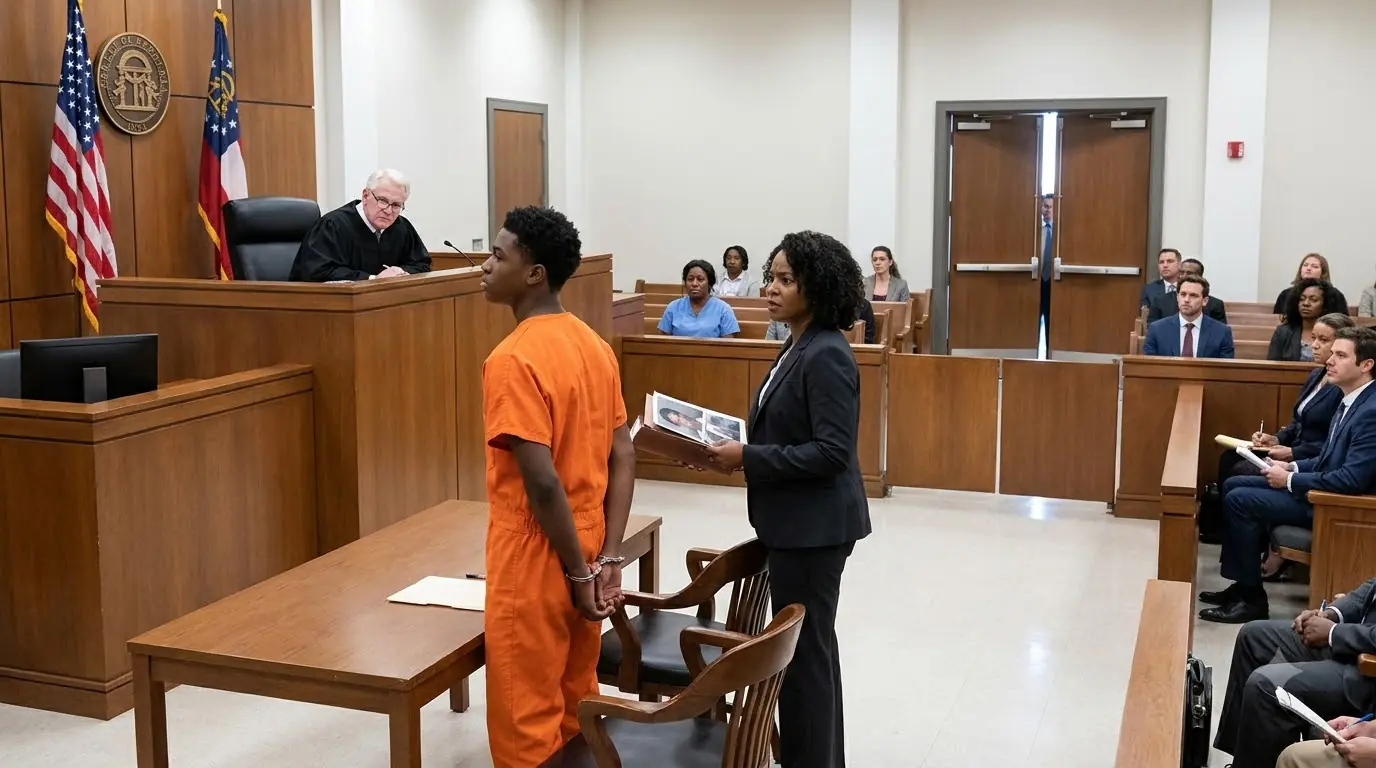
Judge Sentenced a 16-Year-Old Boy Without Hearing His Side — Then a Federal Investigator Entered the Courtroom
The judge did not raise his voice when he called Isaiah Owens an animal.
That was what the sixteen-year-old would remember afterward.
Not the black robe, the American flag behind the bench, or even the cold metal cuffs around his wrists.
He would remember how easily a powerful man could say something cruel when everyone in the room was expected to obey him.
“Get that boy away from my bench,” Judge Harlan Crawford ordered the deputy.
Isaiah had been standing to answer a question about where he had been on the evening of June 4.
He wore a county-issued shirt that hung loosely from his shoulders. His sneakers had been taken during processing, and his hands were secured in front of him.
His mother sat in the second row, wearing the pale blue medical scrubs she had put on after finishing a night shift.
Her eyes were tired.
Her hands were clasped tightly together.
Beside her stood Isaiah’s attorney, Daniel Brooks, holding a folder containing photographs, witness statements, and documents the court had not yet allowed him to present.
“Your Honor,” Isaiah said carefully, “I was at the community center. They can tell you I was there.”
Judge Crawford adjusted his glasses.
“I have heard enough excuses from young men who think rules don’t apply to them.”
“Sir, I’m telling the truth.”
“That’s enough.”
Isaiah looked toward his attorney.
Daniel stepped forward.
“Your Honor, we respectfully request an opportunity to present the additional evidence before any decision is made.”
The judge glanced at him.
“Mr. Brooks, I have already reviewed the prosecution’s submission.”
“But the defense has not been given an opportunity to—”
“I am not interested in another lengthy argument.”
The courtroom became quiet.
Isaiah looked at his mother.
Her expression had changed.
She was no longer simply frightened.
She looked as though she was trying to hold herself together with every bit of strength she had left.
What frightened Isaiah most was not that the judge disliked him.
It was the possibility that the judge had already decided who he was and that nothing he said would ever change that decision.
But there was something nobody in the courtroom knew.
A security recording, an overlooked witness, and a series of electronic records were about to challenge the entire case.
And one phone call would bring a federal investigator through the courtroom doors.
Before the Arrest
Before everything happened, Isaiah’s biggest problem was usually getting to school on time.
He lived with his mother, Denise Owens, in a modest apartment on the eastern side of town.
Denise worked as a nursing assistant at a regional medical center.
Her shifts often lasted twelve hours.
Sometimes she worked overnight.
Sometimes she accepted additional hours when another employee called in sick.
She did everything she could to provide a stable home for her son.
Isaiah understood how hard she worked.
He prepared his own breakfast, helped with household chores, and made sure his school assignments were completed.
He was not a perfect student.
He occasionally forgot homework and sometimes argued with teachers when he believed something was unfair.
But he was a good student overall.
His favorite subjects were mathematics, computer science, and history.
He also volunteered at the Eastside Community Center three afternoons each week.
The center offered after-school activities, tutoring, sports programs, and basic computer classes.
Isaiah helped younger students with their assignments.
He was particularly good at mathematics.
The program director, Mrs. Evelyn Carter, often joked that he was better at explaining difficult problems than some of the adults who worked there.
Isaiah hoped to study engineering after graduation.
His mother encouraged him.
“Whatever you choose, make sure you learn something that gives you options,” she often told him.
He had taken those words seriously.
He spent hours studying online lessons and practicing basic programming.
His mother could not afford expensive private classes, but the community center had a small computer room where he could study.
It was his favorite place.
Nobody there cared about his family’s income.
Nobody expected him to dress like someone else.
They cared about whether he showed up and whether he was willing to learn.
Then, on the evening of June 4, everything changed.
The Night That Changed His Life
At approximately seven o’clock, Isaiah was helping younger students finish their homework.
Mrs. Carter was preparing the evening activity schedule.
Two volunteers were organizing sports equipment.
The center’s security cameras recorded the main entrance and several common areas.
Isaiah remembered the evening clearly.
He had helped a student named Marcus understand a mathematics assignment.
Afterward, he spent some time in the computer room completing his own schoolwork.
At approximately 8:15, he left the building.
He stopped at a small grocery store to purchase bread and milk for his mother.
Then he walked home.
Nothing unusual happened.
But several miles away, a robbery had taken place at a private financial services office.
A security employee had been seriously injured.
The police were searching for two suspects.
One witness described seeing a young Black male wearing a dark jacket near the building shortly before the incident.
Another witness gave a vague description of someone running through a nearby parking area.
Investigators obtained a photograph from a traffic camera.
The image was unclear.
The individual appeared to be wearing dark clothing, but the face could not be identified.
A detective later received an anonymous tip naming Isaiah.
The tip contained little supporting information.
Nevertheless, Isaiah became a person of interest.
The following afternoon, police officers arrived at his school.
They asked him to accompany them for questioning.
Isaiah was frightened.
He asked whether he could call his mother.
The officers told him that the situation needed to be clarified.
When Denise arrived, she discovered that her son was being questioned about a serious robbery.
She immediately requested legal assistance.
But the situation was already moving quickly.
Within days, Isaiah was facing serious allegations.
The prosecution argued that he had been involved in the incident.
The defense maintained that the identification was unreliable and that several witnesses could establish his whereabouts.
Isaiah’s mother believed the truth would become clear.
She had no idea how difficult proving it would be.
The Evidence Nobody Wanted to Discuss
Daniel Brooks was an experienced defense attorney.
He had handled criminal cases involving mistaken identification, unreliable witnesses, and incomplete investigations.
When he first met Isaiah, he noticed that the teenager was frightened but consistent.
He asked him to describe the evening.
Isaiah repeated the same account.
He had been at the community center.
He had left shortly after eight.
He had purchased groceries.
And he had returned home.
Daniel requested records from the community center.
Mrs. Carter provided a signed statement confirming that Isaiah had attended the program.
She also explained that several other students and volunteers had seen him.
The center had security cameras.
However, obtaining the complete recordings required a formal request.
Daniel submitted the necessary paperwork.
He also requested the original records related to the prosecution’s identification evidence.
Several days later, he received a collection of documents.
One item immediately concerned him.
The photograph used to identify Isaiah was extremely unclear.
The person in the image was wearing a dark jacket.
Isaiah owned a dark jacket.
But thousands of people in the area wore similar clothing.
There was no clear facial identification.
Daniel also discovered that the prosecution’s timeline contained an inconsistency.
The alleged robbery had occurred earlier than the initial report suggested.
The exact time had not been firmly established.
That mattered.
If Isaiah’s community center attendance could be independently verified during the relevant period, it could undermine the accusation.
Daniel organized the evidence into a folder.
He intended to present it during the next hearing.
But Judge Crawford appeared impatient with the defense.
He repeatedly interrupted Daniel’s arguments.
He questioned Isaiah’s credibility without examining the supporting documents.
And he seemed increasingly determined to move the case forward.
Denise began to worry.
One evening, she called Daniel.
“Why won’t the judge listen?”
Daniel paused.
“I don’t know, Mrs. Owens. But we are going to keep presenting the evidence.”
“Can they really send my son away without hearing him?”
“They are required to follow the law. If the court makes an improper decision, there are procedures available to challenge it.”
Denise looked toward Isaiah’s bedroom.
Her son was sitting at his desk, trying to complete a mathematics assignment.
He had not asked for help.
He was simply trying to maintain some normality.
“Please don’t let them take his future away,” she whispered.
Daniel promised to do everything he could.
The Courtroom Confrontation
The next hearing began at ten in the morning.
The prosecution presented its summary.
The prosecutor argued that the circumstances justified keeping Isaiah in custody while the case continued.
Daniel stood.
“Your Honor, we have obtained evidence that directly challenges the identification and the prosecution’s timeline.”
Judge Crawford looked toward him.
“What evidence?”
“Security records from the Eastside Community Center, witness statements, and additional information concerning the identification photograph.”
“Have these documents been properly submitted?”
“Yes, Your Honor. We filed them yesterday.”
The judge examined the paperwork briefly.
Then he placed it aside.
“I am not prepared to delay these proceedings.”
Daniel frowned.
“Your Honor, the evidence could be critical to determining whether the defendant was involved.”
The judge leaned forward.
“Mr. Brooks, this court has limited time.”
Isaiah stood.
“Your Honor, I was there. I didn’t do anything.”
The judge looked directly at him.
“Sit down.”
“But my teacher can tell you—”
“Sit down!”
Isaiah slowly returned to his seat.
Judge Crawford turned toward