Jelly-Like Clusters Found in an Oklahoma Lake Reveal the Fascinating World of Freshwater Wildlife
Freshwater lakes are home to countless organisms, many of which remain unnoticed beneath the surface. Fish, aquatic insects, microscopic life, and colonies of tiny animals all contribute to the balance of these environments. Occasionally, however, something unusual catches the attention of people enjoying the water.
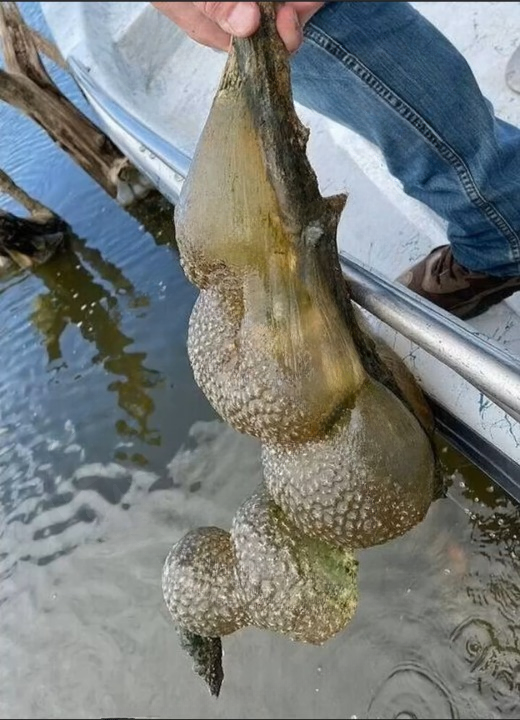
In March 2024, boaters at McGee Creek Reservoir in Atoka County, Oklahoma, reportedly encountered translucent, jelly-like formations attached to submerged branches. The unusual clusters looked unfamiliar and prompted questions about what they were, how they had formed, and whether they posed a risk to people using the lake.
Although such formations can look surprising, some are produced by freshwater organisms that have existed for a very long time. One possible explanation for these gelatinous colonies is a group of aquatic animals known as bryozoans, which can form visible masses in ponds, lakes, and other freshwater habitats.
Understanding these organisms provides a useful reminder that appearances in nature can be misleading. Something that looks strange beneath the water may actually be part of an ordinary ecological process.
What Are Jelly-Like Clusters in Freshwater Lakes?
Not every translucent mass found in a lake has the same origin. Depending on the location, season, and environmental conditions, gelatinous formations may consist of colonies of small animals, algae, eggs, microbial material, or other natural substances.
One group frequently associated with unusual freshwater colonies is the bryozoans. These small aquatic invertebrates are sometimes called moss animals because of the appearance of certain colonies under magnification.
Freshwater bryozoans can form gelatinous structures that attach to submerged branches, rocks, aquatic vegetation, and other stable surfaces. Their colonies may resemble clear or cloudy blobs, rounded masses, or irregular clusters beneath the water.
The appearance can vary considerably. Some colonies are relatively small, while others grow into conspicuous formations that attract attention from boaters, anglers, and people exploring the shoreline.
Although bryozoan colonies may look like a single organism, they consist of many tiny individual animals living together. Each individual, called a zooid, has a specialized structure that allows it to collect microscopic food particles from the surrounding water.
The colony functions as a connected living structure, with its members contributing to the overall survival and growth of the group.
This type of organization is an example of colonial life, a strategy found in several different groups of organisms. Instead of living entirely independently, numerous small individuals form a larger structure that can become visible to the naked eye.
Why Do These Organisms Look Like Gelatin?
The soft, jelly-like appearance of some freshwater colonies comes from the material surrounding their tiny individual animals.
In certain bryozoan species, the colony is embedded in a gelatinous matrix that helps hold its structure together. Because the material contains substantial water, the colony can appear translucent, soft, and almost shapeless.
When viewed from above the water, a colony may resemble a clear lump attached to a submerged branch. Under different lighting conditions, it may appear pale, grayish, greenish, or slightly brown.
The appearance can also change as a colony grows or as particles accumulate on its surface. Water clarity, depth, sunlight, and the background behind the formation can all influence how it looks to an observer.
These characteristics can make identification difficult without closer examination.
A photograph may provide useful clues, but it may not reveal enough detail to establish the species or even the exact type of organism. Other biological material can produce a similar appearance, particularly when viewed through moving water.
For that reason, an unusual gelatinous mass should not automatically be identified as a bryozoan colony simply because it resembles one. A reliable identification may require information about its structure, location, and microscopic features.
Nevertheless, bryozoans provide a well-documented example of how freshwater life can create formations that appear unusual to people who encounter them for the first time.
What Are Bryozoans?
Bryozoans are small aquatic invertebrates belonging to a group of animals found in marine and freshwater environments. Many species live in colonies, with numerous tiny individuals attached to a shared structure.
Although the animals themselves are generally difficult to see without magnification, the colonies they produce can become large enough to notice easily.
Each zooid has a feeding structure that can extend into the water. This structure carries a ring or horseshoe-shaped arrangement of fine tentacles, depending on the species, that helps capture suspended food particles.
The tentacles move water past the feeding surface, allowing the animal to collect tiny organisms and organic particles. These may include microscopic algae and other small components of the aquatic food supply.
Because many bryozoans feed on suspended particles, they form part of the wider network of organisms that process material in aquatic ecosystems.
Different species have different life cycles, colony structures, and environmental preferences. Some grow on solid surfaces, while others form gelatinous masses that may be particularly noticeable in calm freshwater settings.
Their presence can be an ordinary feature of a lake or reservoir rather than evidence of contamination or an unusual biological event.
How Do Bryozoan Colonies Form?
A bryozoan colony begins when a new individual establishes itself in a suitable location. Depending on the species, this may occur through the development of a resting stage or through other reproductive processes.
Once established, the colony grows as individual zooids produce additional members. Over time, these animals form a larger structure that remains attached to an underwater surface.
In gelatinous freshwater species, the colony’s soft matrix can expand as the organisms grow. The result may be a rounded mass or an irregular formation that becomes increasingly visible.
Submerged branches are suitable attachment points because they provide a stable surface in an environment where the colony can access water carrying microscopic food.
Other hard surfaces, including rocks and artificial structures, may also support aquatic colonies.
The colony’s size depends on several factors, including species, water temperature, food availability, and the time available for growth. Conditions that support active feeding and development may allow a colony to become more noticeable.
This growth does not necessarily happen quickly, and the presence of a large colony does not by itself reveal precisely when it began forming.
Freshwater colonies can therefore appear unexpectedly to people who regularly visit a lake but have not previously noticed them. They may have grown gradually underwater or become more visible because of changes in water level, lighting, or seasonal activity.
Why Might They Appear in a Reservoir?
Lakes and reservoirs contain a range of habitats, from shallow shorelines to deeper areas with submerged vegetation and fallen branches. These environments provide different opportunities for aquatic organisms to settle and grow.
A reservoir with submerged woody material may offer attachment surfaces for colonies of bryozoans and other invertebrates. Water movement, food availability, and local conditions can influence where these organisms establish themselves.
Reservoirs also change throughout the year. Water levels may rise or fall, temperatures fluctuate, and sunlight reaches different parts of the water column depending on depth and clarity.
These changes can affect both the organisms themselves and the likelihood that people will notice them.
For example, a branch that was previously hidden may become easier to see when the water is clear or when a person approaches it from a different angle. A colony may also become more conspicuous as it grows.
An unusual-looking formation does not automatically mean that something has recently entered the reservoir or that the ecosystem is experiencing a problem.
The presence of a particular organism must be interpreted in context. Scientists and environmental specialists consider factors such as species identification, habitat conditions, seasonal patterns, and water quality before drawing conclusions about what an observation means.
Are These Jelly-Like Organisms Dangerous to People?
Some freshwater bryozoan colonies are generally regarded as harmless to people who encounter them in lakes and ponds. They are not the same as jellyfish, and their gelatinous appearance does not mean they possess the stinging structures associated with certain marine animals.
Bryozoans feed on microscopic particles in the water rather than hunting people or larger animals.
However, an important distinction is necessary: not every jelly-like formation found in freshwater is a bryozoan colony. Other organisms and biological materials can resemble one another, and a photograph alone may not provide enough evidence for a definitive identification.
It is therefore sensible to avoid handling unfamiliar formations, especially when their identity is uncertain.
People swimming, boating, or fishing should follow ordinary water-safety practices. Avoid swallowing untreated lake water, wash hands after handling objects collected from the water, and keep cuts clean if they come into contact with potentially contaminated surfaces.
If a lake or reservoir has an official swimming advisory, water-quality warning, or other public-health notice, follow that guidance regardless of whether unusual biological formations are present.
The appearance of a gelatinous mass alone is not sufficient evidence that the water is dangerous. Equally, the assumption that a formation is harmless should not replace proper identification when there is a genuine concern.
If an unusual organism is found in an area used for recreation and there is uncertainty about its identity, a local natural-resources agency or qualified aquatic specialist may be able to provide guidance.
Do Bryozoans Mean the Water Is Clean?
The presence of a bryozoan colony should not be treated as a definitive test of water quality.
Aquatic organisms respond to multiple environmental conditions, including temperature, food supply, water chemistry, habitat availability, and seasonal changes. A single species or colony cannot provide a complete picture of the health of an entire lake.
Water-quality assessments typically use a combination of evidence. Depending on the purpose of the assessment, this may include measurements of dissolved oxygen, nutrients, acidity, turbidity, contaminants, and microbial indicators.
Biological monitoring may also examine the diversity and abundance of aquatic organisms over time.
The results are interpreted together because different indicators reveal different aspects of the ecosystem.
A lake may support diverse aquatic life while still experiencing a localized water-quality problem. Conversely, the absence of a particular organism does not automatically indicate poor environmental conditions.
For recreational safety, the most relevant information may come from official water-testing programs and public-health advisories rather than observations of one unusual formation.
This is why it is important to avoid broad claims about water purity based solely on the presence of jelly-like colonies.
What Role Do These Colonies Play in the Ecosystem?
Bryozoans are part of the complex biological communities that support freshwater ecosystems.
By collecting suspended particles from the water, they participate in the movement of material through aquatic food webs. Their feeding activity can contribute to the processing of microscopic food resources and organic particles.
Their colonies also provide surfaces and small-scale habitats that may be used by other organisms. Depending on the setting, tiny invertebrates and microorganisms may live on or around aquatic structures.
Bryozoans themselves can become food for some animals, although their importance varies among habitats and species.
These relationships illustrate how seemingly small organisms can contribute to broader ecological processes.
Freshwater ecosystems are not made up only of fish and plants. They also depend on algae, bacteria, fungi, invertebrates, and many other organisms that are rarely noticed during ordinary visits to the water.
Each group performs different functions, and the relationships among them can influence how nutrients and energy move through the environment.
The presence of a colony may therefore offer a useful reminder of the biological activity taking place beneath the surface.
However, it would be inaccurate to claim that every bryozoan colony has a major effect on water quality or that one visible formation can reveal the condition of the whole reservoir.
Its ecological importance depends on the species, its abundance, and the surrounding environment.
Why People Mistake Natural Organisms for Something Unusual
Human perception is strongly influenced by familiarity. People recognize common animals and plants because they have seen them repeatedly, while unfamiliar forms may appear strange or difficult to categorize.
A translucent mass attached to a branch does not resemble the fish, insects, or plants that visitors usually expect to find in a lake. Its unusual shape may therefore attract immediate attention.
Photographs can intensify that reaction. Close-up images often remove the surrounding context, making an ordinary organism appear larger or more mysterious than it would look in its natural habitat.
Lighting and camera angles can also exaggerate textures and colors. A formation photographed through clear water may look very different from the same colony viewed in person.
Online discussions can add to the uncertainty. When an image is shared without a verified identification, people may offer competing explanations, some of which are based on limited information.
This process can turn an ordinary natural observation into a confusing story.
A better approach is to begin with careful questions. Where was the formation found? Was it attached to a surface? What did its structure look like? Has the same organism been documented in similar habitats? Is there an expert identification?
These questions encourage evidence-based understanding rather than immediate conclusions.
Natural history is full of organisms that appear unfamiliar until their structure and behavior are explained. Learning about them can make outdoor experiences more interesting without requiring sensational interpretations.
How Scientists Identify Unfamiliar Aquatic Life
Identifying a strange organism can involve several stages of observation and analysis.
The first step is often to document its location and habitat. Scientists may record the water depth, temperature, clarity, substrate, and nearby vegetation, depending on the investigation.
Photographs can preserve details of the organism’s overall shape and attachment to its surroundings. Images taken from multiple angles may reveal features that are not visible in a single photograph.
For some organisms, a closer examination under magnification is needed. The arrangement of individual animals, feeding structures, colony patterns, or other anatomical characteristics can help distinguish between similar groups.
Specialists may compare these observations with published identification guides and scientific descriptions. In some cases, genetic analysis or other laboratory techniques can provide additional evidence.
Not every unusual discovery requires an extensive scientific investigation. Common species can often be identified using reliable field guides or advice from experienced naturalists.
However, a confident identification should be based on observable characteristics and appropriate expertise rather than appearance alone.
When people share observations with scientists or local environmental agencies, accurate location details and photographs can be useful. If collecting a sample is necessary, it should be done only when permitted and with suitable guidance.
Responsible identification protects both the observer and the organism while helping ensure that conclusions are reliable.
What Should You Do If You Find a Similar Formation?
If you encounter a jelly-like mass attached to a submerged branch or another surface, there is usually no need to panic.
First, observe it from a safe distance. If you are in a boat, avoid leaning over unstable edges or entering the water simply to inspect the formation.
Notice its general shape, color, location, and whether it appears attached to a solid surface. These details may help a qualified person identify it later.
If you take photographs, avoid disturbing the organism or damaging the habitat around it. There is rarely a need to remove an unfamiliar formation merely because it looks unusual.
Do not taste it or handle it with bare hands. If a sample is genuinely needed for identification, consult a local environmental authority or aquatic specialist about appropriate collection methods and any applicable rules.
If the discovery occurs in a public recreation area and you believe it may represent a broader concern, report the observation to the relevant park authority, lake manager, or natural-resources agency.
Include factual details rather than making assumptions about contamination or danger. For example, describing the location and appearance is more useful than declaring the water unsafe without supporting evidence.
If an official authority identifies the organism and confirms that no special action is necessary, the formation can generally be left undisturbed.
The key is to combine curiosity with sensible precautions and respect for the aquatic environment.
Why Freshwater Habitats Deserve Attention
Lakes and reservoirs provide important resources for people and wildlife. They may supply water, support fisheries, offer recreation, and provide habitat for numerous species.
Their ecological communities depend on a range of physical and biological conditions. Water