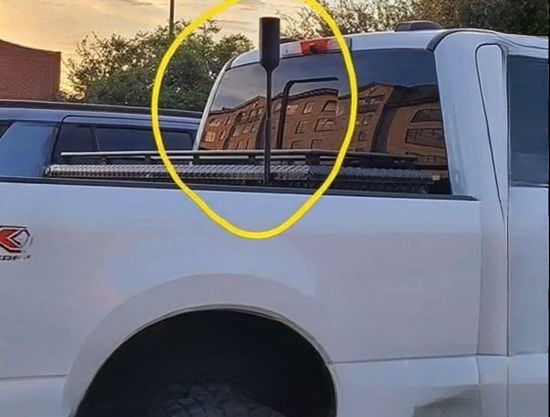
You’ve Noticed This on the Back of Trucks—Here’s the Truth Behind It
Have you ever been driving down the highway and noticed a tall, slender rod sticking up from the back of a truck, pickup, RV, or commercial vehicle? Perhaps you have seen two antennas mounted on either side of a truck cab and wondered why the driver needs them. At first glance, they may look like old-fashioned radio equipment, unusual decorations, or accessories whose purpose is no longer relevant in the modern world.
There is a good reason these objects attract attention. Their simple appearance hides a surprisingly practical role in communication, navigation, and vehicle safety.
For many years, one of the most familiar explanations was Citizens Band (CB) radio. Truck drivers used CB radios to communicate with one another, share information about road conditions, warn about traffic delays, and coordinate with nearby drivers. Although mobile phones and digital communication systems have changed the trucking industry, radio equipment remains useful in many situations.
However, not every rod mounted on a truck is a CB antenna. Depending on its shape, mounting location, and the equipment installed inside the vehicle, it could be part of a different radio system, a cellular signal booster, a fleet communication setup, or even an off-road visibility accessory.
So what are those rods really for? Why do some trucks have one antenna while others have two? And are these devices still useful today?
Here is what you need to know.
The Short Answer: Many of Them Are Antennas
The tall rods commonly seen on trucks are often antennas designed to send and receive radio signals. They allow equipment inside the vehicle to communicate with other radios, wireless networks, or compatible systems.
An antenna is an important part of any wireless communication setup. A radio may generate or process a signal, but it needs an appropriate antenna to transmit that signal efficiently or receive signals from elsewhere.
The antenna’s design depends on its intended purpose. A CB radio antenna, for example, is designed for the frequencies used by Citizens Band radio. An antenna intended for cellular service or another two-way radio system must be suitable for that system instead.
Some antennas are long and flexible. Others are short, compact, and shaped like a small fin or stubby rod. A truck can also carry several antennas because the driver may use multiple communication systems.
The important distinction is that the appearance of an antenna does not reliably tell you exactly which system it serves. Similar-looking devices can perform different jobs, and a truck’s equipment may have been installed for a particular business, route, or activity.
The Original Connection: CB Radios and Truck Drivers
To understand why antennas are so closely associated with trucks, it helps to look at the history of CB radio.
Citizens Band radio became a familiar communication tool for truck drivers during the twentieth century. It allowed drivers with compatible equipment to communicate directly over radio without needing a mobile-phone network or a traditional telephone connection.
This was especially useful when traveling long distances. Drivers could exchange information about congestion, accidents, road hazards, weather conditions, and other issues affecting their journeys.
Imagine approaching a section of highway where traffic has suddenly slowed. A driver farther ahead may already know that a lane is blocked or that an accident has occurred. If the drivers have compatible radios and are within communication range, that information can be shared directly.
For professional drivers, that kind of timely information can be valuable.
CB radio also became part of trucking culture. Drivers developed familiar ways of communicating, used radio terminology, and built a shared sense of community across long routes. The equipment became a recognizable feature of many trucks, and the antenna was one of its most visible components.
Although smartphones now provide many ways to exchange information, CB radio has not become completely obsolete. Some truck drivers, off-road enthusiasts, recreational vehicle owners, and other motorists still use it because it offers direct radio-to-radio communication without relying on cellular coverage.
Why an antenna is essential to CB radio
A CB radio antenna is not simply an accessory added for appearance. It is a functional part of the radio system.
The antenna helps the radio transmit and receive electromagnetic waves. Its dimensions, design, mounting position, and connection to the vehicle all affect how well the system performs.
A poorly chosen or incorrectly installed antenna may deliver disappointing results even when the radio itself is working properly. A suitable antenna, installed and adjusted according to the manufacturer’s guidance, can improve the reliability of communication.
For more information, Cobra Electronics provides a practical guide to choosing a CB antenna.
Why Are Some Truck Antennas So Tall?
One of the most noticeable features of a truck antenna is its height. Some extend several feet above the cab, while others are much shorter.
There is a technical reason for this.
Radio antennas are designed around the frequencies they need to use. At certain frequencies, antenna length has a significant influence on how efficiently the antenna can transmit and receive signals. The vehicle’s metal body, mounting location, and surrounding objects can also affect performance.
A longer antenna can be advantageous for some CB installations, but the longest antenna is not automatically the best choice for every vehicle. The right design depends on the radio system, available mounting space, road conditions, and clearance requirements.
The challenge of highway clearance
Truck drivers must think about more than radio performance. Their vehicles may pass beneath bridges, enter loading bays, travel through garages, or navigate areas with overhead obstacles.
A very tall antenna may strike an obstruction or be damaged by repeated contact with low structures. A shorter antenna can be more practical in certain working environments, even if it involves a performance compromise.
This is why truck antennas come in different designs and lengths. Manufacturers and installers must balance radio performance with durability and the realities of daily driving.
Why some antennas bend
Many vehicle antennas are designed to flex rather than remain perfectly rigid. Flexibility can help an antenna withstand wind and occasional contact with branches or other obstacles.
However, flexibility does not mean that every impact is harmless. An antenna or its mount can still be damaged, and a loose or broken installation may affect performance.
If an antenna is visibly damaged, drivers should inspect it safely when parked and follow the manufacturer’s advice for repair or replacement.
Why Do Some Trucks Have Two Antennas?
You may have noticed that some large trucks have an antenna on each side of the cab. This arrangement is often associated with CB radio installations.
A dual-antenna setup can be designed to shape the radio signal’s coverage pattern. Depending on the antenna spacing, vehicle geometry, and installation, it may favor communication toward the front and rear of the vehicle while reducing coverage toward the sides.
That does not mean two antennas automatically provide twice the range or twice the power.
The results depend on how the system is designed and installed. The antennas and associated cables must be compatible with the radio setup, and incorrect installation can reduce performance rather than improve it.
Some drivers also prefer the symmetrical appearance of two antennas. Appearance may be one reason for a particular installation, but it should not be assumed that every dual setup is purely decorative.
A properly designed dual-antenna system has a technical purpose. Whether it offers an advantage over one well-installed antenna depends on the driver’s needs and the system’s configuration.
Not Every Truck Antenna Is for CB Radio
This is where the subject becomes more interesting. Modern trucks may carry equipment for several different kinds of wireless communication.
A tall rod could be a CB antenna, but other possibilities include antennas for business radio networks, cellular devices, or specialized vehicle equipment. Some vehicles also carry accessories that resemble antennas but serve a visibility function instead.
Here are several common possibilities.
1. CB radio antennas
CB antennas are used with Citizens Band radios. They are commonly found on trucks, pickups, recreational vehicles, and some off-road vehicles.
They may be long, flexible whips or shorter designs that use coils to accommodate the required electrical characteristics in a more compact physical length.
The antenna’s exact shape depends on the design and installation. Some trucks have antennas attached to mirror brackets, while others use mounts on the cab, body, or other suitable locations.
2. Other two-way radio antennas
Some commercial vehicles use two-way radio systems for communication within a company, worksite, or fleet.
These systems may operate on frequencies different from CB radio. Their antennas are designed for the particular equipment and service involved.
For example, a business may use a radio network to coordinate drivers, communicate with dispatch, or keep in touch with workers at a job site. The appropriate system depends on the organization’s operational needs and local radio regulations.
A two-way radio antenna may look similar to a CB antenna from a distance, so its appearance alone may not identify the service.
3. Cellular signal booster antennas
Some drivers use cellular signal boosters to improve phone connectivity in places where mobile reception is weak. These systems generally use an external antenna to receive or transmit signals through a compatible booster.
A cellular booster may be useful in certain rural areas or vehicles with challenging reception conditions, but it cannot guarantee service where no usable signal is available. Performance depends on the available network signal, the equipment, installation, and other conditions.
Cellular equipment can have a different appearance from a traditional CB antenna. Some external antennas are short and compact rather than long and flexible.
4. GPS and fleet-management equipment
Commercial trucks may use satellite-navigation receivers and fleet-management systems to support routing, location tracking, vehicle monitoring, and dispatch operations.
Some equipment incorporates antennas into a compact housing or vehicle-mounted unit. Other systems use separate antennas for different wireless services.
It is important not to assume that every GPS-related device is a