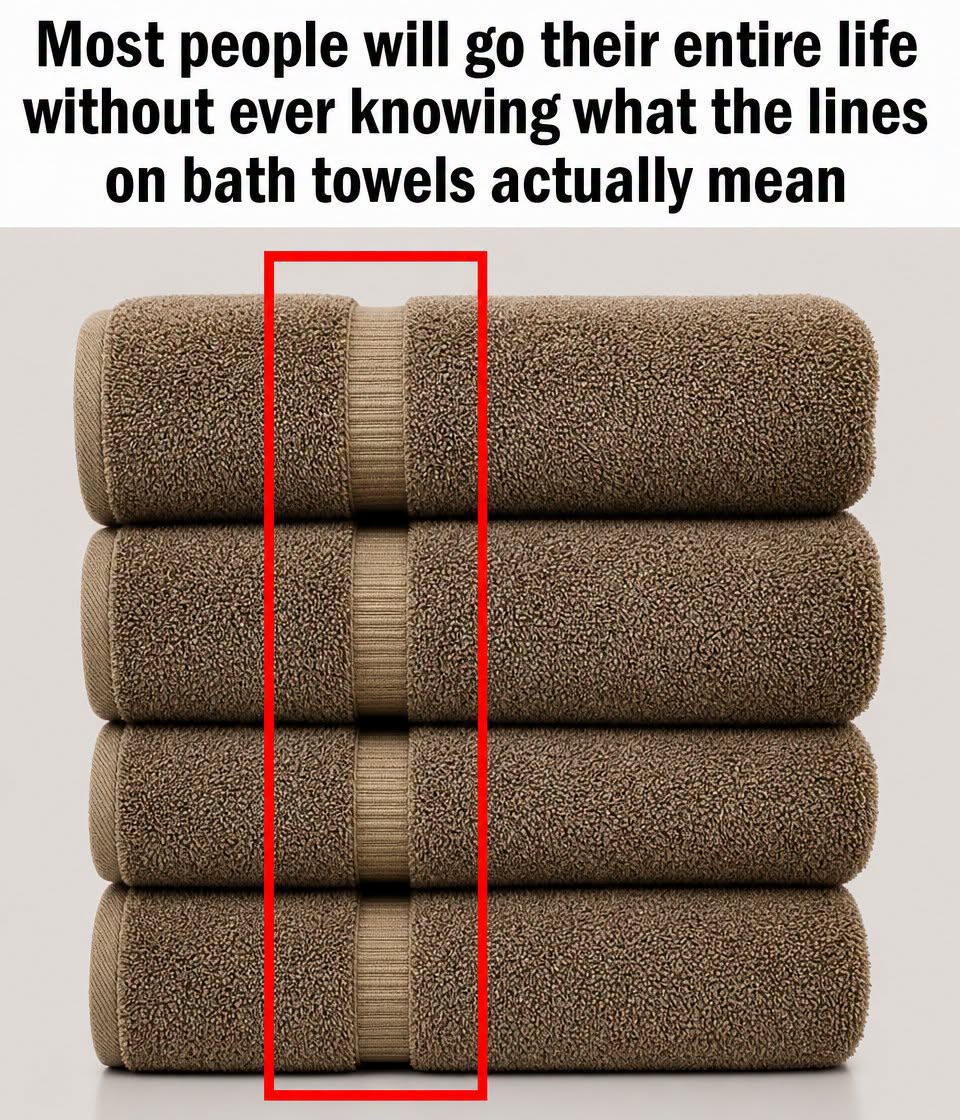
Why Towels Have That Flat Woven Strip: The Practical Purpose Behind the Design
If you have ever looked closely at a bath towel, you may have noticed that it is not made entirely from the same type of fabric. Most of the towel is soft, thick, and covered with tiny loops designed to absorb moisture. Near one or both ends, however, there is usually a flatter section made with a tighter, different-looking weave.
It is easy to assume that this strip is simply decorative.
After all, it often features a different pattern from the rest of the towel, and manufacturers sometimes use it as a place for stripes, borders, or other designs. But the woven section has a practical role as well.
That small change in construction helps the towel maintain its shape, adds structure to the edges, and can contribute to the durability of the product.
Understanding why towels are made this way is a good example of how ordinary household objects often contain small design details that have useful purposes.
The Part of the Towel Most People Notice
Take a typical bath towel and spread it out.
The center and majority of the towel will usually have a soft, looped texture. These loops are what give towels their familiar fluffy appearance.
At the ends, you may find a section that is flatter and more tightly woven.
Depending on the manufacturer, this area can vary considerably in width and appearance. Some towels have a narrow band, while others have a much wider decorative strip.
It may also have horizontal lines, geometric patterns, or a completely different texture.
This area is commonly referred to as a dobby border or dobby weave.
Although the exact construction varies between towels, the general idea is the same: the manufacturer changes the weave in a specific area to provide additional structure and visual definition.
Why Isn’t the Entire Towel Fluffy?
At first glance, it might seem logical to make the entire towel from absorbent loops.
More loops could appear to mean more absorbency.
But a towel is not simply a collection of loops. It is a textile that needs to maintain its shape through repeated washing, drying, folding, handling, and use.
The looped pile that makes a towel soft also has characteristics that make it different from a tightly woven fabric.
The loops can catch on objects, become pulled, and gradually lose their original appearance.
A tightly woven section is more stable.
By placing this stronger construction at the edges, manufacturers can give the towel a defined boundary and help reinforce the transition between the main body and the end of the textile.
The Border Helps Give the Towel Structure
One of the most useful functions of the woven strip is structural.
Imagine a towel made entirely from loose, absorbent loops from one end to the other.
The edges would have less visual definition, and the fabric could be more susceptible to changes in shape.
The border creates a firmer area at the end of the towel.
This can help the towel maintain a recognizable rectangular shape and gives manufacturers a controlled place to finish the main looped section.
Textile construction often involves carefully choosing different weaving techniques for different areas of the same product.
A towel is a simple example of that principle.
It Can Help Control the Looped Pile
Another important function involves the transition between the fluffy pile and the edge.
The main body of a towel contains thousands of small loops.
Those loops are created during weaving and extend outward from the base fabric.
Without a controlled transition, the pile could simply continue toward the edge.
The woven border provides a clear finishing area.
In other words, it helps define where the absorbent pile begins and ends.
This is useful during manufacturing because the towel can be constructed with a predictable and stable edge.
The Border Isn’t Mainly There for Decoration
The decorative appearance can sometimes make people think the strip exists primarily for visual reasons.
Design certainly plays a role.
Manufacturers can use the border to add patterns, colors, stripes, logos, or other details.
However, the fact that the strip can be decorative does not mean it is purely decorative.
Many household textiles combine appearance and function.
Curtains, blankets, sheets, carpets, clothing, and towels often use different materials or weaving patterns in specific areas because those differences serve practical purposes.
The towel border is another example.
What Is a Dobby Border?
The term “dobby” refers to a method of controlling the weaving process that allows textile manufacturers to create small geometric or textured patterns.
A dobby weave can produce designs that are more complex than a basic plain weave while still being integrated into the fabric itself.
On towels, dobby borders are commonly found near the ends.
The patterns can be very subtle.
Some towels have a simple set of horizontal lines. Others feature repeated diamonds, squares, waves, or other geometric motifs.
The exact design depends on the towel manufacturer and the intended style.
Regardless of appearance, the border remains a more tightly structured area than the plush pile in the middle.
Why Towels Use Loops in the First Place
To understand the border, it helps to understand the main body of the towel.
Traditional terry towels are made using loops of yarn.
Those loops increase the surface area of the fabric.
When water comes into contact with the towel, moisture can spread among the fibers and be held within the spaces created by the textile structure.
The loops also give towels their characteristic softness.
A completely flat woven fabric can absorb water, but terry construction is particularly well suited to towels because it combines absorbency with a comfortable texture.
The same loops that make the towel effective at drying, however, are less suitable for forming a firm finished edge.
That is one reason the construction changes near the ends.
Why the Ends Are Different
The ends of a towel experience plenty of handling.
When you pick up a towel, fold it, hang it, wash it, remove it from a dryer, or pull it from a stack, the edges are frequently touched.
They also experience friction.
A more tightly woven area provides a stable finish.
This can make the towel easier to handle and can help prevent the looped pile from extending all the way to the edge.
The border is therefore not an accidental feature.
It is part of the towel’s construction.
Does the Border Make a Towel More Absorbent?
Not necessarily.
The main absorbent area of a terry towel is generally the looped portion.
The tightly woven strip is not designed to compete with the pile in terms of absorbency.
In fact, you may notice that the border feels different when it becomes wet.
It can feel thinner and less plush than the rest of the towel.
That is expected.
Its primary role is related to structure and finishing rather than maximizing the amount of water absorbed.
This is why it is useful to think of the towel as having different zones, each designed for a particular purpose.
The Border Can Also Make Folding Easier
There is another everyday benefit that becomes obvious once you pay attention to the design.
The flatter section provides a visual reference point.
When folding towels, the border can make it easier to line up the ends consistently.
Hotels and households that stack towels neatly often take advantage of the defined edges.
While this may not have been the primary reason the feature was developed, it is certainly one of the practical benefits of having a clearly defined end section.
The border gives the towel a recognizable beginning and end.
Why Some Towels Have Borders at Both Ends
Many bath towels have a decorative or structural strip at both short ends.
There is a simple reason for this arrangement.
A rectangular towel needs to be finished on both ends.
Having matching borders creates balance and gives the product a symmetrical appearance.
It also means the looped pile can be terminated in a consistent way on both sides.
Depending on the towel design, the borders may be identical or slightly different.
Hand towels, washcloths, bath towels, and larger bath sheets can all use variations of this construction.
Why the Border Is Usually Near the Short Ends
If you look at most standard towels, the woven strip appears near the shorter edges rather than running down the sides.
This is largely connected to how the towel is constructed and finished.
The long edges are typically designed to maintain the continuous terry surface, while the shorter ends provide a natural location for the finishing band.
The arrangement also works well visually.
A horizontal border gives the towel a framed appearance without interrupting the large absorbent surface.
Does the Border Prevent Fraying?
It can contribute to edge stability, but it is important not to oversimplify its purpose.
The towel still needs appropriate finishing along its edges.
Manufacturers use different techniques to prevent unraveling and maintain the integrity of the textile.
The woven strip is part of this overall construction strategy, but it should not be thought of as a magical anti-fraying feature.
The quality of the towel, stitching, yarn, weave, washing conditions, and manufacturing process all influence how long the product lasts.
Why Some Towels Feel Thicker Than Others
The presence of a border does not tell you everything about towel quality.
Two towels can have very similar-looking borders while feeling completely different.
Factors such as cotton type, yarn quality, density, loop height, weight, and finishing processes all influence the final product.
A heavier towel may feel more luxurious, while a lighter towel may dry faster and be easier to store.
This is why shopping for towels based only on appearance can sometimes be misleading.
The construction of the main terry area is usually more important to drying performance than the decorative border.
The Importance of Washing Towels Correctly
The design of a towel can help with durability, but proper care is equally important.
Washing towels according to the manufacturer’s instructions can help preserve both the pile and the woven borders.
Excessive heat, harsh chemicals, overloading the washing machine, or using too much detergent can affect how textiles feel over time.
Fabric softener is another consideration.
Although it can make fabrics feel smooth, frequent use on towels may reduce their ability to absorb water because softening agents can coat fibers.
For towels that are primarily valued for absorbency, many people prefer to limit or avoid fabric softener.
Why Towels Sometimes Become Stiff
If a towel becomes rough or stiff after repeated washing, the problem is not necessarily the border.
Several factors can contribute to changes in texture.
Detergent residue can remain in the fabric if too much detergent is used or if the washing machine is overloaded.
Hard water can also contribute to mineral buildup.
High drying temperatures may affect fibers as well.
Air drying can produce a somewhat firmer feel compared with tumble drying, particularly in certain climates.
These changes are generally related to the overall fabric rather than the narrow woven strip at the ends.
Why Loops Sometimes Get Pulled
The fluffy loops in a towel are useful but can be vulnerable to snagging.
A loop may catch on a zipper, hook, rough surface, or another object.
When that happens, you may see a small strand sticking out from the towel.
It can be tempting to pull the loose thread.
That is usually not a good idea.
Cutting the protruding strand carefully is generally preferable to pulling it, because pulling can disturb neighboring loops.
Again, this highlights the difference between the plush body of the towel and its more tightly woven border.
The Border Can Serve as a Design Signature
Towel manufacturers also use borders as part of their visual identity.
A particular pattern can make a product recognizable.
Luxury hotels may use simple, understated borders, while colorful household towels may feature bold patterns.
Some towels have embroidered designs incorporated into the border.
Others use contrasting yarns to create stripes.
Because the border is a stable section of fabric, it provides a convenient location for decorative details.
This is especially useful when manufacturers want to make a towel visually distinctive without covering the entire surface with a pattern.
Why Hotel Towels Often Have Simple Borders
If you have stayed in hotels, you may have noticed that many towels use relatively simple woven bands.
There are practical reasons for this.
Hotel linens need to withstand frequent washing and drying.
They also need to be easy to identify, fold, stack, and maintain.
A simple border provides a clean appearance while retaining the functional benefits of the woven construction.
The familiar white hotel towel with a narrow decorative band has become a recognizable design partly because simplicity works well in commercial laundry environments.
Different Towels, Different Designs
Not every towel has the same border.
Some inexpensive towels may have a very narrow strip.
Higher-end towels may have elaborate woven patterns.
Some modern towels minimize the border altogether.
Others use large decorative bands as a major part of the design.
There are also towels made from different textile constructions that do not look or behave like traditional terry towels.
For example, waffle-weave towels, Turkish-style towels, microfiber towels, and other specialized products can have very different structures.
So while the familiar woven strip is common, it is not universal.
Turkish-Style Towels Show Another Approach
Traditional Turkish towels, sometimes called peshtemals, often have a very different appearance from thick terry bath towels.
They are typically flatter and lighter, with decorative woven areas and fringed ends.
Their construction demonstrates that towels do not need a thick terry pile to serve their purpose.
Different cultures and manufacturers have developed different approaches to balancing absorbency, drying speed, weight, portability, and appearance.
The common towel border is simply one example of textile engineering applied to an everyday object.
Why Small Design Details Matter
It is easy to overlook features that appear on objects we use every day.
We see a towel, use it, wash it, fold it, and put it away.
Because the process is so familiar, we rarely stop to ask why it looks the way it does.
But nearly every part of a well-designed household product has a reason.
The thickness of the fabric, the shape of the edges, the stitching, the loops, and the border all contribute to how the finished product behaves.
The woven strip may look insignificant, but it is part of a larger system of textile construction.
Is the Border Safe to Use for Drying?
Absolutely.
There is no need to avoid the border when drying your hands or body.
It is simply a different type of fabric construction.
You may notice that it feels less absorbent than the terry portion, but it remains part of the towel and can be used normally.
For the best drying performance, the plush looped area will generally be more effective at absorbing moisture.
The border is there for structural and design reasons rather than because it serves as a separate drying zone.
Why the Border May Feel Rougher
The difference in texture is caused by the weave.
The main towel body contains raised loops, creating a soft, three-dimensional surface.
The border is comparatively flat.
As a result, your fingers may immediately notice the difference.
This does not necessarily indicate that the towel is defective.
In fact, the contrast is an intentional feature of the construction.
Over time, the difference may become more or less noticeable depending on washing, drying, and wear.
What to Look for When Buying Towels
If you are shopping for a new towel, the border can tell you something about construction, but it should not be the only factor you consider.
Pay attention to the overall feel of the fabric.
Look at the density and consistency of the loops.
Check whether the edges are neatly finished.
Consider the towel’s weight and intended use.
A thick bath sheet may be comfortable at home but inconvenient for travel.
A lightweight towel may dry quickly and take up less space.
There is no single ideal towel for everyone.
The best choice depends on how and where you intend to use it.
Towel Design Is a Balance Between Comfort and Durability
A good towel has to perform several jobs simultaneously.
It needs to absorb moisture.
It should feel comfortable against the skin.
It needs to survive repeated washing.
It should maintain its shape.
It should be easy to handle and store.
And, for many consumers, it should look attractive.
No single type of fabric construction is perfect for all of these purposes.
That is why towels combine different features.
The soft terry pile addresses absorbency and comfort.
The tighter woven sections provide structure and visual definition.
The stitching and edge finishing help maintain the shape.
Together, these details create the finished product that most people recognize as a bath towel.
A Simple Detail With a Practical Explanation
The next time you step out of the shower and reach for a towel, take a closer look at those flat woven strips near the ends.
They may appear to be little more than decoration, but they are part of the towel’s construction.
The tighter weave helps create a defined ending for the terry pile, contributes structure to the fabric, and provides a natural location for decorative patterns.
The fluffy center and flatter border are not competing designs. They are two different parts of the same textile, each performing a different role.
That small detail is a reminder that everyday objects often contain more thoughtful engineering than we realize.
From the way a towel absorbs water to the way its edges are finished, its design reflects a balance between function, durability, appearance, and comfort.
So while you may have ignored that flat strip on your towels for years, it is not there by accident.
It is one of the small construction details that helps turn a piece of woven fabric into a practical household towel.