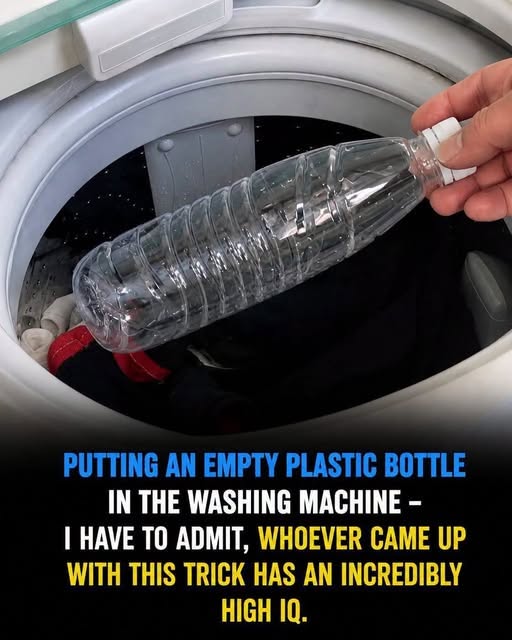
Why Do Some People Put Plastic Bottles in the Washing Machine? Here’s What the Laundry Trick Is Supposed to Do
A washing machine is one of those household appliances that most people use without thinking much about what happens inside the drum.
You add your clothes, measure the detergent, choose a cycle, close the door, and let the machine do its job.
But from time to time, an unusual laundry tip appears online and gets people wondering whether there is a simple way to improve the washing process.
One of those tricks involves something that normally belongs in the recycling bin: an empty plastic bottle.
The idea is simple. A clean, lightweight plastic bottle is placed inside the washing machine along with a load of clothes. As the drum rotates, the bottle moves around with the laundry.
People who use the technique suggest that the bottle can help create additional movement among the clothes, potentially helping separate garments and allowing water and detergent to circulate more freely.
It sounds unusual.
And there is an important question behind the trend:
Does putting a plastic bottle in the washing machine actually do anything useful?
The answer isn’t quite as dramatic as some online posts suggest.
There may be a simple physical explanation for why people believe the trick works, but there are also several precautions worth knowing before putting any household object inside a washing machine.
How the Plastic Bottle Method Works
The basic idea is relatively straightforward.
A person takes a clean, empty plastic bottle, makes sure it doesn’t contain liquid or residue, closes it securely, and places it inside the washing machine with the clothing.
During the wash cycle, the drum rotates.
The clothes move upward and then fall downward as the machine tumbles them.
The bottle moves along with them.
Because the bottle is lightweight and rigid compared with soft clothing, it can move differently through the load.
This may create additional movement between some garments.
The theory is that this movement could reduce the tendency of clothes to become tightly packed together during portions of the cycle.
When clothing is packed closely together, water and detergent may have more difficulty reaching every surface equally.
However, modern washing machines are already specifically designed to tumble clothing and distribute water and detergent throughout the load.
That means a plastic bottle isn’t necessarily providing a major improvement.
The technique should therefore be viewed as a household experiment rather than a proven replacement for proper loading and washing practices.
Why the Idea Became Popular
The popularity of the trick is easy to understand.
People generally like household solutions that are:
- inexpensive
- simple
- easy to test
- based on items they already have
- potentially useful without buying another product
An empty plastic bottle checks all of those boxes.
Instead of purchasing a specialized laundry accessory, someone can reuse an item already sitting in the recycling bin.
Social media has also played a major role in spreading unusual household tips.
A short video showing a plastic bottle tumbling around inside a washing machine can generate curiosity almost immediately.
Viewers may wonder whether it really works, and some decide to try it themselves.
If they notice a difference in their laundry, the tip spreads further.
But an important distinction is necessary.
A household trick becoming popular online does not automatically mean it has been scientifically proven to improve washing performance.
The Importance of the Bottle’s Condition
If someone chooses to experiment with this technique, the condition of the bottle matters.
A dirty or previously used bottle can contain residue.
That is obviously undesirable when washing clothing.
A bottle that previously contained sugary drinks, oils, cleaning products, or other substances should not simply be placed into the washing machine without being thoroughly cleaned.
The safest approach is to use a clean bottle intended for this type of experiment.
It should also be intact.
A bottle with cracks, sharp edges, damaged plastic, or a loose cap can create unnecessary problems.
The goal of a household laundry experiment should never be to introduce another source of debris or damage into the machine.
What Happens as the Machine Spins?
To understand the idea, it helps to think about what happens inside a front-loading washing machine.
The drum rotates.
Clothing is lifted as the drum moves and then falls back down.
Water and detergent move through the fabric during this process.
The exact movement depends on the machine, the selected cycle, the size of the load, and the types of clothing being washed.
A plastic bottle introduces another object into that movement.
Because the bottle is relatively rigid and lightweight, it can bounce, roll, and shift differently from fabric.
That additional object may cause some garments to move around differently.
This is likely the basic physical reason behind the trick.
But that doesn’t mean the bottle dramatically improves cleaning.
The machine itself is already engineered to create mechanical action.
Mechanical Action Is Already Part of Washing
Laundry doesn’t become clean simply because water and detergent are present.
The movement of the clothing also matters.
Washing machines use mechanical action to help loosen dirt from fabrics.
As garments move against one another and against the surfaces of the drum, particles can be dislodged.
Water carries away loosened material while detergent helps interact with oils, dirt, and other substances.
The exact balance depends on the wash cycle.
Modern machines use different combinations of water temperature, drum movement, soaking time, spin speed, and rinsing.
Because of this, adding an extra object to the drum isn’t necessarily required.
In many cases, choosing the appropriate wash cycle and avoiding overloading the machine will have a much more meaningful effect on cleaning performance.
Don’t Overload the Washing Machine
If you’re interested in improving laundry results, one of the first things to examine is the size of the load.
A washing machine needs enough space for clothing to move.
When a drum is packed completely full, garments can become compressed into a dense mass.
Water and detergent may not circulate as effectively.
The machine may also have difficulty tumbling the load properly.
A slightly smaller load can sometimes produce better washing results simply because the clothes have more room to move.
This is especially important for bulky items such as towels, blankets, jackets, and bedding.
Instead of relying on a plastic bottle to create movement, leaving adequate space in the drum is generally a more sensible laundry habit.
Could a Bottle Damage Clothing?
This depends on the bottle and the type of laundry.
A smooth, intact plastic bottle is unlikely to behave like a sharp object.
However, once plastic becomes damaged, cracked, or deformed, the situation can change.
A damaged bottle can develop rough edges.
Those edges could potentially catch on delicate fabrics.
For that reason, experimenting with the technique isn’t something I’d recommend for delicate garments, lace, fine knits, or clothing with easily damaged decorations.
Laundry should always be treated according to the care instructions on the garment.
If a piece of clothing is especially valuable or fragile, there is little reason to introduce an unnecessary object into the wash.