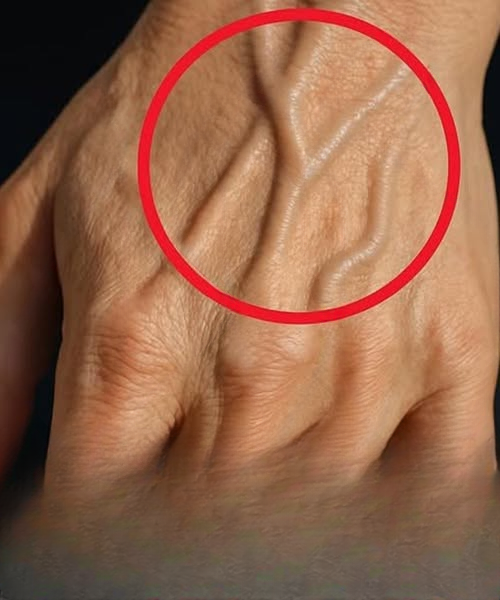
What Visible Veins on Your Hands Really Mean: Understanding Circulation, Aging, and Kidney Health
Visible veins on the hands are extremely common.
For some people, the veins are noticeable all the time. For others, they become more prominent during exercise, hot weather, after physical activity, or as the skin changes with age.
Because the kidneys play such an important role in maintaining fluid balance and circulation, it is understandable that people may wonder whether a change in the appearance of their hands could be connected to kidney health.
The important distinction is that visible hand veins by themselves are not a reliable way to determine whether your kidneys are functioning normally.
A person’s veins can become more noticeable for many ordinary reasons, including genetics, body composition, age, temperature, exercise, hydration, and changes in the skin.
Kidney disease can cause a number of symptoms and changes in the body, but visible veins on the hands are not considered a specific sign that can be used to diagnose kidney problems.
Understanding this distinction can help prevent unnecessary worry while also making it easier to recognize symptoms that genuinely deserve medical attention.
Why Are the Veins on Your Hands Visible?
The veins in your hands are located relatively close to the surface of the skin.
Unlike some deeper veins, superficial veins can often be seen through the skin, particularly when a person has relatively little tissue covering them.
The appearance of these veins varies considerably from one person to another.
Some people naturally have prominent veins because of their genetics.
Others may notice that their veins become more visible as they become leaner or more physically active.
Skin thickness also matters.
When the skin becomes thinner, structures underneath it can become easier to see.
This is one reason veins may become increasingly noticeable with age.
The presence of visible veins does not automatically mean that something is wrong.
In many cases, it is simply a normal feature of an individual’s anatomy.
Exercise Can Make Veins More Prominent
If you have ever noticed that the veins on your hands or arms appear more prominent after exercising, there is a straightforward explanation.
During physical activity, blood flow increases to working muscles.
Blood vessels can become more noticeable as circulation changes and the muscles temporarily become more full.
Strength training can make this effect particularly obvious.
People who exercise regularly may also have lower levels of body fat, making superficial veins easier to see.
This does not mean that prominent veins are evidence of superior or inferior health.
They are simply influenced by several physical factors.
Temperature Can Change How Veins Look
Temperature can also affect the appearance of veins.
When the body becomes warm, blood vessels near the skin can widen to help release heat.
As a result, veins may become more noticeable.
You might observe this after taking a warm shower, spending time outdoors on a hot day, exercising, or entering a heated room.
Conversely, colder conditions can cause blood vessels near the skin to narrow.
This can change how visible the veins appear.
Therefore, looking at your hands at one particular moment does not necessarily tell you much about your overall circulation.
Aging and Visible Hand Veins
Aging is another common reason veins become easier to see.
As people get older, the skin generally becomes thinner and loses some of its elasticity.
The layer of fat beneath the skin can also change.
Together, these changes can make veins more visible.
The hands are particularly noticeable because there is relatively little soft tissue covering many of the superficial structures.
It is therefore common for a person’s hands to look more vascular with age even when there is no underlying medical problem.
This is a normal physical change for many people.
Body Composition Can Make a Difference
People with lower amounts of subcutaneous body fat may have more visible veins.
Subcutaneous fat is the layer of fat located beneath the skin.
When that layer is thinner, structures such as veins, tendons, and bones may become more visible.
This can happen naturally because of genetics or body composition.
It can also occur after significant weight loss.
A sudden change in weight, however, should be considered in context.
Unintentional weight loss can have many causes and may deserve medical evaluation, particularly if it is substantial or accompanied by other symptoms.
The appearance of veins alone is not enough to determine the cause.
Genetics Play a Role
Some families simply have more visible superficial veins.
Two people of the same age and body size can have very different-looking hands.
One may have barely visible veins.
The other may have prominent veins crossing the back of the hands.
Neither appearance automatically indicates a health problem.
This is one reason it can be misleading to compare the appearance of your hands with photographs online.
Social media images may also be affected by lighting, camera angles, skin tone, image editing, and temporary changes caused by exercise or temperature.
What About Kidney Health?
The kidneys are essential organs that perform several important functions.
They filter waste products from the blood, help regulate fluid and electrolyte balance, contribute to blood pressure regulation, and support the production of hormones involved in red blood cell production and bone health.
When kidney function becomes impaired, the effects can involve many different systems.
However, kidney disease does not typically announce itself through one obvious physical feature.
In particular, visible veins on the hands are not a standard diagnostic sign of kidney disease.
Someone can have very visible hand veins and healthy kidney function.
Someone else can have less visible veins and have a kidney condition.
The appearance of the veins does not provide enough information to determine kidney health.
Why Kidney Disease Can Be Difficult to Notice
One important feature of chronic kidney disease is that it may develop gradually.
Early kidney disease may cause few noticeable symptoms.
A person may feel completely normal while changes are occurring in kidney function.
This is why medical testing can be important for people who have risk factors.
Blood tests can assess kidney function, while urine tests can identify certain abnormalities.
Blood pressure measurements are also important because high blood pressure is closely connected with kidney health.
These objective measurements provide much more useful information than looking at the veins on the hands.
Common Risk Factors for Kidney Disease
Several conditions and circumstances can increase the likelihood of kidney problems.
These include:
- Diabetes
- High blood pressure
- Cardiovascular disease
- A family history of kidney disease
- Certain inherited conditions
- Previous kidney injury
- Some autoimmune diseases
- Certain medications or long-term medication use
- Older age
Having a risk factor does not mean that someone has kidney disease.
It simply means that monitoring may be more important.
People with known risk factors should discuss appropriate screening with their healthcare professional.
Possible Symptoms of Kidney Problems
Kidney disease can cause different symptoms depending on its cause and severity.
Possible signs may include changes in urination, swelling, fatigue, changes in appetite, nausea, difficulty concentrating, or persistent itching.
However, many of these symptoms can occur for numerous reasons.
For example, fatigue can result from poor sleep, stress, nutritional problems, anemia, infections, medication effects, and many other conditions.
Similarly, swelling can have causes involving the heart, liver, circulation, medications, or other parts of the body.
A symptom does not automatically identify the cause.
That is why medical evaluation is important when symptoms are persistent or unexplained.
Changes in Urination Can Be More Relevant
Because the kidneys produce urine, changes in urination can sometimes provide useful information.
Examples may include:
- A significant change in how often you urinate
- Blood in the urine
- Persistently foamy urine
- Significant changes in urine volume
- Difficulty urinating
- Pain associated with urination
These signs can have many different causes.
For example, blood in the urine can be associated with infections, kidney stones, medications, or other conditions.
Persistent changes should therefore be evaluated rather than interpreted based on online symptom lists.
Swelling and Fluid Retention
Kidney problems can sometimes affect the body’s ability to maintain fluid balance.
As a result, some people with significant kidney dysfunction may develop swelling, particularly around the legs, ankles, feet, or sometimes the area around the eyes.
But swelling has many possible causes.
Standing for long periods, certain medications, heart conditions, liver problems, venous circulation problems, and other issues can also contribute.
Visible hand veins are therefore not equivalent to fluid retention.
They reflect a very different physical process.
Blood Pressure and Kidney Health
The relationship between blood pressure and kidney health is particularly important.
High blood pressure can damage blood vessels throughout the body, including those in the kidneys.
At the same time, kidney disease can contribute to high blood pressure.
This creates a connection in which the two conditions can influence each other.
Because high blood pressure often causes no obvious symptoms, regular measurement is more informative than trying to judge circulation by appearance.
A blood pressure reading can provide objective information that cannot be obtained by examining the veins on your hands.
Blood Tests Can Provide Useful Information
If a healthcare professional wants to evaluate kidney function, blood testing is one of the standard approaches.
A blood test can be used to measure substances such as creatinine.
Kidney function estimates can then be calculated using established formulas.
These measurements provide information about how effectively the kidneys are filtering the blood.
The exact tests used depend on the person’s situation.
A healthcare professional may consider age, medical history, medications, blood pressure, symptoms, and previous test results.
Urine Testing Is Also Important
Urine can provide useful information about kidney health.
One important measurement involves albumin, a protein that normally remains largely within the bloodstream.
The presence of increased amounts of albumin in urine can be a sign of kidney damage in certain circumstances.
Other urine tests may identify blood, protein, signs of infection, or other abnormalities.
Again, these tests provide information that the appearance of hand veins cannot.
Why Online Health Claims Can Be Misleading
Health information spreads rapidly online.
A photograph of prominent veins can easily be accompanied by a caption suggesting that the image reveals a hidden medical condition.
Such claims can be persuasive because they are visually simple.
But medical diagnosis rarely works that way.
A single visible feature may have dozens of possible explanations.
Without a medical history, examination, and appropriate testing, it is generally impossible to determine the cause of a health issue from an image alone.
This is particularly important when the claim involves an internal organ such as the kidneys.
The Difference Between a Sign and a Diagnosis
A medical sign is a finding that may provide useful information in the right context.
A diagnosis, however, requires a broader evaluation.
For example, swelling can occur in kidney disease, but swelling does not prove that a person has kidney disease.
Similarly, visible veins may occur in healthy people and in people with various medical conditions.
The presence of a feature is not the same as proof of a disease.
This distinction is important when evaluating health information on social media.
When Visible Veins May Need Attention
Although prominent veins are often harmless, there are circumstances in which a change in a vein may deserve medical attention.
For example, a vein that suddenly becomes painful, red, warm, swollen, or unusually firm should not simply be dismissed because it is a visible vein.
Likewise, significant swelling of one arm or hand, especially when it develops suddenly, may require evaluation.
The concern in these situations is not specifically kidney disease.
Other circulation or vascular problems can produce such symptoms.
The appropriate response is to have the change assessed rather than attempting to diagnose it from appearance.
One Hand Versus Both Hands
Another useful observation is whether a change affects both hands or only one.
A symmetrical appearance can sometimes be explained by general factors such as genetics, temperature, exercise, or body composition.
A sudden change affecting one hand may have a different explanation.
For example, injury, inflammation, changes in circulation, or local vascular conditions can affect one side.
This does not mean that every difference between the hands is concerning.
Human bodies are naturally somewhat asymmetrical.
The important factor is whether a change is sudden, persistent, painful, or associated with other symptoms.
Dehydration and Vein Visibility
Hydration can also influence the appearance of veins.
When someone is dehydrated, changes in blood volume and tissue fluid can affect how the veins appear.
Exercise and sweating can further change the visual appearance of superficial veins.
This is another reason why a photograph of someone’s hands at a particular moment provides very limited medical information.
Hydration status changes throughout the day.
So does body temperature.
So does physical activity.
Weight Loss and Changes in Appearance
People sometimes notice more visible veins after losing weight.
This can be a straightforward result of having less tissue beneath the skin.
However, it is useful to distinguish intentional weight loss from unexplained weight loss.
If someone deliberately changes their diet and exercise routine and loses weight gradually, more visible veins may simply reflect the change in body composition.
If someone loses a substantial amount of weight without trying, that is a different situation.
Unintentional weight loss can have numerous causes and should be discussed with a healthcare professional.
Exercise and Strength Training
Strength training can produce temporary increases in vascular visibility.
During a workout, muscles require increased blood flow.
After exercise, the veins may remain noticeable for a period of time.
People who train regularly may also have changes in body composition that make veins easier to see even when they are resting.
This is particularly common among physically active individuals.
The appearance of veins in this context does not provide a direct assessment of kidney function.
Skin Tone and Lighting Matter
The visibility of veins also depends on skin characteristics and lighting.
Bright overhead lighting can make veins appear more prominent.
Natural daylight can produce a different appearance.
Photography can exaggerate shadows and contrast.
Skin tone, pigmentation, and individual skin thickness also influence what can be seen.
Therefore, comparing a person’s hands in different photographs can be misleading.
What a Routine Kidney Check Can Involve
For people with risk factors or symptoms, a healthcare professional may recommend kidney screening.
Depending on the circumstances, this can include:
- Blood pressure measurement
- Blood testing
- Urine testing
- Review of medications
- Assessment of medical history
- Evaluation of diabetes status
- Discussion of family history
Additional testing may be considered if there are specific concerns.
The exact approach depends on the individual.
Diabetes and Kidney Health
Diabetes is one of the major health conditions associated with chronic kidney disease.
Over time, elevated blood glucose can affect blood vessels and tissues, including structures within the kidneys.
People with diabetes are therefore often advised to monitor kidney health through appropriate medical testing.
This is much more reliable than looking for visible physical changes.
Someone with diabetes should follow the screening schedule recommended by their healthcare professional.
High Blood Pressure and Kidney Health
High blood pressure is another major risk factor.
Because high blood pressure can damage blood vessels, long-term uncontrolled hypertension can affect kidney function.
At the same time, kidney problems can contribute to blood pressure elevation.
Regular blood pressure monitoring is therefore an important part of maintaining overall health.
Again, the key lesson is that measurable health information is more useful than visual guesses.
Family History Matters
Some kidney conditions have genetic components.
If close family members have had certain kidney diseases, it may be useful to tell your healthcare professional.
Family history can influence decisions about screening and evaluation.
This is another example of why medical context matters.
Two people with identical-looking hands may have very different health histories.
What You Should Not Do
If you notice prominent veins on your hands, there is generally no reason to assume that you have kidney disease.
You also should not attempt to treat a suspected kidney condition based solely on information found online.
Avoid stopping prescribed medications because of a social media claim.
Avoid extreme diets or unproven supplements marketed as ways to “cleanse” or “detox” the kidneys.
The kidneys already perform filtration and waste-removal functions as part of their normal physiology.
If you are concerned about kidney health, professional medical evaluation is a much more appropriate approach.
Practical Ways to Support Kidney Health
Although visible veins cannot tell you whether your kidneys are healthy, there are general habits that support overall health.
These include managing blood pressure, maintaining healthy blood glucose when relevant, staying appropriately hydrated, avoiding smoking, maintaining a balanced diet, exercising regularly, and following medical advice for existing conditions.
People taking medications that can affect kidney function should use them according to professional guidance.
There is no need to pursue extreme approaches.
Consistent everyday habits are generally more useful than dramatic health trends.
When to Seek Medical Advice
A person should consider medical advice when they notice persistent or significant changes such as:
- Unexplained swelling
- Persistent changes in urination
- Blood in the urine
- Significant unexplained fatigue
- Unintentional weight loss
- Persistent nausea
- Repeatedly elevated blood pressure
- New or worsening symptoms associated with an existing kidney condition
These symptoms do not automatically mean kidney disease.
They simply deserve appropriate evaluation.
If symptoms are severe or develop suddenly, urgent medical care may be appropriate depending on the circumstances.
The Bigger Picture
It is natural to look for visible clues about health.
People notice changes in their skin, nails, eyes, hands, hair, and other parts of the body and wonder whether those changes mean something deeper.
Sometimes physical changes are genuinely useful clues.
But a visible feature should be interpreted within context.
The veins on your hands are influenced by anatomy, genetics, temperature, exercise, hydration, age, body composition, and skin characteristics.
They are not a reliable standalone indicator of kidney function.
If you want to understand your kidney health, objective medical measurements are far more informative.
Final Thoughts
Prominent veins on the hands can attract attention, especially when they appear more visible than usual.
However, their appearance alone does not provide a dependable way to determine whether the kidneys are functioning properly.
For many people, visible hand veins are simply a normal feature influenced by genetics, aging, body composition, exercise, temperature, and the thickness of the skin.
Kidney health is assessed differently.
Blood pressure measurements, blood tests, urine tests, medical history, risk factors, and symptoms provide much more meaningful information.
If you have diabetes, high blood pressure, a family history of kidney disease, or another risk factor, regular medical monitoring can be particularly important.
And if you notice persistent or unexplained changes in urination, swelling, fatigue, or other symptoms, it is better to discuss them with a healthcare professional than to rely on an online checklist.
The most useful approach to health is not to fear every visible change.
It is to understand what that change can and cannot tell you.
Your hands may reveal many ordinary aspects of your body’s anatomy.
But when it comes to kidney health, the most reliable answers come from proper medical evaluation rather than the appearance of a vein.