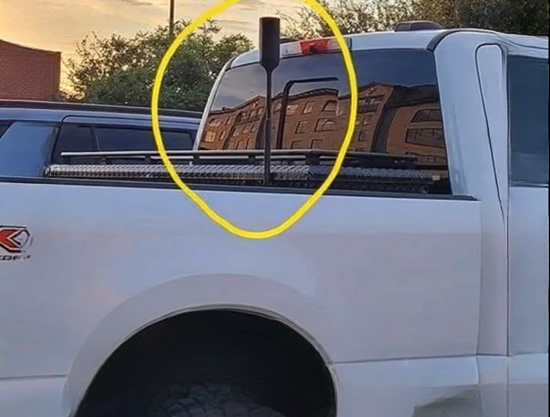
What Is That Tall Antenna on the Back of Trucks? Understanding CB Radios, Communication Systems, and Modern Truck Antennas
If you’ve ever spent time driving on highways, you’ve probably noticed something unusual on certain trucks, RVs, and larger vehicles.
A long, thin antenna may extend above the roof or cab, sometimes appearing almost like a simple metal rod. On some vehicles it is short and flexible, while on others it can be noticeably taller.
For years, many people automatically associated these antennas with CB radios.
And in many cases, that assumption was correct.
Citizens Band, commonly known as CB radio, became closely associated with trucking culture during the second half of the twentieth century. Truck drivers used CB radios to communicate with one another, share information about road conditions, discuss traffic, and simply stay connected while spending long hours on the road.
Today, however, seeing an antenna on a truck doesn’t necessarily mean the vehicle is using a traditional CB radio.
Modern commercial vehicles can use several different communication and navigation systems, and antennas can serve a variety of purposes.
Some are used for two-way radio communication. Others may support cellular connectivity, GPS navigation, satellite communication, or other electronic equipment.
So what exactly is that antenna?
The answer depends on the vehicle, the antenna design, and the equipment connected to it.
Understanding the history of these antennas also provides an interesting look at how communication technology has changed over the decades.
Why Trucks Need Antennas
Before looking specifically at CB antennas, it helps to understand why vehicles use external antennas in the first place.
Wireless communication depends on radio signals.
A vehicle’s electronics may need to send or receive signals over distances ranging from a few feet to many miles. The antenna provides an interface between the electrical system and the radio waves traveling through the surrounding environment.
The size, shape, location, and design of an antenna depend heavily on what frequency the equipment uses and what the manufacturer wants the system to accomplish.
For example, an antenna designed for one type of radio communication may look very different from one designed for another.
That’s why simply seeing a long rod on a vehicle isn’t enough to determine exactly what equipment is inside.
The antenna is only one part of a larger system.
The Connection to CB Radio
CB radio is probably the most familiar explanation for the antennas traditionally seen on trucks.
CB stands for Citizens Band.
It is a radio service that allows people to communicate over designated channels without needing the same type of individual licensing required for many other radio services, although rules vary by country.
In the United States, CB radio operates in the 27 MHz range and traditionally uses 40 channels.
Truckers became particularly associated with CB radios because the technology provided a convenient way for drivers to communicate while traveling.
Before smartphones and widespread mobile internet, this type of communication could be extremely useful.
A driver could communicate with another nearby driver without needing to make a telephone call.
They could ask about traffic ahead.
They could discuss road conditions.
They could exchange information about construction zones or slowdowns.
And sometimes, they could simply have a conversation during a long journey.
The antenna was essential to this system.
Why CB Antennas Can Be Tall
One reason people notice truck antennas is their height.
A CB antenna can be relatively long because of the radio frequency involved.
The ideal physical dimensions of an antenna are related to the wavelength of the radio signal.
At CB frequencies, a quarter-wave antenna is several feet long.
A quarter-wave antenna for the CB band is roughly 8.7 feet in free space, although practical vehicle antennas are often much shorter because of electrical loading, coils, and other design techniques.
This is one reason CB antennas often look longer than the antennas people are accustomed to seeing on modern consumer electronics.
Manufacturers and radio enthusiasts have developed different ways of making antennas practical for vehicles while maintaining useful performance.
Some antennas use coils or other loading techniques to achieve an electrically useful length without requiring an extremely long physical rod.
Why the Antenna Is Usually Mounted High
You may also notice that antennas are often positioned toward the top of the vehicle.
There is a practical reason for this.
The antenna needs to interact with radio signals efficiently.
Mounting it higher can help provide a clearer signal path and reduce some of the obstruction caused by the vehicle itself.
A truck cab is surrounded by metal.
Metal can affect how radio-frequency energy behaves.
The vehicle body can become part of the antenna system, depending on the design and mounting arrangement.
This is why antenna placement can make a noticeable difference in performance.
For CB enthusiasts, antenna location, grounding, cable quality, and tuning are all important considerations.
Why Truckers Used CB Radio So Much
CB radio became an important part of trucking culture long before smartphones became common.
Imagine driving thousands of miles without a mobile phone, navigation application, or internet connection.
If traffic suddenly slowed down, a driver had limited ways to learn what was happening farther ahead.
Another truck driver could provide useful information.
“Traffic is backed up ahead.”
“There is construction near the next exit.”
“The highway is moving slowly for several miles.”
These simple conversations could help drivers make decisions about their route.
CB communication was particularly valuable because truckers were often traveling in the same areas at the same time.
A driver coming from the opposite direction could provide information about what was happening farther down the road.
This created a kind of informal communication network.
The people using it were physically moving through the same transportation system.
CB Radio and Trucking Culture
CB radio eventually became more than a practical communication tool.
It became part of trucking culture.
Drivers developed nicknames, or “handles,” that they used over the radio.
Certain phrases became widely recognized.
Radio conversations could be serious, practical, humorous, or simply social.
This culture became familiar to people who had never operated a CB radio themselves.
Movies, television programs, music, and popular culture helped reinforce the association between truckers and CB antennas.
For many people, the tall antenna on a truck immediately brings to mind an image of a long-distance driver communicating with others over the radio.
Although technology has changed, that visual connection remains.
Are CB Radios Still Used?
Yes.
CB radios haven’t disappeared.
Many truck drivers, off-road enthusiasts, RV owners, and hobbyists still use them.
However, their importance has changed.
Modern drivers have access to technologies that were unavailable during the peak of CB radio’s popularity.
Smartphones provide voice communication, messaging, internet access, mapping, and real-time information.
GPS navigation is built into many vehicles.
Fleet operators can use dedicated communication and tracking systems.
Internet-connected devices can provide information about traffic and weather.
Despite these developments, CB radio still has advantages.
It can provide direct local communication without relying on a cellular network.
That can be useful in areas with weak or unavailable cellular coverage.
It’s also simple.
Two compatible radios can communicate directly over the appropriate channel without requiring a conventional phone call.
For hobbyists, the appeal is also partly cultural.
Using a CB radio connects modern drivers with a long history of road travel and radio communication.
Not Every Truck Antenna Is a CB Antenna
This is one of the most important points.
If you see an antenna on a truck, don’t automatically assume it is connected to a CB radio.
Commercial vehicles can have several antennas.
A vehicle may use antennas for:
- Cellular connectivity
- GPS and satellite navigation
- Fleet communication
- Two-way business radio
- Satellite communication
- Wi-Fi or wireless networking
- Telematics systems
- Specialized transportation equipment
- CB radio
The antenna’s appearance can sometimes provide clues, but it doesn’t always reveal its exact function.
Modern vehicles can contain sophisticated communication systems that are invisible from the outside.
Cellular Antennas
Many modern trucks rely heavily on cellular communication.
Fleet-management systems can use cellular networks to transmit information about vehicles.
Depending on the system, information may include location, operating status, mileage, diagnostic information, or other fleet-management data.
The antenna supporting such a system may be much smaller than a traditional CB antenna.
Some systems use antennas integrated into the vehicle.
Others use external antennas for improved reception or because of the specific equipment configuration.
This means a modern truck can have several antennas that serve completely different purposes.
GPS Antennas
GPS is another important technology found in modern vehicles.
Navigation systems need to receive signals from satellites to determine the vehicle’s position.
A GPS antenna is usually much smaller than a traditional CB antenna.
It may be mounted on the roof or integrated into another component.
The location can provide the antenna with a clearer view of the sky.
GPS antennas are generally designed for very different frequencies and applications than CB antennas.
So even though both are technically antennas, their jobs are quite different.
Two-Way Business Radio
Some commercial fleets use radio systems designed for business or professional communication.
These systems may operate on frequencies different from CB.
The antennas can vary considerably depending on the radio system.
For example, a fleet using a professional two-way radio network may have an antenna that looks similar to a conventional vehicle radio antenna but is designed for another frequency range.
This is another reason appearance alone isn’t enough to identify an antenna.
The Importance of Antenna Tuning
For people who actually use CB radios, the antenna is one of the most important parts of the entire system.
A high-quality radio connected to a poorly installed or improperly tuned antenna may perform worse than expected.
One measurement frequently discussed in CB radio is SWR, or Standing Wave Ratio.
SWR provides an indication of how well the radio system is matched to the antenna and transmission line.
A very high SWR can indicate that the antenna system isn’t properly matched.
That can reduce performance and, depending on the equipment and circumstances, potentially cause problems for the radio’s transmitter.
For this reason, CB enthusiasts often tune their antenna after installation.
Why the Vehicle Body Matters
The vehicle itself can play an important role in antenna performance.
Many traditional mobile antennas use the vehicle body as part of the antenna system.
This is often described in terms of a ground plane.
A large conductive surface can help an antenna operate as intended.
This is one reason antenna mounting location can matter.
A magnetic mount, mirror mount, roof mount, hood mount, or other configuration can produce different results depending on the antenna design and vehicle.
For people who simply want to use a CB radio casually, the details may not be especially important.
For radio enthusiasts, however, antenna installation can become a fascinating technical subject.
Why Some Antennas Are Flexible
If you’ve watched a truck traveling down the highway, you may have noticed that its antenna sometimes bends or moves.
This doesn’t necessarily indicate a problem.
Many vehicle antennas are intentionally flexible.
They need to tolerate wind, vibration, and occasional contact with branches or other objects.
A rigid antenna could be more vulnerable to damage.
Flexible fiberglass antennas are common in mobile radio applications because they can provide a useful combination of durability and electrical performance.
Some antennas also use flexible whips or spring-mounted sections.
The ability to move can be especially important on vehicles that regularly travel under bridges, through parking areas, or near loading facilities.
Why Truck Antennas Can Look Different
If you compare several trucks, you may notice that their antennas aren’t identical.
There are several reasons.
The vehicle owner may have chosen a different model.
The truck may use a different radio system.
The antenna may have been installed for a specific purpose.
The owner may prefer a particular mounting position.
Some antennas are optimized for durability.
Others are designed for performance.
Some are short and compact.
Others are significantly taller.
A fleet company may also standardize equipment across its vehicles.
Therefore, two trucks that look nearly identical can have completely different communication equipment.
What About RVs?
RV owners are another group that has historically used CB radios.
Long-distance recreational travel creates many of the same communication challenges that truckers face.
People driving in groups may want a way to communicate without relying on phone calls.
CB radio can be useful for convoy communication.
An RV may also have several other antennas because modern recreational vehicles often contain multiple wireless systems.
A large RV can potentially have antennas for television reception, Wi-Fi, cellular connectivity, GPS, satellite services, and radio communication.
The tall antenna you notice may therefore be only one component of a much larger communications setup.
Why CB Radio Remains Interesting
Technology changes quickly.
A device that was considered essential several decades ago can eventually become a niche product.
But that doesn’t necessarily mean the technology becomes useless.
CB radio continues to have a place because it provides something that internet-based communication doesn’t always provide: direct local radio communication.
It doesn’t require a social-media account.
It doesn’t require a messaging application.
It doesn’t require an internet connection.
And it can be used by multiple people who share the same channel and are within communication range.
That simplicity has lasting appeal.
The Evolution of Communication on the Highway
Looking at a truck antenna is actually a small reminder of how dramatically transportation technology has changed.
Decades ago, a truck driver might rely heavily on a paper map, roadside signs, a CB radio, and personal experience.
Today, a driver may have access to:
- Digital navigation
- Real-time traffic information
- Cellular communication
- Fleet tracking
- Electronic logging systems
- Vehicle diagnostics
- Weather information
- Digital dispatch systems
- Satellite-based positioning
- Wireless internet
The truck has effectively become a connected computer on wheels.
Yet some of the older technology remains.
That’s why a CB antenna can still appear alongside much newer equipment.
The Antenna Is Only the Beginning
One of the interesting things about radio communication is that the visible antenna doesn’t tell the whole story.
Behind that simple rod may be:
- A radio
- Coaxial cable
- Connectors
- Mounting hardware
- A grounding system
- Tuning components
- Filters
- Other electronic equipment
The antenna is simply the component that interacts with electromagnetic waves.
Its performance depends on the entire system.
This is why experienced radio users often spend considerable time choosing the right antenna, mounting it correctly, routing the cable properly, and checking the system after installation.
Why People Still Notice These Antennas
Even as technology becomes smaller, the tall antenna remains visually distinctive.
Smartphones don’t have large external antennas.
Most modern consumer electronics use compact internal antennas.
Vehicles increasingly use integrated systems that hide their communication equipment.
A tall external antenna therefore stands out.
For people who grew up during the height of CB radio culture, it can immediately bring back memories of long highway trips, truck stops, radio conversations, and old transportation technology.
For younger drivers, it may simply look like a mysterious piece of equipment.
The truth is that it can represent several different technologies depending on the vehicle.
A Simple Way to Think About It
If you see a tall antenna on a truck, the safest assumption is simply:
It is part of a communication or radio system, but you can’t know exactly which one just from its appearance.
If the vehicle belongs to a CB user, it may indeed be a CB antenna.
If it is a modern commercial truck, the antenna could support another communication or data system.
If it is an RV, it could be part of one of several wireless systems.
The design, installation, and vehicle configuration provide better clues than the antenna’s existence alone.
Why This Small Detail Tells a Bigger Story
Something as simple as an antenna can tell us a lot about transportation history.
For decades, drivers depended on radio communication to stay informed and connected.
CB radio helped create a communication culture among truckers and travelers.
As technology developed, cellular networks, GPS, satellite systems, and internet-connected devices gradually took over many of the functions that CB radio once handled.
But the older technology didn’t completely disappear.
It became one option among many.
That’s why you can still see a traditional-looking antenna on a modern truck.
It may represent an old-fashioned CB setup.
It may support newer equipment.
Or it may simply be part of a specialized communication system.
The important point is that not every vehicle antenna serves the same purpose.
Final Thoughts
The next time you see a tall antenna extending from the roof or side of a truck, you may look at it differently.
For generations, antennas like these were closely associated with CB radios and the trucking community.
They helped drivers communicate, exchange information, and stay connected during long journeys.
Today, CB radio remains in use, but modern trucks can carry many other types of communication equipment as well.
Cellular systems, GPS, fleet-management technology, two-way radios, satellite services, and other wireless systems have transformed the modern truck into a highly connected vehicle.
The familiar antenna may therefore be part of an old tradition, a modern communications system, or something in between.
What looks like a simple metal rod can actually be an important part of the technology that keeps people connected while traveling.
And that’s perhaps the most interesting thing about it.
The next time you’re on the highway and notice one of those antennas, you don’t have to wonder whether it is simply an outdated piece of equipment.
It may be.
But it could also be part of a sophisticated communication system that you can’t see from the outside.
Either way, that small antenna represents a fascinating connection between the history of road travel and the technology used by today’s drivers.