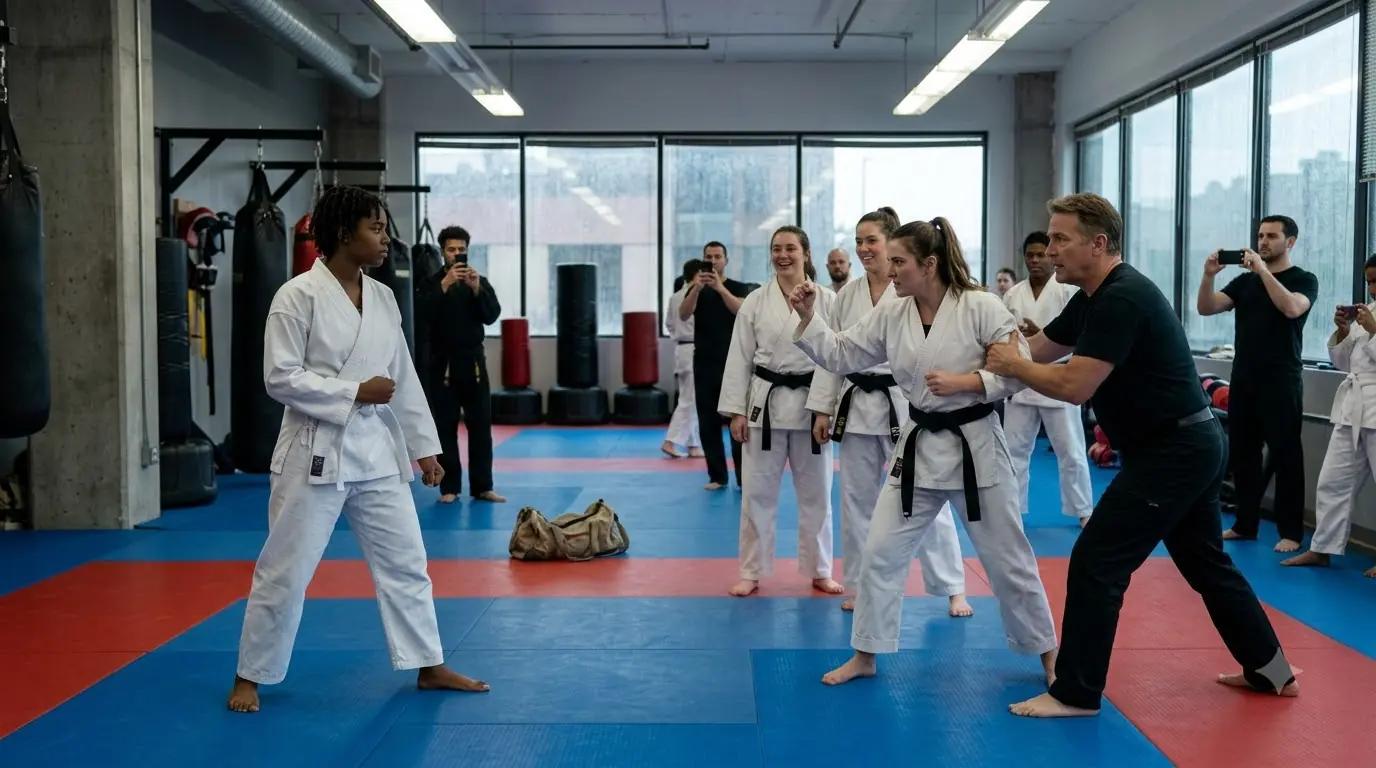
Rain had been falling over Columbus since early afternoon, leaving the streets glossy beneath the evening lights. Outside Northline Martial Arts, water collected along the edges of the parking lot, and the occasional car sent a soft spray across the pavement as it pulled into a space.
Inside the academy, the atmosphere was warmer. The familiar sounds of martial arts training filled the building: feet moving across padded floors, instructors offering corrections, and students practicing combinations with careful concentration. Heavy bags hung in a neat row near the far wall, while framed photographs of previous tournament teams decorated the hallway leading toward the changing rooms.
Northline Martial Arts had earned a respectable reputation over the years. Its students participated in regional competitions, volunteered at community events, and helped introduce children and beginners to martial arts. At the center of the academy’s success was its head instructor, Daniel Mercer, a forty-six-year-old coach who believed discipline and respect mattered just as much as technical ability.
Daniel had spent more than a decade building the academy. He had watched beginners become confident students, nervous teenagers grow into responsible adults, and talented competitors learn that winning was not the only measure of progress.
He had also learned that experience did not automatically produce humility.
That lesson would become especially important on a rainy Thursday evening.
The Three Students Who Dominated the Advanced Class
Madison Reed, Kelsey Hart, and Brooke Ellis were among the academy’s most experienced students.
All three held black belts and had spent years developing their skills. They had competed in tournaments, helped newer members learn basic techniques, and represented Northline at events throughout the region.
Madison was twenty-six, with light brown hair usually tied into a tight braid. She was confident, energetic, and known for accepting difficult challenges without hesitation.
Kelsey, twenty-four, was tall and analytical. She preferred careful preparation to improvisation and often studied an opponent’s movements before deciding how to respond.
Brooke, twenty-seven, was athletic and outspoken. She enjoyed competitive training and had a habit of turning ordinary practice sessions into friendly contests.
Together, they were a formidable group.
Their familiarity with the academy gave them a certain confidence. They knew the schedule, understood the training routines, and could predict how most classmates would respond to their movements.
Unfortunately, that familiarity had begun to create a problem.
They had become so accustomed to training with one another that they rarely encountered situations that challenged their assumptions. New students usually spent their first sessions learning fundamental positions, balance, and movement. The advanced group, meanwhile, continued practicing with people whose strengths and weaknesses they already understood.
Brooke had been complaining about it for weeks.
“We need someone new in this class,” she said while stretching beside the edge of the mat. “I feel like I can predict everyone’s next move before they make it.”
Madison smiled. “That’s because you’ve trained with the same people for too long.”
“Exactly. A new partner would make things interesting.”
Kelsey adjusted the belt around her uniform. “A new partner would probably need a few weeks before they could keep up with our usual pace.”
Brooke laughed.
“Then we’ll help them catch up.”
Their conversation was interrupted by the sound of the front door opening.
At 6:12 p.m., a young woman entered the academy carrying a plain black duffel bag.
She appeared to be around eighteen or nineteen years old. Her short twists were pulled away from her face, and she wore a charcoal-gray hoodie, black training pants, and simple white sneakers. Rain had darkened the fabric around her shoulders.
She paused near the entrance, wiped her shoes carefully, and looked around the room.
Unlike many first-time visitors, she did not appear overwhelmed by the activity. She simply observed the training area, the equipment, and the students moving across the mats.
Then she approached the front desk.
“Hello,” she said politely. “I’m here for the trial class.”
The receptionist looked up from the computer.
“Welcome to Northline. Have you trained in martial arts before?”
“A little,” the young woman replied.
“What style?”
“Mostly karate, with some other training.”
The receptionist nodded and handed her a short registration form.
“Coach Mercer will speak with you in a moment. You can change in the room down the hall.”
The young woman thanked her and began filling out the paperwork.
Across the training floor, Madison noticed her.
She leaned toward Brooke.
“Looks like we have our new student.”
Brooke glanced at the visitor’s plain clothing and unmarked duffel bag.
“She doesn’t look like she’s been training for very long.”
Kelsey followed their gaze.
“We shouldn’t judge from appearances.”
“I didn’t say she couldn’t learn,” Brooke replied. “I’m just saying she looks like a beginner.”
Madison shrugged.
“Either way, she’ll probably start with the basics.”
None of them knew that the young woman had spent years learning how to remain calm in unfamiliar environments.
And none of them noticed the quiet attention with which she watched the class.
A Name and a Simple Introduction
A few minutes later, Daniel finished his conversation at the front desk and approached the visitor.
“Good evening,” he said. “I’m Daniel Mercer, the head instructor. You must be joining us for the trial session.”
“Yes, sir. My name is Amara Johnson.”
“Nice to meet you, Amara. Have you practiced karate before?”
“Yes. I’ve trained for several years, although I’ve been away from regular classes recently.”
Daniel looked at her registration form.
“That’s perfectly fine. Everyone returns to training at a different pace. Tonight, we’ll take things gradually and see where you’re comfortable.”
Amara nodded.
“That sounds good.”
Daniel asked a few routine questions about her experience, previous instruction, and any limitations that might affect training. Amara answered clearly and explained that she wanted to find a place where she could improve her technique and continue learning.
She did not mention tournaments or achievements.
She did not ask to join the advanced class.
She simply wanted to train.
Daniel appreciated that attitude.
“Go ahead and change into your training clothes,” he said. “We’ll introduce you to the class shortly.”
As Amara walked toward the changing room, Daniel watched her for a moment.
There was something familiar about the way she carried herself. Her steps were measured, her shoulders relaxed, and her attention seemed to move naturally between the room and the people inside it.
Still, he decided not to draw conclusions.
A good instructor did not determine a student’s ability before seeing how that student trained.
When Amara returned wearing a simple white karate uniform, Daniel gathered the class.
“Everyone, we have a new student joining us for a trial session. This is Amara Johnson. Please make her feel welcome.”
Several students greeted her.
Amara bowed respectfully.
Madison, Kelsey, and Brooke exchanged brief glances.
The newcomer had changed into training clothes, but nothing about her appearance suggested that she was looking for special treatment.
Brooke stepped forward.
“Would you like to practice with us during the partner drills?” she asked.
Amara smiled.
“Thank you. I’d be happy to.”
Daniel looked toward Brooke.
“We’ll begin with the standard warm-up. After that, we’ll decide which partners are appropriate for each exercise.”
“Of course, Coach,” Brooke replied.
The class began.
For the first twenty minutes, the students worked through familiar warm-up routines, footwork exercises, and basic combinations.
Amara followed the instructions without difficulty. She listened closely, asked questions when necessary, and adjusted her movements whenever Daniel offered a correction.
She did not attempt to impress anyone.
She did not rush ahead of the class.
She focused on the task in front of her.
That approach caught Daniel’s attention more than any single movement could have.
An Unexpectedly Calm Student
The first partner exercise involved simple movement and distance control.
Students worked in pairs, practicing how to maintain balance, recognize changes in distance, and move without colliding with one another.
Daniel assigned Amara to a student named Olivia, who had been training for approximately six months.
Olivia was nervous about working with someone new, but Amara quickly put her at ease.
“Don’t worry about getting everything right,” Amara told her. “Just focus on your balance and listen to the instructions.”
Olivia smiled.
“Thanks. I’m still trying to remember where my feet are supposed to go.”
“That takes time.”
They began practicing.
Amara moved slowly enough for Olivia to follow, offering small corrections without interrupting the exercise. When Olivia lost her balance, Amara waited patiently while she reset her position.
Daniel observed them from across the room.
He noticed that Amara seemed comfortable adjusting her speed to match her partner. She did not treat the exercise as an opportunity to demonstrate superiority.
That was a useful quality in any martial artist.
A student who could perform a technique well but could not help another person understand it had more to learn about the purpose of training.
After several minutes, Daniel called the class together.
“Good work. Remember that these exercises are about control, awareness, and communication. Your partner is not an obstacle. Your partner is helping you improve.”
He allowed the students a short break before moving to the next activity.
During that break, Brooke approached Amara.
“So, you said you’ve trained before?”
“Yes.”
“How long?”
“A number of years, with some breaks.”
Brooke raised her eyebrows.
“That’s a pretty vague answer.”
Amara took a drink of water.
“I’ve moved around a little, so my training hasn’t always been consistent.”
“What belt did you earn?”
“I trained under different instructors. Belts weren’t always the main focus.”
Brooke exchanged a glance with Madison.
That answer was not what she had expected.
In their academy, rank was an important part of the training structure. It represented progress through a formal curriculum and helped instructors organize classes.
But Amara’s response did not mean she had never achieved a high rank. It simply meant her experience could not be measured by one answer.
Madison folded her arms.
“Would you be comfortable doing a light technical round with one of us?”
Amara looked toward Daniel, who was speaking to another student.
“If Coach approves and we keep it appropriate for a trial session, sure.”
Brooke smiled.
“Excellent. I was hoping you’d say that.”
The Suggestion That Changed the Evening
When the break ended, Daniel announced that the advanced students would practice controlled partner exercises.
The purpose was to improve timing, defensive awareness, and decision-making under mild pressure. It was not a competition, and students were expected to remain within the instructor’s guidelines.
Madison, Kelsey, and Brooke gathered near the center of the mat.
Brooke raised her hand.
“Coach, could Amara work with one of us for a short round?”
Daniel considered the request.
“She’s here for a trial session. We don’t know enough about her current conditioning or experience to put her into an unrestricted round.”
“We can keep it light,” Madison said.
Kelsey nodded.
“Just basic movement and distance control.”
Daniel looked at Amara.
“Are you comfortable with that?”
“Yes, provided we keep it controlled.”
“Good. We’ll start with a simple exercise. No unnecessary contact, no forceful techniques, and no attempts to prove anything. If I call a stop, everyone stops immediately.”
All three experienced students agreed.
Daniel then turned toward Madison.
“You can begin with Amara. Kelsey and Brooke, watch from the side until I decide whether to rotate partners.”
Madison stepped onto the practice area.
Amara bowed.
Madison returned the bow.
The first round began with a simple movement drill. Madison advanced, Amara adjusted her position, and both students practiced maintaining appropriate distance.
At first, Madison assumed the newcomer would respond predictably.
Instead, Amara remained composed.
She did not retreat unnecessarily, and she did not rush forward. She moved just enough to maintain balance and keep the exercise within its intended limits.
Madison changed direction.
Amara adjusted.
Madison paused, then tried a different approach.
Amara responded without appearing hurried.
Nothing dramatic happened. There were no spectacular movements, no sudden collisions, and no display designed to attract attention.
Yet Madison began to feel uncomfortable.
She was accustomed to recognizing patterns in her partners. She could often anticipate when someone would move too quickly, become unbalanced, or react to a change in distance.
Amara gave her very little to anticipate.
The newcomer was not moving wildly or relying on speed. She was simply observing.
Madison increased the pace slightly.
Amara continued to maintain her position.
From the edge of the mat, Kelsey leaned forward.
“She’s watching the shoulders,” she whispered.
Brooke frowned.
“What does that mean?”
“She’s paying attention to the movement before the rest of the body follows. Look at her.”
Kelsey had noticed something important.
Amara was not responding only to individual actions. She was paying attention to the relationship between posture, balance, and movement.
It was a skill that could develop through years of careful practice.
Daniel noticed it too.
He moved closer to the training area, watching the exercise with growing interest.
Madison attempted another change of direction.
Amara adjusted her footing and remained balanced.
The instructor raised one hand.
“Stop there.”
Both students immediately stepped back.
Daniel nodded.
“Good. Madison, slow down and focus on the exercise rather than trying to make your partner react. Amara, keep doing what you’re doing, but don’t assume you know what the other person intends. Continue observing.”
“Yes, Coach,” they replied.
The round had lasted less than a minute.
Still, Madison returned to her starting position with a new awareness of the challenge in front of her.
For the first time that evening, she wondered whether she had underestimated the newcomer.
Kelsey Volunteers for the Next Round
When Daniel asked whether Madison wanted to continue or rotate partners, Kelsey stepped forward.
“I’d like to work with Amara next.”
Madison looked at her.
“You sure?”
Kelsey gave a small nod.
“I want to understand what she’s doing.”
Daniel agreed, but he reminded both students that the exercise would remain technical and controlled.
Before they began, Kelsey took a moment to adjust her stance.
Unlike Madison, she did not attempt to increase the pace immediately. She began with small changes in distance, paying close attention to how Amara responded.
For a while, the exercise proceeded smoothly.
Kelsey tested different angles and varied the rhythm of her movement. Amara responded appropriately, sometimes shifting position and sometimes remaining still until a clearer opening appeared.
Kelsey soon recognized that the newcomer was not following a fixed routine.
Amara appeared to be making decisions based on what was actually happening rather than what she expected to happen.
That distinction mattered.
Many students learned combinations by repeating the same sequence until it became familiar. Such repetition was valuable, but real training also required the ability to adapt when circumstances changed.
Amara seemed comfortable with that uncertainty.
Kelsey stopped and lowered her hands.
“Where did you train?”
Amara smiled.
“At a few different places.”
“Did you compete?”
“Sometimes.”
“At what level?”
“Mostly regional events when I was younger. I learned more from some of the training sessions than I did from the medals.”
Kelsey looked thoughtful.
“That’s an interesting way to put it.”
“I think competition can be useful,” Amara replied. “But it doesn’t tell you everything about a person’s ability.”
Daniel heard the exchange.
He agreed with her.
A tournament could reveal how a person performed under particular rules, against a particular opponent, on a particular day. It could not measure every aspect of that person’s understanding, character, or ability to teach.
Daniel called the round to an end.
“Good work from both of you. Kelsey, what did you notice?”
Kelsey hesitated before answering.
“She doesn’t react the way I expected. I kept trying to predict her next movement, but she wasn’t committing to a pattern.”
Daniel nodded.
“That’s useful feedback. Now consider why you expected a pattern in the first place.”
Kelsey looked down at the mat.
“Because I wanted to find one.”
“Exactly. Sometimes the problem isn’t the other person’s movement. It’s the assumption we bring into the exercise.”
The students listened.
Madison looked less amused than before.
Brooke, meanwhile, had become increasingly curious.
She had originally imagined the evening as an opportunity to test the new student. Now she wanted to see whether her own approach would reveal something different.
“Coach,” she said, “may I have a turn?”
Daniel studied her expression.
“Yes. But remember our instructions.”
“Understood.”
Brooke Makes an Important Mistake
Brooke stepped onto the mat with an energetic smile.
“Ready?”
Amara bowed.
“Ready.”
The exercise began.
Brooke was naturally quick and liked to keep her training partners moving. She changed direction, varied her rhythm, and attempted to draw Amara into reacting too early.
For several moments, the approach seemed promising.
Amara had to adjust more frequently than before. She moved to maintain balance and avoided rushing into uncertain positions.
Brooke noticed the change and became more confident.
“That’s better,” she said.
Amara did not respond.
She remained focused on the exercise.
Brooke increased the pace again.
Daniel immediately raised his hand.
“Brooke, reduce the speed.”
Brooke slowed.
They continued, but something had changed. Brooke was no longer concentrating entirely on the technical objective. She had begun measuring her performance against Madison’s and Kelsey’s.
She wanted to be the person who figured Amara out.
That desire made her less patient.
On the next exchange, Brooke moved before fully establishing her balance. It was a small mistake, but Daniel recognized it immediately.
“Stop.”
Everyone froze.
Daniel walked toward them.
“Brooke, tell me what happened.”
Brooke looked puzzled.
“I changed direction.”
“Yes. And what happened to your balance?”
She considered the question.
“I shifted too quickly.”
“Correct. Why?”
Brooke opened her mouth, then paused.
“I was trying to increase the pace.”
“More specifically?”
She looked toward Amara and then back at Daniel.
“I wanted to catch her off guard.”
Daniel nodded.
“And that changed the quality of your movement. You stopped focusing on the exercise and started focusing on the person. Those are not the same thing.”
The gym became quieter.
Daniel continued in a measured voice.
“Martial arts training is not about proving that you can surprise someone. It’s about learning to make good decisions, even when you feel challenged. If you abandon your fundamentals because another student doesn’t respond as expected, you have given away the very discipline you’ve spent years developing.”
Brooke’s expression softened.
“Understood, Coach.”
“Good. We are going to finish this round slowly, with the goal of maintaining balance and awareness. There is nothing to win here.”
Brooke nodded.
They resumed at a lower pace.
This time, she concentrated on her footing and paid more attention to the instructions. The exercise became smoother, and both students finished without incident.
Daniel called them back to the center of the mat.
“That’s enough for now.”
Brooke bowed to Amara.
“Thank you. I think I learned more from that round than I expected.”
Amara returned the bow.
“You’re welcome.”
There was no teasing in her voice, and no suggestion that she had defeated anyone.
That made Brooke feel even more aware of her own earlier assumptions.
The Coach Asks Everyone to Pause
Daniel looked at the three black belts.
“Madison, Kelsey, Brooke, come here for a moment.”
The women approached him.
He spoke quietly enough that the entire class did not need to hear every word, but his expression made it clear that he expected them to pay attention.
“Before tonight, how many of you had already decided what kind of student Amara would be?”
The three exchanged glances.
No one answered immediately.
Daniel continued.
“You saw someone arrive for a trial class. You noticed her clothing, her age, and the fact that you didn’t recognize her. Within minutes, you had already started making assumptions about her experience.”
Madison shifted her weight.
“We didn’t mean anything disrespectful.”
“I believe you,” Daniel replied. “But good intentions don’t automatically make an assumption accurate.”
Kelsey nodded slowly.
Daniel gestured toward the training floor.
“Think about what actually happened. Amara followed instructions, worked patiently with a beginner, adjusted to different partners, and remained composed when the pace changed. Those are useful qualities. Yet none of you noticed them until you decided to test her.”
Brooke looked embarrassed.
“We thought we were just making the class more interesting.”
“And asking questions is fine. Challenging yourself is fine. Inviting a new student to participate can be a good way to welcome them. The problem begins when you treat someone as an easy opponent before you understand who they are.”
Madison lowered her gaze.
Daniel let the silence settle before continuing.
“A black belt is not a guarantee that you are better than everyone in the room. It is a reminder that you have accepted responsibility for continuing to learn.”
The words were familiar, but they carried a different weight that evening.
The three women had heard similar lessons many times. They had repeated them to younger students and discussed them during instructor-led sessions.
Now they had an opportunity to apply them to themselves.
Daniel glanced toward Amara, who was helping Olivia collect the practice equipment.
“I want you to remember something else. We don’t know everything about another person’s journey. Someone may have trained for years without collecting medals. Someone may have taken a break because life became complicated. Someone may be returning after a difficult period. You don’t need to know every detail to treat them with respect.”
Kelsey nodded.
“You’re right.”
Daniel smiled slightly.
“Good. Then let’s put that understanding into practice.”
He turned toward the class and raised his voice.
“Everyone, gather around. We’re changing the final activity.”
A Different Kind of Challenge
The students assembled near the center of the mat.
Daniel explained that the final exercise would focus on observation, communication, and cooperative problem-solving rather than competitive rounds.
Students would work in small groups. Each group would practice a simple sequence, identify where their timing became inconsistent, and offer constructive feedback to one another.
The goal was not to identify the strongest person.
It was to help every participant understand something they could improve.
Daniel divided the students into groups and asked Amara to join Madison, Kelsey, and Brooke.
The three experienced martial artists looked at one another.
A short time earlier, they had considered the newcomer someone who might provide an easy challenge. Now they were being asked to learn alongside her.
Madison spoke first.
“Would you like to start by showing us how you approached the movement exercise?”
Amara considered the request.
“I can explain what I was paying attention to, but I don’t want you to think there’s only one correct way to do it.”
Kelsey smiled.
“That’s fair.”
They began with a simple movement sequence.
Madison performed it first. She had strong technique and good balance, but she tended to move quickly from one position to the next.
Amara observed quietly.
“What do you think?” Madison asked.
“Your movements are clear,” Amara said. “I noticed that you sometimes begin the next action before the previous one is completely settled. If you slow down slightly, you might find it easier to change direction when necessary.”
Madison repeated the sequence.
This time, she paused just long enough to confirm her balance before moving again.
The improvement was immediate.
“That’s helpful,” she admitted.
Kelsey took her turn next.
Her technique was precise, but she often hesitated when the sequence changed unexpectedly.
Amara asked her to repeat one section while paying attention to the point where she stopped moving.
Kelsey tried again.
“I think I know what you’re seeing,” she said. “I’m trying to make the entire sequence perfect before I allow myself to continue.”
“That can make sense when you’re learning something new,” Amara replied. “But once you understand the fundamentals, you also need to learn how to recover when something doesn’t happen exactly as planned.”
Kelsey nodded.
Brooke’s challenge was different.
She moved with confidence but sometimes relied on speed to cover small inconsistencies in her positioning.
When she repeated the sequence more slowly, she noticed details she had overlooked.
“All right,” Brooke said with a laugh. “I see why Coach keeps telling me to stop rushing.”
Amara smiled.
“Speed is useful when it’s supported by control. It becomes less useful when it replaces control.”
Brooke pointed toward her.
“That sounds like something Coach would say.”
Daniel, standing nearby, overheard the comment.
“Perhaps that’s because I have been saying it for years.”
The class laughed.
For the first time that evening, the tension surrounding the new student disappeared completely.
They were no longer trying to determine who was better.
They were simply practicing martial arts.
The Conversation That Followed
As the session approached its end, Daniel asked each group to share one thing they had learned.
Some students spoke about balance. Others mentioned patience, timing, or the importance of communicating clearly with a partner.
When it was the advanced group’s turn, Madison stepped forward.
“We learned that experience can make you more confident, but it can also make you assume you already understand a situation.”
Kelsey added, “We were looking for familiar patterns instead of observing what was actually happening.”
Brooke took a breath.
“And I learned that trying to prove something can interfere with the reason you’re training in the first place.”
Daniel listened without interrupting.
“Those are good observations.”
He then turned toward Amara.
“Would you like to share anything from your first evening here?”
Amara looked around the room.
“I think people sometimes expect experience to look a certain way. They expect someone to have a particular uniform, a certain rank, or a list of achievements. But training isn’t always a straight line.”
She paused before continuing.
“People start at different ages. They learn from different instructors. Some compete, some teach, and some spend years practicing without ever entering a tournament. None of those paths tells the whole story.”
The students listened attentively.
“For me,” Amara continued, “the most important part of training is being willing to learn. If I walk into a room thinking I already know everything, then I’m not going to get much out of being there.”
Daniel smiled.
“That is a valuable perspective.”
He thanked the students for their work and dismissed the class.
As people began collecting their bags and changing shoes, Madison approached Amara.
“Can I ask you something?”
“Of course.”
“Why didn’t you tell us more about your background when we asked?”
Amara considered the question.
“I wasn’t trying to hide anything. I just didn’t think it was important before we had trained together.”
Madison nodded.
“That makes sense.”
She hesitated.
“I also want to apologize. I made assumptions about you before I knew anything about you.”
Amara accepted the apology with a small smile.
“Thank you. I appreciate that.”
Kelsey joined them.
“Would you be interested in coming back for another session? I’d like to work on some of the things we practiced today.”
Brooke nodded enthusiastically.
“Me too. Next time, I promise to listen when Coach says to slow down.”
From across the room, Daniel called out, “I’ll believe that when I see it.”
Everyone laughed.
The exchange was lighthearted, but something important had changed.
The three black belts had not lost their experience or their achievements. They had simply gained a clearer understanding of what those things did and did not mean.
A New Beginning at Northline
The following week, Amara returned to Northline Martial Arts.
This time, the weather was clear, and sunlight entered through the front windows. The parking lot had dried, and the academy felt brighter than it had during her first visit.
When Amara walked through the door, Olivia waved from the beginner area.
“You’re back!”
“Of course,” Amara replied. “I said I wanted to train.”
Madison, Kelsey, and Brooke were already preparing for class.
Madison greeted her first.
“Ready to work on balance today?”
“Ready.”
Kelsey had brought a notebook in which she recorded observations from previous sessions. She wanted to develop a more systematic approach to understanding movement.
Brooke had another idea.
“I’ve decided we’re doing the whole sequence slowly today.”
Madison raised an eyebrow.
“Who are you, and what have you done with Brooke?”
Brooke laughed.
“Don’t get used to it.”
Daniel watched the exchange from the instructor’s station.
He was pleased to see the students working together, but he understood that one successful evening did not permanently change someone’s character. Humility required practice, just like any other skill.
Over the next several weeks, Amara became a regular member of the academy.
She trained with beginners and experienced students alike. She helped Olivia develop confidence in her basic movements and occasionally shared observations with the advanced class when Daniel invited her to contribute.
She never demanded special attention.
When she made mistakes, she accepted corrections. When other students offered useful suggestions, she listened. And when someone struggled with a technique she understood well, she explained it patiently.
Her approach gradually influenced the people around her.
Madison began asking more questions before making judgments about a training part