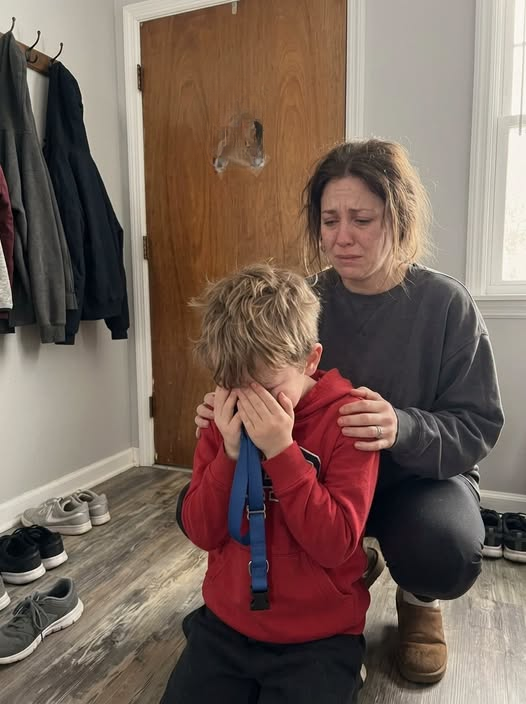
My in-laws left a note on my eleven-year-old daughter’s bedroom door.
It contained only one sentence:
“We gave your dog away. Your cousin didn’t want her around. Don’t make a scene.”
My daughter found it first.
She came downstairs in tears, still holding the note in her trembling hands.
I read it twice.
Then I looked at her.
“Where is Sadie?”
My daughter couldn’t answer.
She simply pointed upstairs.
That was when I noticed what I should have realized immediately.
Sadie’s bed was gone.
Her food and water bowls had disappeared.
Her favorite rope toy was missing.
Even the small blanket she slept on during thunderstorms had been taken.
Someone had removed almost every trace of her from my daughter’s room.
And the people responsible were sitting downstairs as though nothing unusual had happened.
I didn’t scream.
I didn’t cry.
I didn’t give them the dramatic reaction they apparently expected.
Instead, I picked up my phone.
Because there was one thing my in-laws had forgotten.
Sadie wasn’t just a family pet.
She was registered to me.
She had a microchip.
She had veterinary records.
And I had every document proving that she belonged with my daughter.
What I didn’t know yet was that finding Sadie would uncover something much more troubling than a family disagreement.
Part One: The Empty Bedroom
My daughter, Sophie, was eleven years old.
She wasn’t the kind of child who demanded expensive things.
She rarely complained when plans changed.
She understood that our family sometimes had to compromise.
But Sadie was different.
Sadie had been part of her life for years.
The dog originally belonged to my mother.
After my mother passed away, Sadie became closely attached to Sophie.
Whenever Sophie was upset, Sadie stayed beside her.
Whenever there was a thunderstorm, Sadie slept near her bed.
When Sophie struggled with homework, Sadie would lie beneath the desk while she worked.
To an outsider, it might have looked like an ordinary relationship between a child and a family dog.
To Sophie, Sadie was much more.
She represented security.
She represented home.
And she was one of the few remaining connections Sophie had to my mother.
That’s why the empty corner of her bedroom was so painful.
The bed had always been beside the window.
Now there was nothing there.
Sophie stood in the doorway.
“They took everything,” she whispered.
I put an arm around her.
“Who told you?”
She handed me the note.
I read it again.
We gave your dog away. Your cousin didn’t want her around. Don’t make a scene.
I looked at my daughter.
“Did anyone talk to you before they took her?”
She shook her head.
“No.”
“Did Grandma ask you?”
“No.”
“Did Grandpa?”
“No.”
Her eyes filled with tears again.
“Mom, I didn’t even get to say goodbye.”
That sentence broke my heart.
But I forced myself to stay calm.
“Let’s go downstairs.”
Part Two: The Conversation
My mother-in-law, Brenda, was sitting at the kitchen table drinking tea.
My father-in-law, Gordon, was reading the newspaper.
Their behavior was so ordinary that for a moment I wondered whether I had misunderstood the situation.
Then I placed the note on the table.
“Where is Sadie?”
Brenda looked at me.
“Who?”
“My daughter’s dog.”
She took another sip of tea.
“Oh. Sadie.”
“Where is she?”
Brenda exchanged a glance with Gordon.
“We found her another home.”
“You gave her away?”
“Yes.”
“You took her without telling us?”
Brenda sighed.
“It needed to be done.”
I looked at Gordon.
He folded his newspaper.
“Your cousin Madison is uncomfortable around the dog.”
I stared at him.
“Madison is afraid of Sadie?”
“She’s uncomfortable around her.”
“Sadie has never hurt anyone.”
“That isn’t the point.”
“Then what is the point?”
Brenda leaned back.
“The point is that Madison should be able to feel comfortable when she’s here.”
I couldn’t believe what I was hearing.
“You have two granddaughters.”
Brenda looked toward the hallway.
“Sophie is old enough to understand that sometimes other people’s needs come first.”
Behind me, I heard a quiet sniffle.
Sophie was still standing near the doorway.
I turned.
She was staring at the floor.
“Mom,” she whispered, “Grandma said I was selfish because I cried.”
I looked back at Brenda.
Something inside me changed.
This wasn’t about a dog anymore.
It was about the way they had treated my daughter.
They had made a major decision about something deeply important to her without speaking to her parents.
Then they had told her that being hurt was selfish.
That wasn’t acceptable.
I picked up the note.
“You should have called us.”
Brenda shrugged.
“We knew you’d make it difficult.”
“That was your decision to make?”
Gordon interrupted.
“This is our house.”
I nodded slowly.
There it was.
The sentence he always used when he wanted to end an argument.
This is our house.
Part Three: The House
For several years, my husband Colin and I had lived in the house with his parents.
It wasn’t our original plan.
After a difficult period financially, Gordon and Brenda had offered us a place to stay.
They said it would be temporary.
We agreed.
We contributed to household expenses.
We paid for groceries.
We covered utilities when needed.
Colin handled repairs and maintenance.
I cooked regularly and helped around the house.
But whenever there was an argument, Gordon reminded us that the property belonged to him and Brenda.
We understood that.
We never claimed otherwise.
But living under their roof didn’t give them the right to make decisions about our child without us.
And it certainly didn’t give them permission to take her dog.
I looked at Brenda.
“Where did you take Sadie?”
She shook her head.
“She’s fine.”
“That’s not what I asked.”
“Some people from church took her.”
“Who?”
“I don’t remember their names.”
“You don’t remember the names of the people you gave our dog to?”
Gordon stood.
“Enough.”
“No,” I said. “Not enough.”
I turned toward him.
“I want their name and address.”
“You’re being unreasonable.”
“My daughter’s dog has been taken from her room without permission. I don’t think asking where she is unreasonable.”
Gordon’s expression hardened.
“You should calm down.”
“I am calm.”
And I was.
That seemed to bother him more than if I had shouted.
Part Four: The Records
I went upstairs.
Sophie followed me.
She was still holding Sadie’s old collar.
“Mom?”
“Yeah?”
“Are we going to get her back?”
I looked at my daughter.
“Yes.”
She stared at me.
“How?”
“I don’t know yet.”
That was the truth.
But I knew where to start.
I opened the storage cabinet beneath my bed and pulled out a box.
Inside were Sadie’s records.
Vaccination certificates.
Veterinary invoices.
Training documents.
Microchip information.
Adoption paperwork.
And several photographs.
One of them showed my mother holding Sadie as a puppy.
Another showed Sophie at six years old sitting beside her.
I gathered everything.
Then I called the veterinarian.
“I’m calling about Sadie Lawson.”
The receptionist recognized the name.
“Yes?”
“I need to confirm her microchip registration.”
After verifying my identity, the veterinarian confirmed that Sadie was registered to me.
I explained what had happened.
The receptionist became serious.
“I’ll place a note on her file.”
“Thank you.”
Then I contacted the microchip registry.
Again, I reported that the dog had been removed without my permission.
The company explained the appropriate process for reporting the animal missing or improperly transferred.
I followed every step.
Then I started looking for information about where Sadie might have gone.
I checked local animal shelters.
I contacted nearby veterinary clinics.
I posted a short notice in our neighborhood community group.
I didn’t accuse anyone publicly.
I simply stated the facts.
Our family dog, Sadie, was removed from our home without our permission. She is microchipped and registered. If anyone has information about her location, please contact me.
I attached a recent photograph.
Then I waited.
Part Five: The Message
For several hours, nothing happened.
Sophie sat beside me on the couch.
She barely spoke.
Every few minutes, she looked toward the front door.
I knew what she was thinking.
She was waiting for Sadie to walk through it.
Then, shortly after two in the afternoon, my phone buzzed.
It was a message from someone I didn’t know.
Hi. I saw your post. I think I may know where your dog is.
My heart started beating faster.
I replied immediately.
A few minutes later, the person sent me a screenshot.
I opened it.
And there she was.
Sadie.
Sitting on an unfamiliar porch.
The photograph showed her looking directly at the camera.
The caption underneath said:
“Older, well-trained family dog available to an appropriate home. Calm temperament. Rehoming fee applies.”
My hands went cold.
I read the contact information.
Then I saw the phone number.
It belonged to Gordon.
I stared at the screen.
For a few seconds, I couldn’t speak.
Then I called my husband.
“Colin?”
“What’s wrong?”
“Where is your father’s phone number?”
“What?”
“Look at this.”
I sent him the screenshot.
He called me back almost immediately.
“That’s Dad’s number.”
“I know.”
He was silent.
Then he said:
“Did they sell her?”
“I don’t know.”
I looked at the advertisement again.
There was a listed rehoming fee.
It wasn’t proof of what had happened.
But it was enough to make me very concerned.
Part Six: The Person Who Took Sadie
The contact person from the advertisement eventually responded.
Her name was Martha.
I called her.
At first, she sounded nervous.
“I hope you’re not angry.”
“I’m not angry with you.”
“I was told the dog belonged to someone who couldn’t keep her anymore.”
“Who told you that?”
“A man named Gordon.”
I closed my eyes.
“What did he tell you?”
“He said the family no longer wanted the dog and that she needed a quieter home.”
I looked at Sophie.
She was watching me carefully.
“Did you pay him?”
Martha hesitated.
“Yes.”
“How much?”
She told me.
I documented the information and explained that Sadie belonged to my family and had been removed without our permission.
Martha was shocked.
“I had no idea.”
“I believe you.”
She immediately offered to cooperate.
She told me where she was keeping Sadie and agreed to meet us in a public place.
I contacted the appropriate authorities and made sure everything was documented properly.
I didn’t want to create another conflict.
I wanted Sadie home.
Part Seven: The Reunion
We met Martha in a shopping center parking lot.
I saw Sadie before Sophie did.
She was sitting beside Martha’s vehicle.
For a moment, she looked uncertain.
Then Sophie stepped out of our car.
Sadie’s ears lifted.
Her tail began moving.
“SADIE!”
Sophie ran toward her.
Sadie stood immediately.
Sophie dropped to her knees.
The dog pressed against her.
My daughter buried her face in Sadie’s fur and started crying.
But this time, the tears were different.
They were tears of relief.
“I thought I’d never see you again,” she whispered.
Sadie licked her cheek.
I turned away for a moment.
Martha approached me.
“I’m sorry.”
“You didn’t know.”
“I should have asked more questions.”
“Maybe.”
She handed me the paperwork she had received.
I looked through it.
There were details about the supposed transfer.
And there was something else.
A receipt.
The payment had been made directly to Gordon.
That was significant.
I photographed everything.
Martha agreed to provide a statement if necessary.
Before we left, she crouched beside Sophie.
“She was very gentle,” Martha said.
Sophie smiled through her tears.
“She always is.”
Part Eight: The Second Discovery
I thought getting Sadie back was the end of the problem.
It wasn’t.
When we returned home, Sophie took Sadie upstairs.
I stayed in the kitchen with Colin.
He was looking through the paperwork.
“There has to be more to this,” he said.
“I think so too.”
We began reviewing everything.
Then Colin noticed something unusual.
The date on the transfer paperwork was the same day that Brenda had taken Sophie to a family event.
That meant the decision had been planned.
It wasn’t spontaneous.
They hadn’t simply decided that afternoon that Sadie should go somewhere else.
They had prepared documents.
They had contacted someone.
They had arranged payment.
They had waited until neither Colin nor I was home.
The note on Sophie’s door had made it sound casual.
It wasn’t.
Someone had planned the entire thing.
Part Nine: The Real Family Conflict
The next morning, Colin confronted his parents.
This time, I stayed beside him.
Gordon was furious.
“You went behind our backs.”
Colin looked at him.
“You took our daughter’s dog.”
“She was causing problems.”
“You gave her away.”
“We found her a good home.”
“You accepted money.”
Gordon’s face changed.
“That wasn’t your business.”
Colin stared at him.
“It became my business when you took my daughter’s property.”
Brenda stepped in.
“We were trying to help.”
“Then why didn’t you ask us?”
Neither of them answered.
Sophie was upstairs.
We had deliberately kept her away from the argument.
She had already experienced enough.
Gordon finally said:
“You two have always been ungrateful.”
Colin shook his head.
“This isn’t about gratitude.”
“Then what is it about?”
“Boundaries.”
The word seemed to stop the conversation.
For years, everyone had accepted certain family patterns.
Brenda favored Madison.
Sophie was expected to compromise.
Gordon used the house as leverage.
And Colin often avoided confrontation because he wanted to keep peace.
But this time, peace wasn’t the same as doing the right thing.
Part Ten: The Knock at the Door
The next morning, there was a knock on Brenda and Gordon’s door.
They weren’t expecting anyone.
When Gordon opened it, he found two people standing outside.
One was an animal welfare officer.
The other was an investigator who had been asked to document the circumstances surrounding Sadie’s transfer.
Martha had already provided her statement.
The veterinary records had confirmed my ownership.
The microchip registration supported it.
The payment record established that Gordon had accepted money.
No one was there to create a dramatic confrontation.
They were there because the situation needed to be properly documented.
Gordon’s face went pale.
Brenda began shouting.
“What is this?”
The investigator calmly explained why they were there.
Gordon looked toward the street.
Then toward Brenda.
For the first time, neither of them appeared confident.
The consequences of their decision were no longer something they could dismiss as a family argument.
They had created a record.
And now they had to answer questions.
Part Eleven: What Happened Next
The situation took time to resolve.
There were conversations with professionals.
There were statements.
There were discussions about the money that had changed hands.
Most importantly, Sadie was safely back home.
We also made a decision about our living arrangement.
Colin and I began looking for our own place.
It wasn’t financially easy.
But after everything that happened, we knew we needed our own home.
A place where decisions about our daughter would be made by her parents.
A place where Sophie didn’t have to wonder whether someone might remove something important from her room while she was at school.
A place where she could feel safe.
When we finally moved, Sophie carried Sadie’s bed into her new bedroom herself.
She placed it beside the window.
Then she put Sadie’s bowls underneath the desk.
Finally, she hung the old collar on a small hook beside her bed.
I watched her.
“Happy?”
She smiled.
“Very.”
Part Twelve: The Lesson
Looking back, I realize the biggest issue wasn’t the dog.
It was the belief that someone else had the right to make decisions for our family simply because they were older or owned the house we lived in.
Sadie was important.
But the deeper issue was trust.
My daughter had been taught that her feelings were inconvenient.
She had been told not to make a scene when something she loved disappeared.
That was the part I couldn’t accept.
Children need to learn that disappointment is part of life.
They need to learn that other people have needs.
They need to learn how to compromise.
But they also need to know that their feelings matter.
Sophie didn’t need to be told she was selfish.
She needed an adult to listen.
She needed someone to say:
“I’m sorry this happened. We’re going to find out what happened, and we’re going to make sure you’re heard.”
That’s what I tried to do.
The experience also taught me something about boundaries.
Family relationships can become complicated when people share a home.
Financial help can create expectations.
Good intentions can become controlling behavior.
And sometimes avoiding conflict for years only makes the eventual conflict worse.
Colin and I had spent too much time trying to keep everyone comfortable.
We should have been paying more attention to whether our daughter was comfortable.
That distinction changed everything.
A New Home
Months later, we visited my in-laws for the first time since moving out.
We didn’t stay long.
There were still unresolved feelings.
There were apologies, although not all of them sounded sincere.
Gordon admitted that accepting money for Sadie had been wrong.
Brenda insisted she had only been trying to protect Madison.
I didn’t argue.
Some people need time to understand the consequences of their choices.
Our priority was different now.
We wanted to build a peaceful home.
Sophie seemed happier.
Sadie had returned to her routine.
Every evening, the dog slept beside Sophie’s bed.
Whenever there was a storm, Sadie still stayed close.
One night, I walked past Sophie’s bedroom and saw her reading beneath the lamp.
Sadie was asleep beside her.
The old collar was hanging on the wall.
I stopped at the doorway.
Sophie looked up.
“Mom?”
“Yeah?”
“I’m glad you got her back.”
I smiled.
“So am I.”
She looked at Sadie.
“She really is part of our family.”
I nodded.
“She always has been.”
And that was the end of the story I had never expected to live.
Not because everything became perfect.
Not because my in-laws suddenly changed.
And not because one confrontation magically fixed years of family tension.
It ended because we finally made a decision.
We would no longer allow fear of conflict to determine what was best for our daughter.
We would set boundaries.
We would protect our home.
And we would make sure Sophie knew something she should never have had to question:
Her feelings were not a problem.
Neither was loving her dog.
And neither was standing up when someone crossed a line.