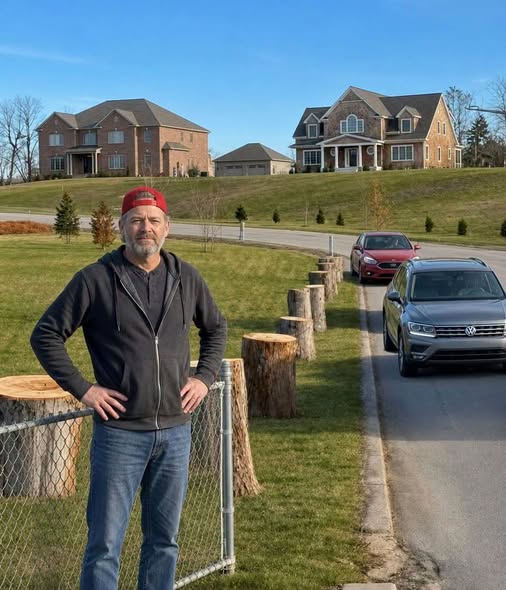
They cut down my trees because they wanted a better view.
That was how the whole dispute began.
What happened afterward became one of the strangest property conflicts I had ever experienced.
If I tell the short version, people usually look at me as though I’m exaggerating.
They’ll ask, “Wait. They actually cut down your trees?”
Yes.
Six of them.
Trees that had stood along the eastern edge of my property for decades.
Trees that were part of my family’s history.
And trees that someone apparently decided were inconvenient because they blocked the view from a newer development above my land.
But the trees weren’t the only thing that had been misunderstood.
There was also a road.
And that road would eventually become the most important part of the entire dispute.
An Ordinary Tuesday
It started on a Tuesday afternoon.
At the time, I had no reason to believe the day would be different from any other.
I was sitting at my desk eating a turkey sandwich during my lunch break when my sister, Mara, called.
Mara wasn’t someone who called me during work hours without a reason.
We talked regularly, but if she needed something during the middle of the day, it was usually important.
I answered immediately.
“Hey, what’s going on?”
For several seconds, she didn’t say anything.
I could hear wind in the background.
Then I heard her breathing.
She sounded upset.
“You need to come home.”
I sat up.
“What happened?”
“Just come home, Eli.”
There was something about the way she said it that made me stop asking questions.
I closed my laptop, told my manager there was a family emergency, and grabbed my keys.
The drive home seemed unusually long.
I kept calling Mara back for more information, but she didn’t provide much.
She simply repeated that I needed to get there.
My property was located along Pine Hollow Road, a narrow stretch that could become difficult to navigate during bad weather.
That afternoon, however, the weather was beautiful.
The sky was clear.
The road was dry.
Nothing looked unusual.
Until I turned onto my private property road.
Then I saw it.
Something was missing.
At first, I couldn’t quite process what I was looking at.
The landscape seemed strangely open.
The eastern side of the property looked almost empty.
Then I realized why.
The trees were gone.
Six Missing Trees
Six large sycamore trees had been standing along that edge of the property for as long as I could remember.
Now there were only stumps.
Freshly cut stumps.
The cuts were clean, and the surrounding area had been cleared of most of the branches and debris.
Whoever had done it hadn’t simply come onto the property with a chainsaw and left a mess.
They had brought professional equipment.
They had removed the trees methodically.
I got out of my vehicle and stood there in silence.
I couldn’t believe what I was seeing.
My father had planted three of those trees when I was a child.
I remembered helping him carry supplies across the yard.
I remembered watching the trees grow year after year.
The remaining three had been planted later.
Together, they created a natural line along the eastern boundary.
They provided shade during the warmer months.
They gave the house privacy.
They also helped make the property feel like home.
Now there was nothing but open sky.
Mara was standing near the fence.
Her arms were crossed.
She looked furious.
“I tried to stop them,” she said.
I turned toward her.
“What do you mean?”
She explained that two trucks had arrived earlier that morning.
The workers were wearing safety equipment and appeared to be part of a professional tree service.
There were company logos on the vehicles.
They had chainsaws, cutting equipment, and a trailer.
At first, Mara assumed they were working on a nearby property.
Then she saw them cutting the trees.
She walked over and asked what they were doing.
One of the workers told her they were carrying out a work order.
“Who authorized it?” she asked.
According to Mara, the worker said the order had come from the Cedar Ridge Estates homeowners association.
That immediately raised a question.
Cedar Ridge Estates was the gated community located on the ridge above my property.
It had been built only a few years earlier.
The development was impressive.
Large homes.
Carefully maintained landscaping.
Stone walls.
A decorative entrance.
And, apparently, residents who cared very much about their views.
But there was one obvious problem.
My property wasn’t part of Cedar Ridge Estates.
Neither were my trees.
The Call to the Tree Company
Mara had found a business card in the truck and given it to me.
The company was called Summit Tree & Land Management.
I called the number.
A man named Brad answered.
I tried to keep my voice calm.
“Brad, I need to ask you about some work your company performed today.”
“Sure,” he said.
“Your crew removed six trees from my property.”
There was a brief silence.
“I’ll need the address,” he said.
I gave it to him.
He apparently pulled up the work order.
After a moment, he said, “We received a request from the Cedar Ridge Estates HOA.”
“Did they give you permission to cut trees on my property?”
He paused.
“The work order was for boundary clearing along the south overlook.”
“Those trees weren’t on their property.”
Another pause.
Brad sounded less certain.
“Sir, the HOA representative who arranged the work told us the trees were crossing onto community property and were obstructing a designated view area.”
I looked at the six stumps.
“A designated view area?”
“That’s what the work order says.”
I couldn’t believe it.
The trees had been standing there for decades.
Cedar Ridge didn’t exist when they were planted.
The development had been constructed later, and now someone had apparently decided that the trees were inconvenient.
I asked Brad whether his company had reviewed the property boundary before beginning the work.
He hesitated.
“I’m not sure what documentation was provided to the crew.”
That answer concerned me.
I asked for a copy of the work order.
He said he would have to check what could be released.
Before ending the call, I asked one more question.
“Did anyone from my property give permission for those trees to be removed?”
“No, sir.”
“Then we have a problem.”
He agreed that the matter needed to be investigated.
The View They Wanted
I walked around the property that evening.
Without the trees, I could see directly toward Cedar Ridge.
From certain parts of the ridge, the houses now had a much more open view across the valley.
It suddenly became obvious what had happened.
The trees had been blocking the view.
The people living above us had probably looked across the landscape and seen a line of mature trees where they wanted an unobstructed view.
Instead of accepting the landscape as it was, someone had apparently decided to change it.
The frustrating part wasn’t only the loss of the trees.
It was the assumption behind the decision.
Someone had treated my property as though it were an extension of their development.
That was something I couldn’t simply ignore.
Looking at the Property Records
The next morning, Mara and I began gathering documents.
We pulled out old property records, maps, surveys, and paperwork relating to the road and boundaries.
I wanted to understand exactly where everything stood.
The property had been in my family for many years.
I knew the general boundaries, but I wanted documentation rather than assumptions.
That’s when we found something particularly important.
The private road leading from the main road toward Cedar Ridge crossed a small portion of my property.
I had known that the road passed through the lower part of the land.
What I hadn’t fully appreciated was how important it was to the newer development.
Cedar Ridge Estates had one primary access route.
And part of that route crossed land belonging to me.
There was an access arrangement associated with the road, but it did not mean the HOA owned the land itself.
That distinction suddenly seemed very important.
I called a property attorney and explained the situation.
I wasn’t interested in threatening anyone.
I simply wanted to understand my rights and responsibilities before taking any action.
The attorney reviewed the documents.
Then he said something I hadn’t expected.
“The road may be the key issue here.”
I asked what he meant.
He explained that access rights and ownership rights were not necessarily the same thing.
The HOA might have certain rights to use the road, depending on the recorded agreements.
But that didn’t automatically give them ownership of the underlying property.
And it certainly didn’t automatically give them permission to remove trees somewhere else.
That was enough for me to realize that the situation was more complicated than a simple neighborhood disagreement.
A Meeting With Cedar Ridge
A few days later, representatives from Cedar Ridge contacted me.
They wanted to discuss the trees.
I agreed to meet.
When I arrived, several people were waiting.
One introduced herself as the HOA president.
She explained that residents had complained for some time about the trees obstructing the view from several properties.
I asked her directly whether the HOA had authorized the tree removal.
She admitted that it had.
I then asked whether anyone had confirmed that the trees were on HOA property.
There was a pause.
“We believed they were within the boundary area covered by the development’s maintenance responsibilities,” she said.
“Believed?”
She didn’t answer immediately.
I placed copies of my property survey on the table.
The boundary line was clear.
The trees had been on my side.
The room became quiet.
Finally, one of the representatives said they had assumed the area was part of the community’s landscape corridor.
I replied that it wasn’t.
That was the entire problem.
An assumption had resulted in six mature trees being removed from private property.
I Wasn’t Looking for Revenge
At this point, some people might expect the story to become a dramatic battle.
It didn’t.
I didn’t want to block anyone’s driveway.
I didn’t want to damage anyone’s property.
I didn’t want to start a public argument.
I wanted the situation handled properly.
The trees were already gone.
Nothing could change that.
What I could do was make sure the same mistake didn’t happen again.
I also wanted to understand the legal arrangement surrounding the access road.
If the road crossed my land, I wanted everyone involved to understand exactly what rights existed and what responsibilities came with them.
That was especially important because the road had become a major access point for the development.
The Road Question
The road had existed long before Cedar Ridge was built.
It was originally a rural access route serving several properties.
Over time, the area changed.
New homes were constructed.
The development expanded.
Traffic increased.
But the underlying property boundaries didn’t simply disappear because the neighborhood became larger.
According to the records we reviewed, Cedar Ridge residents had certain access rights.
That meant they could use the road under the terms of the recorded agreement.
It did not mean they could make unlimited changes to the surrounding property.
The distinction mattered.
I told the HOA representatives that I wasn’t interested in preventing lawful access.
However, I expected the property agreement to be respected.
That included boundaries.
It included maintenance responsibilities.
And it included communication before work was performed.
The Conversation Changed
After the documents were reviewed, the tone of the conversation changed.
The HOA representatives seemed to realize that the situation wasn’t as straightforward as they had initially believed.
One person apologized.
Another asked whether there was anything they could do to make things right.
I told them the trees couldn’t simply be replaced overnight.
They had taken decades to grow.
But there were other ways to address the situation.
I asked for written confirmation that no further work would be performed on my property without permission.
I also asked for clarification about the road’s maintenance and use.
Eventually, an agreement was reached.
The HOA would arrange for a proper survey of the boundary area.
They would also cover certain costs associated with repairing the immediate damage caused by the tree removal.
And, importantly, future work affecting my property would require communication and authorization.
What Happened to the Road?
The road remained open.
That part is important.
Despite what people sometimes assume when they hear this story, I didn’t simply close the road and leave an entire neighborhood without access.
The road was subject to existing rights and agreements.
Those rights mattered.
What changed was the way everyone understood them.
The HOA could not simply treat the road or surrounding property as though it belonged to them.
At the same time, I couldn’t ignore whatever legal access rights had been established.
The final arrangement was much more practical than a dramatic confrontation.
Everyone knew where the boundaries were.
Everyone knew what could and couldn’t be done.
And the road continued to serve the people who had the right to use it.
Replacing What Was Lost
The hardest part was still the trees.
There was no realistic way to recreate what had been removed.
Planting six new trees would not bring back the mature canopy my father had watched grow.
It wouldn’t restore the exact landscape.
It wouldn’t recreate the memories.
But we decided to plant again.
We chose several native trees suitab