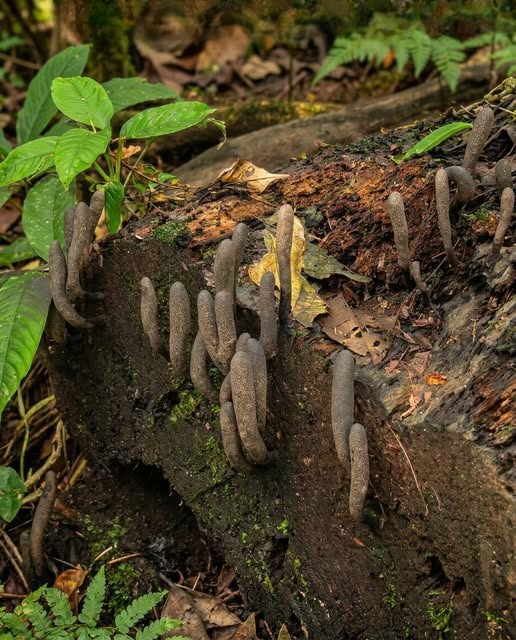
The Strange Forest Fungus That Looks Like a Hand Rising From the Ground: The Fascinating Truth Behind Nature’s Creepiest Illusion
A peaceful walk through the woods is usually filled with familiar sights—towering trees, birds singing overhead, patches of moss, colorful wildflowers, and the occasional mushroom peeking through fallen leaves. Most hikes are relaxing, offering a chance to disconnect from busy routines and reconnect with nature.
But every now and then, the forest presents something so unusual that it immediately captures your attention.
Imagine rounding a bend on a woodland trail and noticing what appears to be a dark hand reaching up through the forest floor.
Long, twisted “fingers” stretch toward the sky.
The shape looks startlingly lifelike.
For a split second, your imagination races.
Is it a root?
A sculpture?
Something left behind by another hiker?
Or something much stranger?
Fortunately, the explanation is both harmless and fascinating.
What many people mistake for a hand emerging from the earth is often a remarkable type of fungus whose unusual appearance has made it one of nature’s most talked-about woodland curiosities.
When Nature Plays Tricks on Our Eyes
Our brains are remarkably good at recognizing familiar shapes.
Psychologists call this tendency pareidolia—the natural habit of seeing recognizable objects or faces in random patterns.
It’s why people sometimes notice:
- Faces in clouds
- Animals in rock formations
- Shapes in tree bark
- Figures in shadows
- Human features in mushrooms and plants
This survival instinct helps us quickly recognize important objects, but it can also make ordinary natural formations seem mysterious.
A Fungus Unlike Most Others
Many fungi develop into the familiar umbrella-shaped mushrooms people recognize immediately.
Others, however, take forms that seem almost impossible.
Some resemble coral.
Others look like tiny bird nests.
A few resemble fingers, antlers, stars, or branches.
Among the most unusual are dark, finger-like fungi that grow from decaying wood or forest debris.
Their appearance explains why hikers often stop in surprise.
Why It Looks Like a Hand
Several factors contribute to the illusion.
The fungus often develops:
- Long vertical projections
- Dark coloring
- Rounded tips
- Irregular textures
- Clusters resembling fingers
When partially hidden beneath leaves or soil, these features can strongly resemble a hand reaching upward.
Lighting conditions in forests often enhance the effect.
Shadows create additional depth, making the illusion even more convincing.
An Important Part of the Forest
Although its appearance may seem unsettling, this fungus performs an important ecological role.
Like many fungi, it helps break down dead organic material.
Without fungi, forests would quickly become buried beneath fallen branches, leaves, and decaying wood.
Instead, these organisms recycle nutrients back into the soil.
This natural process supports healthy ecosystems and encourages new plant growth.
Nature’s Recycling System
Fungi are among the world’s most effective decomposers.
They feed on materials such as:
- Fallen trees
- Dead branches
- Leaves
- Bark
- Plant debris
As they decompose these materials, nutrients become available for future generations of plants.
In many ways, forests depend on fungi to maintain long-term ecological balance.
Why People Find It So Fascinating
Unusual fungi regularly become popular online because they challenge our expectations.
Most people expect mushrooms to look familiar.
When nature produces something completely different, curiosity naturally follows.
Social media photographs often spark dramatic captions and imaginative theories.
In reality, these remarkable organisms simply demonstrate the incredible diversity found within the fungal kingdom.
Not Every Strange Fungus Is Dangerous
One common misconception is that unusual-looking fungi are automatically dangerous.
Appearance alone does not determine whether a fungus is harmless or toxic.
Some brightly colored mushrooms are poisonous.
Others are not.
Some ordinary-looking mushrooms may be unsafe if consumed.
Because identification can be difficult, experts generally recommend avoiding contact with or consumption of wild mushrooms unless they have been positively identified by someone with appropriate knowledge.
Why Forests Produce So Many Unique Shapes
Woodlands create ideal conditions for fungal growth.
Moisture, shade, and decaying organic matter provide everything many species need to thrive.
As a result, hikers may encounter an incredible variety of forms, including:
- Fan-shaped fungi
- Shelf fungi
- Coral-like fungi
- Jelly fungi
- Puffballs
- Finger-like species
- Cup-shaped fungi
Each plays its own role within the ecosystem.
A Reminder to Look Closely
One of the joys of exploring nature is discovering details we might otherwise overlook.
Many fascinating organisms remain hidden in plain sight.
The next unusual object you encounter during a hike might not be mysterious at all—it may simply be something you’ve never noticed before.
Curiosity often turns ordinary walks into memorable experiences.
Responsible Wildlife Observation
If you encounter unusual fungi while hiking, consider these simple guidelines:
- Observe without disturbing them.
- Take photographs instead of collecting specimens.
- Stay on marked trails when possible.
- Leave natural habitats as you found them.
- Avoid touching unknown fungi unnecessarily.
These practices help protect delicate ecosystems for future visitors.
Why Identification Can Be Challenging
Thousands of fungal species exist worldwide.
Some closely resemble one another despite being unrelated.
Others change appearance dramatically as they mature.
Professional identification often considers:
- Shape
- Color
- Habitat
- Spore characteristics
- Growth pattern
- Time of year
Because of this complexity, photographs alone may not always provide enough information for accurate identification.
Appreciating Nature’s Creativity
Few groups of living organisms display as much visual diversity as fungi.
Some resemble flowers.
Others imitate coral reefs.
Some appear almost alien.
Their extraordinary forms remind us that nature often creates designs far more imaginative than anything humans invent.
A Lesson From the Forest
The “hand” emerging from the ground teaches an important lesson about perception.
Our first impression isn’t always the correct one.
What initially appears mysterious or alarming may simply reflect the remarkable creativity of the natural world.
Taking time to observe carefully often replaces fear with fascination.
Final Thoughts
Finding a fungus that appears to resemble a hand rising from the forest floor can certainly be surprising.
Its dark color, unusual shape, and finger-like projections naturally capture attention and inspire curiosity.
Fortunately, these remarkable organisms are simply another example of nature’s incredible diversity.
Rather than something mysterious or supernatural, they represent the important work fungi perform every day by recycling organic material and supporting healthy forest ecosystems.
The next time you encounter an unusual mushroom or fungus during a hike, pause for a closer look.
You may discover that what first seemed strange is actually one of the most fascinating—and essential—parts of life in the forest.
Nature has an extraordinary way of surprising us, especially when we take the time to truly notice what’s growing beneath our feet.