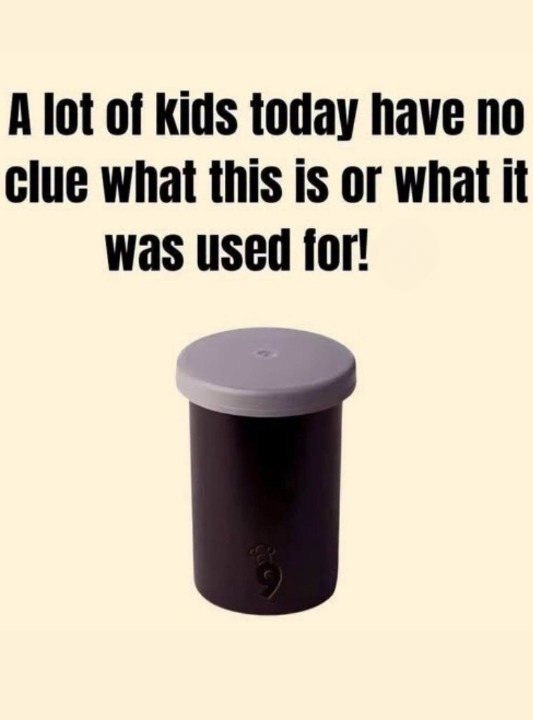
Open almost any junk drawer in a home that has been lived in for a few decades, and you’re likely to discover a fascinating collection of forgotten treasures. Old keys with no matching locks, loose screws saved “just in case,” expired coupons, tangled charging cables, spare batteries, paper clips, and perhaps, tucked quietly into a corner, a small black plastic film canister with a gray or translucent lid.
To many people today, it’s just another outdated object from a different era.
To others, it represents an entire chapter of life.
Long before smartphones placed a camera into nearly every pocket, photography required planning, patience, and a little bit of faith. Every photograph mattered because every frame was limited. Each tiny plastic canister held a roll of film capable of capturing just twenty-four or thirty-six photographs. Once those frames were used, there were no instant previews, no filters, and certainly no unlimited retakes.
Every picture became a deliberate decision.
That simple difference changed how many of us experienced life’s most meaningful moments.
A Small Container That Carried Big Expectations
For decades, film canisters were common household items.
They traveled inside backpacks, camera bags, glove compartments, and vacation suitcases. Families packed several rolls before birthdays, graduations, weddings, school performances, road trips, and holiday celebrations.
Loading a fresh roll into a camera was almost ceremonial.
The gentle click of the camera door closing, the winding lever advancing the film, and the first photograph taken all marked the beginning of a new collection of memories waiting to be created.
Unlike today’s digital world, every photograph required thought.
Would this sunset be worth using one frame?
Should we save the remaining pictures for tomorrow?
Did everyone blink?
Should we take another one?
These questions made photography feel intentional.
Rather than documenting every second, people focused on preserving the moments that truly mattered.
The Excitement Didn’t End When the Pictures Were Taken
Today’s photographs appear instantly on a screen.
Within seconds they can be edited, shared with family, uploaded to social media, or stored in cloud services.
Film photography offered a very different experience.
After finishing an entire roll, the canister was carefully sealed and taken to a photo lab or local pharmacy.
Then came the waiting.
Sometimes it lasted only a day.
Sometimes it took a week or longer.
That waiting became part of the experience itself.
Families wondered whether the vacation pictures turned out well.
Parents hoped birthday candles had been captured clearly.
Children eagerly anticipated seeing themselves in printed photographs.
Opening the envelope of developed photos felt like opening a time capsule.
Every image was a surprise.
Some were beautifully composed.
Others were blurry.
Someone inevitably blinked.
A finger occasionally covered the lens.
Yet those imperfections often became the pictures everyone remembered most.
Why Many People Still Keep Empty Film Canisters
Interestingly, countless households still have empty film canisters even after the photographs have long been developed.
Why?
Partly because they were useful.
People found creative ways to reuse them for storing buttons, sewing needles, coins, fishing hooks, garden seeds, matches, vitamins, or tiny craft supplies.
Teachers used them in classrooms.
Campers packed emergency items inside them.
Gardeners labeled different flower seeds for the following spring.
Parents discovered they were perfect containers for children’s collections of shells, marbles, or small treasures found during outdoor adventures.
The canister itself became almost as familiar as the camera it once served.
More Than Plastic
Objects don’t always become meaningful because they are expensive.
Often, they become meaningful because of the stories attached to them.
A faded concert ticket may hold little financial value, yet it can instantly remind someone of their first live performance.
A handwritten recipe card can bring back memories of grandparents.
An old keychain may recall a first car.
Film canisters belong to this same category.
Their value lies in what they represent rather than what they are made of.
Holding one often reminds people of family vacations, birthday parties, school events, camping trips, holiday gatherings, and ordinary afternoons that eventually became cherished memories.
In many ways, these simple containers symbolize a slower pace of life.
Photography Before Unlimited Storage
Modern technology has transformed photography in remarkable ways.
Today we can take hundreds of pictures without worrying about running out of space.
Artificial intelligence can improve lighting.
Software removes unwanted objects.
Cloud storage preserves thousands of images automatically.
These innovations make photography more accessible than ever before.
Yet they have also changed our relationship with photographs.
When every moment can be captured endlessly, individual images sometimes receive less attention.
Many pictures remain buried inside phone galleries, rarely viewed again after they are taken.
Film encouraged a different mindset.
Each photograph had purpose.
Every click carried intention.
Families gathered around printed albums instead of scrolling separately through digital folders.
The experience was slower, but often more memorable.
Passing Memories to the Next Generation
Many younger people have never loaded film into a camera.
Some have never held a developed photograph fresh from the printing envelope.
Others have never seen a film canister except in museums, thrift stores, or family collections.
That makes these small objects surprisingly effective conversation starters.
Grandparents can explain how vacations were documented before smartphones.
Parents can share stories about waiting excitedly for developed photographs.
Children often find it fascinating that people once couldn’t immediately see the pictures they had taken.
These conversations become opportunities to preserve family history.
Sometimes the object itself matters less than the memories it inspires.
The Joy of Printed Photographs
Printed photographs possess a unique quality that digital images cannot fully replace.
Albums become family traditions.
Boxes of old photographs invite storytelling during holidays.
Children point to unfamiliar faces and ask questions.
Parents remember places they had nearly forgotten.
Grandparents identify relatives whose stories might otherwise disappear over time.
Film photography naturally encouraged these shared experiences because photographs existed physically.
They could be held, passed around, framed, or stored inside albums for decades.
Many families still treasure pictures developed thirty or forty years ago because they continue telling stories long after the moment itself has passed.
A Reminder to Slow Down
Perhaps the greatest lesson these small plastic containers offer has nothing to do with photography.
Instead, they remind us that meaningful experiences often benefit from patience.
Waiting for developed photographs taught anticipation.
Limited film encouraged thoughtful choices.
Printed pictures inspired families to gather together and reflect on shared experiences.
While modern technology offers incredible convenience, it can also encourage us to move quickly from one moment to the next.
Looking back at film photography reminds us that slowing down isn’t always a disadvantage.
Sometimes it helps us appreciate life more deeply.
Looking at Everyday Objects Differently
It’s easy to dismiss older household items as clutter.
Yet many ordinary objects quietly carry extraordinary stories.
An old cookbook preserves family recipes.
A handwritten letter captures someone’s voice across generations.
A worn suitcase recalls decades of travel.
A film canister represents countless moments that once seemed ordinary but later became priceless memories.
These objects connect us to the people we love and the experiences that shaped us.
They remind us that history isn’t found only in museums.
It’s also hidden inside our homes, tucked into drawers, shelves, attics, and storage boxes waiting to be rediscovered.
A Small Piece of the Past Worth Appreciating
The next time you come across one of those familiar plastic film canisters, pause for a moment before deciding what to do with it.
You may choose to recycle it.
You may decide to reuse it for storing small household items.
Or perhaps you’ll simply smile as it reminds you of family vacations, birthday celebrations, school performances, or quiet weekends spent capturing life’s simple joys one photograph at a time.
Its greatest value isn’t measured by money.
It’s measured by memory.
Sometimes the smallest keepsakes become the strongest links to our personal history. They remind us that life’s most meaningful moments rarely announce themselves while they’re happening. Instead, they quietly settle into our hearts, waiting for years later when a simple object—a tiny plastic canister once carried in a camera bag—can bring them back with remarkable clarity.
In a world that moves faster every year, these humble reminders encourage us to slow down, reflect, and appreciate how far we’ve come. Whether tucked away in a drawer, displayed alongside vintage cameras, or saved as part of a family collection, the little film canister remains more than just a container.
It represents an era when every photograph was intentional, every memory was carefully preserved, and every click of the shutter carried the promise of a story that would last for generations.