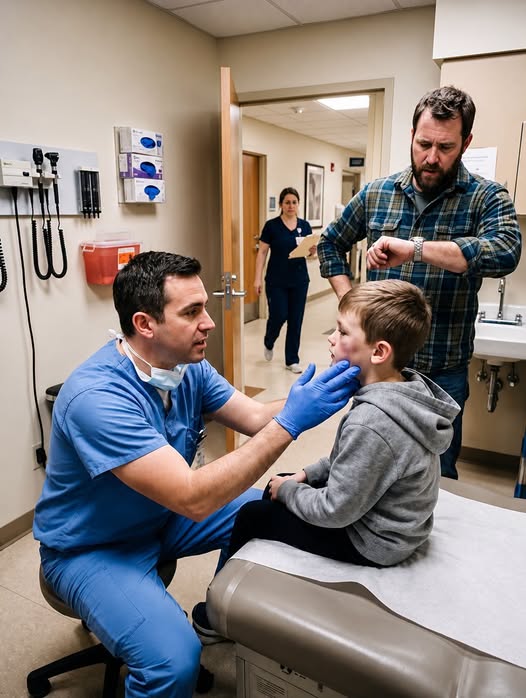
The Nine-Year-Old Boy Who Arrived at the ER With a Story No One Expected
At 3:14 in the morning, rain tapped steadily against the ambulance bay doors of a small coastal Oregon hospital.
The emergency department was unusually quiet.
A few patients waited beneath fluorescent lights. Wet footprints stretched across the entrance floor. A stack of magazines leaned crookedly beside the triage desk, and an untouched cup of coffee sat beside the computer station.
Then the doors opened.
A man hurried inside with a nine-year-old boy beside him.
The man looked at the clock before looking at the nurse.
“Spider bite,” he said. “He needs antibiotics. Something quick.”
His name was Greg.
The boy was Leo.
Greg glanced at his watch again.
“I have work in a few hours,” he added. “Can we get this taken care of?”
The nurse asked what had happened.
“Probably a spider.”
“When did the swelling begin?”
Greg shrugged.
“Earlier.”
“How much earlier?”
“I don’t know. His mother handles all that stuff.”
The boy stood silently beside him.
He was wearing a gray hoodie that looked slightly too large.
His shoes were wet.
His hair was damp from the rain.
And he wasn’t looking at the nurse.
He was looking at the floor.
I was the physician on duty that night.
When I approached the pair, I introduced myself.
“I’m Dr. Thomas. I’m going to examine Leo.”
Greg nodded impatiently.
“Fine.”
He tightened his grip on the boy’s wrist.
Leo immediately turned his body away.
I noticed that small movement.
Sometimes the smallest reactions tell you more than a long explanation.
“Let’s head into Room 4,” I said.
Greg followed us.
Leo walked several steps ahead.
Inside the examination room, he climbed onto the bed and pulled his hood farther over his head.
Rainwater dripped from the edges of his shoes onto the floor.
“Sit up,” Greg told him.
Leo immediately straightened.
I looked at my nurse, Sarah.
She had already opened the patient’s chart.
There were several details that didn’t fit together.
The adult accompanying Leo insisted it was a simple spider bite.
But he couldn’t explain when it had started.
He couldn’t describe what kind of spider might have been involved.
He couldn’t even say whether Leo had been outside when the problem began.
And whenever I asked Leo a question, Greg answered instead.
Sarah quietly stepped closer.
“Something doesn’t feel right,” she whispered.
I agreed.
I pulled my stool toward the examination bed.
Then I stopped several feet away.
“Leo,” I said gently, “would it be okay if I take a look at your face?”
The boy glanced toward Greg.
That was the first thing that concerned me.
He didn’t look at me for permission.
He looked at Greg.
After several seconds, Leo gave a small nod.
I carefully lowered the hood.
The right side of his face was noticeably swollen.
There was discoloration around the area, and the skin looked irritated.
Near the center was a small opening that didn’t look typical for an ordinary insect bite.
There was also an unusual smell.
Not the smell I would normally expect from a simple skin irritation.
Greg shrugged.
“Looks nasty, right?”
I ignored the comment.
“Leo, does it hurt?”
The boy shook his head.
“Does it burn?”
Another shake.
“Does it feel uncomfortable?”
He thought for a moment.
“It feels heavy.”
That answer stayed with me.
I continued the examination carefully.
Then I asked Greg to wait near the other side of the room while I examined Leo.
He frowned.
“Why?”
“Because I need to ask him a few medical questions.”
“I’m his stepfather.”
“I understand.”
“I should be here.”
“You can remain in the room.”
Greg looked annoyed but eventually moved away.
Leo’s posture changed almost immediately.
His shoulders relaxed.
His hands came out from inside his hoodie.
That was when I noticed the marks around his wrist.
They weren’t consistent with the explanation we’d been given.
Sarah saw them too.
She didn’t say anything.
She simply looked at me.
I knew exactly what she was thinking.
I gently examined Leo’s wrist.
“How did this happen?”
Leo looked down.
“I don’t know.”
“Did you fall?”
He shook his head.
“Did someone grab you?”
Silence.
Greg suddenly spoke from across the room.
“He plays rough.”
Leo became completely still.
I looked toward Greg.
Then back at Leo.
“Leo, I need you to tell me what happened in your own words.”
The boy didn’t answer.
Instead, he looked at the floor.
I didn’t pressure him.
Children sometimes need time before they feel safe enough to speak.
I moved on to the medical examination.
I checked his temperature.
His pulse.
His breathing.
His blood pressure.
His pupils.
The swelling around his face required further investigation.
We needed imaging and laboratory tests before deciding on treatment.
I explained this to Greg.
“We’re going to run some tests.”
Greg immediately shook his head.
“Can’t you just give him antibiotics?”
“Not until we know what we’re treating.”
“It’s a spider bite.”
“We don’t know that.”
Greg sighed.
“Doctors always make things complicated.”
I didn’t respond.
There was no reason to argue.
My job was to determine what was happening to Leo.
Not to satisfy an impatient adult.
We prepared Leo for imaging.
Before leaving the room, I asked him one more question.
“Have you eaten today?”
Leo looked at Greg.
Again.
That was becoming a pattern.
I waited.
Finally, Leo whispered:
“Not since yesterday.”
Sarah looked at me.
I nodded.
We arranged for him to receive something to eat once it was medically appropriate.
Then the situation changed.
Greg walked toward the bed.
“Come on.”
Leo pulled away.
It was a small movement, but it was immediate.
Greg reached toward him again.
Leo moved to the other side of the bed.
“Leo.”
The boy didn’t respond.
Greg’s voice became firmer.
“We’re leaving.”
I stepped between them.
“No. We’re not finished.”
Greg looked at me.
“He’s fine.”
“He isn’t.”
“You already said it’s a bite.”
“I said I don’t know what caused it.”
Greg’s expression hardened.
“You can’t keep my stepson here.”
“I can keep a patient here when there is a legitimate medical reason to continue evaluating him.”
Greg shook his head.
“This is ridiculous.”
At that moment, Sarah quietly activated the hospital’s security procedure.
She didn’t create a scene.
She didn’t announce what she had done.
She simply returned to the workstation.
Within a minute, two security officers appeared in the hallway.
Greg noticed them.
His attitude changed.
He became calmer.
Almost friendly.
“I think there has been a misunderstanding,” he said.
One of the security officers asked him to step into the hallway.
Greg looked at Leo.
“Tell them you’re okay.”
Leo said nothing.
“Tell them.”
Still nothing.
Greg eventually walked outside the examination room.
The door closed.
The room became quiet.
Leo remained on the bed.
I sat down several feet away.
For the first time since he had arrived, nobody was answering questions for him.
“Leo?”
He looked at me.
“You can take your time.”
He nodded.
“Did a spider cause the injury?”
He shook his head.
“Are you sure?”
Another nod.
“Okay.”
I waited.
“Can you tell me what happened?”
Leo stared at his hands.
He picked at a loose thread on his sleeve.
He wrapped it around one finger.
Then slowly pulled it loose.
He repeated the motion several times.
I didn’t interrupt him.
Eventually, he spoke.
“He put me in the shed.”
I felt the room become completely still.
Sarah looked at me.
I looked back at Leo.
“What happened in the shed?”
Leo swallowed.
“I don’t know.”
“You don’t have to tell me everything at once.”
He nodded.
“He said I was being difficult.”
I waited.
“He said I needed to learn.”
The boy’s voice became quieter.
“He locked the door.”
I asked how long he had been there.
“I don’t know.”
“Was anyone else home?”
He shook his head.
Then he said something that changed the entire direction of the case.
“My mom doesn’t know.”
I asked why.
Leo looked toward the closed door.
“Because he said she would be angry.”
“At you?”
Leo nodded.
“Why would she be angry?”
“Because he told her I was lying.”
The story began coming together.
The swollen area on Leo’s face wasn’t the simple spider bite Greg had described.
The marks around his wrist weren’t explained by rough play.
And the fear Leo displayed whenever Greg moved toward him couldn’t be dismissed as ordinary nervousness.
We immediately followed the hospital’s safeguarding procedures.
A child welfare specialist was contacted.
Law enforcement was notified.
A pediatric specialist was requested.
Most importantly, Leo was kept in a safe environment while the appropriate professionals investigated.
None of us knew yet exactly what had happened.
And we weren’t going to assume.
That was important.
A hospital investigation isn’t about deciding someone’s guilt in an examination room.
It’s about protecting the patient, documenting what is known, treating the medical problem, and making sure the right authorities have the information they need.
The imaging results eventually gave us another clue.
There was no evidence of the simple explanation Greg had given us.
The swelling required treatment and observation, but the medical findings didn’t match the casual story we had been told.
We documented everything carefully.
The appearance of the swelling.
The marks on Leo’s wrist.
His statements.
His behavior.
The timeline.
The information provided by Greg.
Every detail mattered.
A few hours later, Leo’s mother arrived at the hospital.
She looked confused.
Then worried.
Then devastated.
She had been told that Leo had suffered a minor injury.
She hadn’t been told that he had been taken to the emergency department with significant swelling.
She hadn’t known about the shed.
And she certainly hadn’t known that Leo had been afraid to speak.
When she entered the room, Leo looked at her.
For several seconds, neither of them spoke.
Then his mother sat beside him.
“I’m here.”
Leo reached for her hand.
That was all.
She held it.
The room remained quiet.
Later, she explained that Greg had often insisted Leo was difficult.
She had trusted him to handle discipline while she worked.
She had never imagined that he might be frightening the child.
That realization was difficult for her to process.
But the medical team reminded her that the most important thing at that moment was Leo’s safety and recovery.
The investigation continued after Leo left the emergency department.
Statements were collected.
Records were reviewed.
The circumstances surrounding the injuries were examined.
Authorities determined what additional steps were necessary.
The hospital staff remained focused on what they could control.
Leo received appropriate medical care.
His mother was connected with support services.
And the hospital’s child-protection team followed the case.
Days later, I saw Leo again.
His swelling had improved.
He was sitting in a chair wearing the same gray hoodie.
But this time, he wasn’t hiding his face.
He was drawing.
A nurse walked past the doorway.
Leo held up the picture.
It was a house.
There were trees around it.
A blue sky.
And three people standing outside.
“Who’s that?” I asked.
“My mom.”
“And the other person?”
“My teacher.”
I smiled.
“Who’s the third?”
Leo thought for a moment.
“Me.”
That answer told me more than any medical test could have.
He was beginning to see himself as someone who deserved to be included in his own story.
Someone whose voice mattered.
Someone who could ask for help.
The night he arrived, he had been treated like a problem that needed to be handled quickly.
His stepfather wanted medication.
He wanted to leave.
He wanted the hospital to accept the simplest explanation and move on.
But medicine doesn’t work that way.
Neither does child safety.
Sometimes the most important part of an examination isn’t the obvious symptom.
It’s the detail that doesn’t fit.
A patient who looks away when someone speaks.
A child who becomes tense when an adult enters the room.
An explanation that doesn’t match the physical evidence.
A timeline that doesn’t make sense.
A question that gets answered by someone else.
Those details may not prove anything by themselves.
But they deserve attention.
That night, the swelling on Leo’s face brought him into the emergency department.
What happened afterward reminded everyone there that a child’s silence can sometimes be a form of communication.
Leo didn’t need someone to speak for him.
He needed someone willing to give him enough time and space to speak for himself.
And once he finally did, the entire story changed.
The most important moment wasn’t when the unusual swelling was discovered.
It wasn’t when Greg became impatient.
It wasn’t even when the security team arrived.
It was the moment a frightened nine-year-old realized that someone in the room was actually listening.
And sometimes, for a child who has been afraid to speak, that can be the beginning of everything changing.