Understanding Palm Reading as a Cultural Practice
Throughout history, humans have looked for meaning in patterns found in nature and the human body. One of the oldest traditions connected to this curiosity is palmistry, also known as chiromancy.
Palmistry is the study of the lines and shapes on the palm, interpreted in various cultures as symbolic reflections of personality traits and life experiences. While modern science does not support palm reading as a predictive method, it remains an important part of cultural history, symbolism, and traditional belief systems in many parts of the world.
For some people, palmistry is a way of self-reflection rather than a literal prediction of fate.
The Main Lines of the Palm in Traditional Palmistry
In classical palmistry traditions, the palm is usually interpreted through several major lines. Each is believed to represent different aspects of life and personality.
1. The Life Line
The Life Line curves around the base of the thumb. In palmistry traditions, it is associated with vitality, energy levels, and overall life experiences. Contrary to a common myth, it is not interpreted as a direct indicator of lifespan.
2. The Heart Line
Located near the top of the palm, the Heart Line is traditionally linked to emotional expression, relationships, and personal connections with others.
3. The Head Line
This line runs across the middle of the palm and is often associated with thinking patterns, decision-making styles, and learning preferences in palmistry interpretations.
4. The Fate Line
Not everyone has a clearly visible Fate Line. In palmistry, it is sometimes interpreted as representing career direction or life influences shaped by external circumstances.
The “M” Shape on the Palm: What It Traditionally Symbolizes
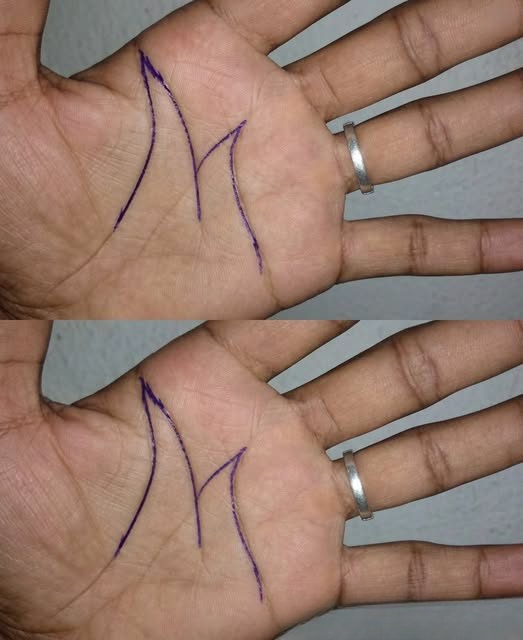
One of the most widely discussed patterns in palmistry is the appearance of an “M” shape formed by the intersection of the main palm lines.
In traditional interpretations, this shape is often associated with:
- Strong intuition and observation skills
- Practical thinking and problem-solving ability
- Leadership tendencies or independence in decision-making
- A balanced combination of logic and emotional awareness
It is important to note that these interpretations are symbolic and vary widely between different palmistry schools and cultural beliefs.
Some readers see the “M” shape as a sign of heightened awareness or strong communication skills, while others view it simply as a natural variation in palm line patterns.
The Crescent Moon Shape in Palmistry Interpretations
Another interesting pattern sometimes identified in palm reading is a crescent or arc-like shape formed by overlapping lines.
In symbolic palmistry traditions, crescent shapes are often linked to:
- Creativity and imagination
- Emotional sensitivity
- Adaptability and openness to change
- Strong inner reflection or intuition
In many cultures, crescent shapes are also associated with cycles, transformation, and personal growth, which is why they are often interpreted in a positive and reflective context.
Why People Are Drawn to Palmistry
Even though palmistry is not scientifically validated, it continues to attract interest around the world. There are several reasons for this:
- It encourages self-reflection and mindfulness
- It connects people with cultural and historical traditions
- It provides a symbolic way to think about personality traits
- It offers entertainment and curiosity-based exploration
For many, palm reading is less about predicting the future and more about understanding themselves in a different way.
A Balanced Perspective
Modern science explains palm lines as natural skin folds formed during fetal development and movement of the hands over time. These patterns are unique to each individual but are not considered indicators of destiny or personality by medical science.
However, cultural practices like palmistry remain meaningful in storytelling, tradition, and personal reflection.
It is best understood as a symbolic belief system rather than a factual prediction method.
Final Thoughts
The fascination with symbols like the “M” shape or crescent markings shows how deeply humans are drawn to meaning and pattern recognition.
Whether viewed as cultural tradition, symbolic interpretation, or simple curiosity, palmistry continues to be a topic that blends history, psychology, and imagination.
Ultimately, the most meaningful insights about a person’s life come not from the lines on their hand, but from their actions, choices, and experiences.