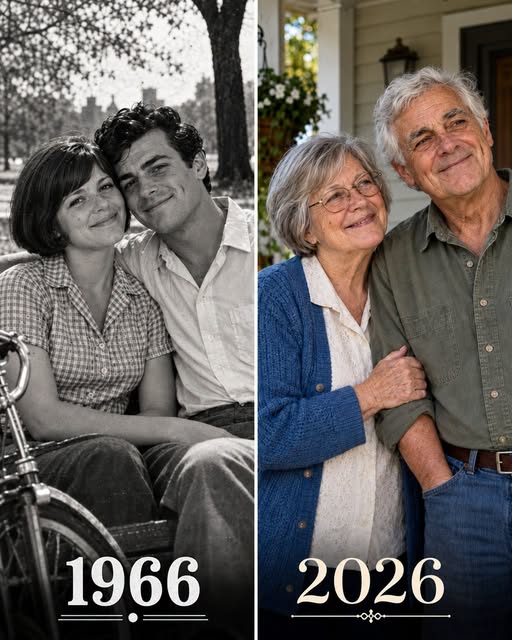
The Legacy of Sixty Years: A Memoir of Love, Deception, and Discovery
The silence of an empty house is a heavy thing. When you have shared every morning, every quiet afternoon, and every fading twilight with someone for six decades, the sudden absence of their breath leaves a void that feels almost physical.
My name is Arthur, and at eighty-six years old, I am learning how to navigate a world that has grown drastically unfamiliar in more ways than one. It took my grandson teaching me how to use social media just so I could type these words—because some stories are too vast to be kept entirely inside your own chest, and the weight of mine became too heavy to carry alone.
A few days ago, I buried my wife, Irene. Or at least, the woman I believed was my wife for sixty years.
Chapter 1: The Promise of Summer
Our story began in the vibrant, uncertain days of our youth, back when we were students at university. Irene was the kind of person who seemed to capture the ambient light of any room she walked into. I remember the exact shade of her laughter before I even remember her words. It took me nearly a year of quiet persistence, awkward conversations, and shared library tables to finally convince her to give me a chance.
When she finally agreed to be my girlfriend, it felt as though the trajectory of my entire existence had aligned into something meaningful. But happiness in those days was often shadowed by the demands of the world.
Not long after we found our rhythm together, my draft notice arrived.
The Vietnam War was a looming shadow, and the thought of leaving for a combat zone without securing my future terrified me more than the conflict itself. One evening, sitting on a low stone wall near the campus quad, I looked at her and said the words that would anchor my life for the next sixty years: I could not bear the thought of leaving without marrying her first.
Irene looked at me, her eyes reflecting the amber glow of the streetlamps, and she said yes.
We didn’t have money for a grand celebration. We didn’t need one. I can still close my eyes today and picture her clearly: she wore a simple white summer dress dotted with tiny, pale-blue wildflowers. After a brief ceremony, we went to a local roadside diner, sharing a basket of fries and a single milkshake with two straws. It was modest, quiet, and entirely perfect.
A few days later, I boarded a transport bus, leaving behind the only person who truly mattered to me.
Chapter 2: Distance and Devotion
War is an exercise in measuring time by heartbeats and letters. Irene and I wrote to each other constantly. I kept every single envelope she sent tucked inside my rucksack, reading them by the dim light of a field lantern until the ink blurred at the creases. Those letters were the anchor that kept me tethered to humanity.
When my tour finally ended, and I stepped off the bus back home, Irene was waiting. The embrace we shared on that crowded station platform erased every difficult moment I had endured overseas. It was, without a doubt, one of the purest moments of joy I would ever experience.
From that afternoon onward, we built a life with deliberate care.
-
We secured a small, creaky house with a porch that caught the evening breeze.
-
We welcomed three children into our home, raising them with scraped knees, Sunday dinners, and shared laughter.
-
As the decades turned, five grandchildren arrived, and Irene spoiled every single one of them with homemade cookies and endless patience.
By all conventional measures, our life together was a triumph. We weathered financial scares, the quiet grief of aging parents, and the ordinary friction of two people sharing a lifetime. When we celebrated our diamond wedding anniversary this year, surrounded by children and grandchildren who represented the very best of us, I genuinely believed I was the luckiest man alive.
Then, Irene fell ill.
It wasn’t a sudden tragedy, but a slow, quiet fading. For weeks, I sat by her bedside in the room we had shared for decades, holding her fragile hand until her breathing finally grew still and quiet. I stayed there long after the medical staff left, refusing to let go until the room grew cold.
Chapter 3: The Visitor at the Door
The days immediately following the funeral passed in a haze of gray static. The house, which had always hummed with life, suddenly felt cavernous. Every hallway echoed; every stray coffee mug left on the counter felt like a monument to an absence.
Then, one afternoon, the doorbell rang.
I pulled open the heavy wooden door to find a man I had never seen before. He was dressed in a sharp, slate-gray suit that felt entirely out of place on our quiet suburban porch. He held a leather briefcase in one hand and a thick manila envelope in the other.
“Mr. Arthur Vance?” he asked, his voice measured and professional.
“Yes,” I replied, frowning.
“My name is Julian Vance—no relation,” he added quickly, noticing my confusion. “I am an attorney. More importantly, I was your late wife’s legal counsel.”
The words tangled in my brain. Irene’s attorney?
“There must be some mistake,” I said, stepping back slightly. “My wife never had a lawyer. We didn’t need one.”
Julian’s expression softened, though it did little to ease the cold knot tightening in my stomach. He shifted the manila envelope forward.
“Mr. Vance, I’m truly sorry to intrude during such a painful time, but Mrs. Irene left very specific instructions. I was directed to deliver this document to you personally, and only after her passing.”
My hands began to tremble. Age had made my joints ache, but this was something entirely different—a sudden, primal dread.
“What is this about?” I demanded, my voice cracking. “What could my wife possibly need a lawyer for?”
Julian hesitated. He looked down at the porch floorboards for a fraction of a second before looking me squarely in the eyes.
“Your wife?” he repeated softly. “Sir… legally speaking, you and Irene were never actually married.”
Chapter 4: The Fracture
The world seemed to tilt on its axis. The sound of the neighborhood traffic down the street vanished, replaced by a roaring silence in my ears.
“What did you just say?” I whispered.
“You didn’t know?” Julian asked, genuine surprise flickering across his face.
I couldn’t speak. My tongue felt dry, heavy in my mouth. My knees buckled slightly against the doorframe.
“Open the envelope, Mr. Vance,” Julian urged gently, extending the package toward me. “Irene explained everything inside. It is all there.”
Sixty years. Three children. Five grandchildren. Decades of shared memories, holidays, morning coffees, and whispered confidences in the dark. And now, a stranger in a suit was standing on my porch, casually dismantling the entire architecture of my existence.
With shaking, arthritic fingers, I reached out and took the envelope.
Written across the front, in the familiar, elegant cursive I had known since my college days, was my name: Arthur. The sight of her handwriting made the reality of the moment even more agonizing.
I tore the flap open, pulled out several folded sheets of heavy cream paper, and began to read.
My dearest Arthur,
If you are reading this letter, it means my journey has ended, and yours has taken a sudden, painful turn. I am so sorry for the shock this will cause you. For sixty years, I loved you more than my own life, but there was a truth I carried like a stone in my chest every single day.
Do you remember the summer before you left for Vietnam? Do you remember the small chapel downtown where we thought we exchanged our vows?
What you never knew, Arthur, was that the license we signed was never filed. My father… he discovered something about my past—something dark and dangerous involving people he was entangled with. To protect me, to hide me from a world that was hunting my family, he arranged for a false ceremony. The preacher was an actor; the paperwork was a diversion. Legally, I was never Irene Vance. I was someone else entirely.
When you came back from the war, so full of hope and love, I wanted to tell you the truth. But I looked into your eyes and saw a man who had finally found peace, and I was a coward. I couldn’t bear to break your heart, and I couldn’t bear to lose you. So I kept the secret. I lived a lie with the man I truly loved, praying that death would find me before the truth ever did.
Please forgive me. Every single day we spent together was real to me. You were my home.
Forever yours, Irene
Chapter 5: The Echoes of a Ghost
The letters slipped from my fingers, fluttering down to land softly on the wooden porch at my feet.
The sound that tore from my throat didn’t sound like me. It was a jagged, raw cry that echoed off the living room walls behind me and spilled out into the quiet afternoon.
“God, Irene… who were you?” I choked out, staring down at the empty air where she should have been.
Julian stood quietly, offering a sympathetic nod before turning to walk back down the steps, leaving me alone with the remnants of a lifetime built on sand.
Editor’s Note on Integrity and Truth: In moments of profound emotional upheaval, we often discover that the narratives we construct are far more fragile than we realize. Yet, love—even love complicated by deception—leaves a real mark upon the soul. The legality of a certificate does not undo sixty years of shared coffee, quiet comfort, and genuine devotion.
Now, sitting in this quiet room with the light fading through the window, I look at the framed photograph of her standing in that white summer dress covered in pale-blue flowers. The anger remains, tangled inextricably with an overwhelming, suffocating grief.
She lied to me. She kept me in the dark for an entire lifetime.
And yet, as I look down at my own trembling hands, I know the simple, terrifying truth: even if I had known the truth on that day in college, I would have loved her anyway.
Reflection and Discussion
How would you process such a revelation after an entire lifetime shared with someone you thought you knew completely? Share your thoughts below.