The Lake That Always Made Me Curious—Until I Finally Looked Beneath the Surface
There is an artificial lake in our village that most people pass without giving it much thought.
It sits quietly between familiar stretches of homes, trees, and narrow roads, almost as though someone deliberately placed it there to break up the landscape.
Unlike natural lakes that seem to belong to the land around them, this lake has always felt slightly different.
Its edges are unusually regular in certain places.
The surrounding landscape shows signs of human planning.
There are paths nearby, patches of grass, and areas where people occasionally stop to sit, talk, or simply enjoy the view.
For the people who live around it, however, the lake has become part of the background.
Children have grown up seeing it.
Older residents remember when the area looked different.
People walk past it on their way to other places.
Some sit nearby on warm afternoons.
Others barely notice it anymore.
I had always been somewhere in between.
I knew the lake was there.
I had walked past it countless times.
But I had never really stopped to think about what was beneath its surface.
That changed one quiet afternoon when I decided to spend some time near the water.
What started as an ordinary walk turned into an unexpectedly interesting exploration of how artificial lakes are created, what can exist beneath their surfaces, and how much history can become hidden in a familiar landscape.
A Familiar Place Can Still Hold Questions
The lake had never seemed mysterious in the dramatic sense.
There were no strange lights.
No unusual sounds.
No stories that everyone in the village agreed upon.
It was simply a body of water that didn’t look quite like the natural lakes I had seen elsewhere.
The more I thought about it, the more questions appeared.
Why had it been built?
When was it created?
What had occupied the area before it became a lake?
How deep was it?
What was underneath the water?
Was the bottom completely covered with mud and sediment, or were there traces of the landscape that existed before?
These weren’t questions I had ever considered seriously.
The lake had been there for so long that I had stopped thinking of it as something that had a history.
But every artificial landscape has a story.
Someone planned it.
Someone changed the land.
Someone decided where the water would go.
And once water fills a depression or reservoir, the original landscape can become difficult to see.
The Difference Between Natural and Artificial Lakes
A natural lake generally develops through geological, glacial, volcanic, river-related, or other natural processes.
Artificial lakes, sometimes called reservoirs or man-made lakes, are created or significantly modified by people.
They may be built for many reasons.
Water storage is one.
Agriculture is another.
Flood management, recreation, landscaping, industrial use, and other purposes can also lead to the creation of artificial bodies of water.
The lake near our village was a reminder that landscapes don’t always appear exactly as nature created them.
Sometimes what looks like an ordinary geographical feature is actually the result of decades of planning and construction.
Once completed, however, an artificial lake can become so familiar that people forget it was ever constructed.
What Happens Before a Lake Is Filled?
Creating an artificial lake can involve substantial changes to the surrounding land.
Depending on the project’s purpose and size, construction may include excavation, earthworks, embankments, drainage systems, channels, retaining structures, or other infrastructure.
Before water enters the area, the site may look completely different.
Vegetation may be cleared.
The ground may be reshaped.
Existing drainage patterns may be altered.
Paths and roads may be moved.
Structures may be removed or relocated when necessary.
Then water gradually fills the area.
Once the water reaches its intended level, much of that preparation becomes invisible.
People who encounter the lake years later may have no idea what the site looked like beforehand.
That was one of the things I found most fascinating.
The water wasn’t just covering soil.
It was covering history.
The Surface Tells Only Part of the Story
Standing beside the lake, I could see only the surface.
The water reflected the sky.
Leaves moved gently along the shoreline.
Small ripples appeared whenever the wind passed across the lake.
From above, everything looked simple.
But water hides an enormous amount of information.
Below the surface could be layers of sediment.
There could be rocks.
Branches.
Leaves.
Roots.
Aquatic plants.
Old construction materials.
And, depending on the lake’s history, remnants of how the area was used before the water arrived.
That doesn’t mean every artificial lake contains something remarkable.
Most contain ordinary material accumulated over time.
But even ordinary sediment can tell researchers something about environmental history.
Sediment Is Like a Natural Record
One of the most interesting things about lakes is sediment.
As time passes, small particles settle toward the bottom.
These particles can come from soil carried by rainwater, decaying plants, wind-blown material, and other natural processes.
In some lakes, sediment can build up in layers.
Scientists can sometimes study these layers to learn about past environmental conditions.
Depending on the location and circumstances, sediment may preserve evidence of changes in vegetation, erosion, pollution, climate patterns, or human activity.
The bottom of a lake can therefore act as a kind of historical record.
The deeper layers may represent older periods, while newer material accumulates closer to the surface.
Of course, interpreting sediment requires scientific methods and proper sampling.
You cannot simply look at muddy water and determine its history.
But the principle is fascinating.
A lake that looks unchanged from the outside may be constantly recording small environmental changes beneath the surface.
The Plants Beneath the Water
Another feature that can make an artificial lake look more natural over time is vegetation.
Plants may grow along the shoreline.
Aquatic plants can establish themselves in shallow areas.
Algae and microscopic organisms can become part of the lake ecosystem.
Over many years, these living organisms can transform a newly constructed reservoir into something that looks much more like a natural body of water.
The boundary between human construction and natural processes becomes less obvious.
People may eventually look at the lake and assume that it has always been part of the landscape.
But the ecosystem that developed afterward is a product of both the original construction and the environmental processes that followed.
What I Saw From the Shore
I wasn’t equipped for scientific exploration.
I wasn’t conducting a formal survey.
I was simply observing.
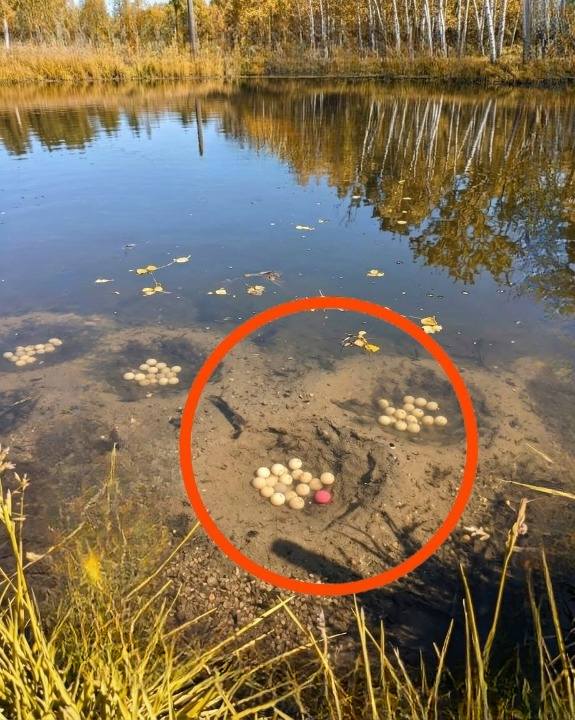
I walked along the shoreline and looked carefully at the places where the water was shallow enough to see the bottom.
In some areas, the water was relatively clear.
In others, the bottom disappeared quickly into darker water.
There were small stones near the edge.
Pieces of vegetation had collected in certain places.
A few branches had fallen into the water.
None of these things were unusual.
But together they made me realize how quickly a landscape changes once water becomes a permanent feature.
What looked like a simple lake from a distance was actually a constantly changing environment.
Why Artificial Lakes Become Ecosystems
When people create a body of water, nature does not simply stop.
Plants, insects, birds, fish, microorganisms, and other organisms may begin interacting with the new environment.
The exact ecosystem depends on the climate, water quality, surrounding vegetation, depth, nutrient availability, and many other factors.
Over time, an artificial lake can become home to a wide variety of species.
Birds may use the shoreline.
Insects may reproduce around shallow water.
Fish may inhabit the lake if introduced or naturally connected populations reach it.
Plants may colonize the edges.
Animals may visit to drink.
This transformation can happen gradually.
A newly constructed water body may look artificial.
Decades later, it may look completely integrated into the surrounding environment.
Looking Beneath the Surface Is Not Always a Good Idea
My curiosity did make me wonder what I might see if I could explore the bottom.
But curiosity should have limits.
Lakes can have unpredictable conditions.
Water depth can change suddenly.
Mud can be unstable.
Visibility may be poor.
Underwater vegetation can become difficult to navigate.
Artificial structures may also be present in some reservoirs or managed water bodies.
For those reasons, simply entering unfamiliar water isn’t a sensible way to investigate it.
Swimming, diving, or boating should only be done where those activities are permitted and where appropriate safety measures are in place.
The lake’s surface may look calm, but calm water does not necessarily mean simple conditions underneath.
The Importance of Knowing a Lake’s History
The more I thought about the lake, the more I wanted to know about its origins.
Local history became surprisingly useful.
Older residents remembered changes that younger people had never seen.
Someone remembered when the surrounding road had been different.
Another person recalled construction work from years earlier.
Someone else remembered when the area had been used differently.
This is one of the fascinating aspects of local history.
Official records can tell us when a project was designed or completed.
Maps can show how the landscape changed.
But personal memories can provide details that never appear in formal documents.
When combined carefully, these sources can create a much fuller picture.
Old Maps Can Reveal What Water Hides
One of the best ways to understand a transformed landscape is to compare old and modern maps.
An older map may show:
- Roads that no longer exist
- Former property boundaries
- Streams
- Fields
- Buildings
- Forested areas
- Footpaths
- Drainage patterns
A modern map shows the lake.
An older map may show what existed before it.
The comparison can be surprisingly revealing.
A shoreline that looks permanent may actually be relatively recent.
A road that seems to end at the lake may once have continued farther.
A patch of water may have replaced land that previously served an entirely different purpose.
The Lake Changed More Than the View
Creating a lake does more than introduce water into a landscape.
It can change local drainage.
It can alter wildlife patterns.
It can affect nearby vegetation.
It can create recreational opportunities.
It can influence how people move through an area.
It may even change how communities think about the surrounding land.
People begin walking along the shoreline.
Children grow up fishing or observing wildlife.
Families use nearby spaces for recreation.
Photographers discover new viewpoints.
The lake becomes a landmark.
Eventually, it becomes part of local identity.
Why People Stop Noticing Familiar Places
There is a psychological reason we often overlook places that are always around us.
Our brains become accustomed to repeated surroundings.
A building we pass every day can become invisible.
A tree on our route may receive no attention.
A street corner that once seemed interesting can become completely ordinary.
The same happened with the lake.
It was always there, so I rarely looked at it.
It took a deliberate decision to slow down before I began noticing details.
That experience made me wonder how many other familiar places contain stories we simply haven’t taken the time to investigate.
The Shoreline Is Always Changing
Even when a lake appears unchanged, its shoreline can shift over time.
Water levels rise and fall.
Rain changes runoff.
Sediment moves.
Plants grow.
Trees fall.
Soil erodes.
People modify nearby areas.
Seasonal changes can make the same location look completely different.
In spring, vegetation may make the shoreline appear lush.
During summer, water levels and plant growth may change its appearance.
Autumn can cover the surrounding ground with leaves.
Winter can reveal features that were hidden by vegetation.
Photographing the same location throughout the year can therefore reveal changes that would otherwise go unnoticed.
What Lies Beneath Is Often Ordinary
There is a tendency to imagine that anything hidden beneath a lake must be mysterious or unusual.
But the reality is usually much more ordinary.
Most lake bottoms contain combinations of sediment, rocks, organic material, and biological matter.
Artificial lakes may also contain materials associated with their construction or previous land use.
That doesn’t make them uninteresting.
In fact, ordinary material can tell an important story.
A layer of sediment can reveal erosion.
A concentration of organic material can indicate vegetation changes.
Changes in water clarity can reflect environmental conditions.
The value is not necessarily in finding something dramatic.
It is in understanding how the environment changes over time.
A Lake Is a Living System
Perhaps the biggest change in my thinking was realizing that the lake isn’t static.
It may look still from the shore.
But beneath the surface, countless processes are occurring.
Water temperature changes.
Plants grow and decay.
Organisms interact.
Sediment moves.
Rainwater enters.
Water evaporates.
Nutrients circulate.
Wind affects the surface.
Seasonal conditions alter the ecosystem.
A lake is not simply a container filled with water.
It is an environment.
Artificial or natural, it becomes part of a larger ecological system.
The Human Side of the Lake
There is also a social story attached to the lake.
People have different memories of it.
For some, it is simply a landmark.
For others, it may be where they spent time as children.
Someone may remember fishing there with a parent.
Another person may remember walking around it after school.
Someone else may have watched birds there.
A local business may have grown because people began visiting the area.
These personal memories don’t necessarily appear on maps.
But they are part of the lake’s history too.
A landscape isn’t only made of soil, trees, buildings, and water.
It is also made of memories.
What I Learned From Looking More Carefully
The most interesting discovery wasn’t something I pulled from the water.
It was the realization that I had been looking at the lake without really seeing it.
For years, I knew its basic shape.
I knew where the paths were.
I knew where the road passed nearby.
But I had never considered the layers of history beneath the surface.
That changed after one quiet afternoon.
I started seeing the lake differently.
The shoreline became a boundary between two environments.
The sediment became a record of gradual change.
The surrounding vegetation became part of an ecosystem.
And the lake itself became evidence of how humans and nature can reshape one another’s landscapes.
A Simple Way to Explore Local History
You don’t need specialized equipment to investigate a familiar place.
Start with observation.
Take photographs.
Compare different seasons.
Talk to longtime residents.
Look for old photographs.
Search local archives or historical records.
Compare older maps with modern ones.
Learn why the feature was originally created.
If the area is environmentally sensitive, follow local rules and avoid disturbing it.
Sometimes these simple steps reveal fascinating information.
Questions Worth Asking About an Artificial Lake
If you live near an artificial lake, you might ask:
When was it constructed?
Why was it created?
What was on the land before the lake existed?
How was the water supplied?
How deep is it?
Does the water level change seasonally?
What plants and animals live around it?
How has the shoreline changed?
Are there old photographs of the area?
Are there historical maps showing the original landscape?
These questions can turn a familiar location into a fascinating local-history project.
Respect the Environment
Curiosity is valuable, but it should be balanced with respect for the environment.
Avoid removing plants, rocks, wildlife, or other natural materials unnecessarily.
Don’t leave trash near the shoreline.
Don’t disturb nesting birds or other animals.
Follow posted regulations.
If the lake is managed for drinking water, conservation, flood control, or another specific purpose, additional restrictions may apply.
A beautiful environment remains beautiful when people treat it responsibly.
The Mystery Was Really About Time
Looking at the lake made me realize that the most interesting thing beneath its surface wasn’t necessarily a single object.
It was time.
Years of sediment had accumulated.
Plants had grown and disappeared.
Animals had come and gone.
Water levels had changed.
People had used the surrounding land.
The community had changed.
The landscape had gradually developed a new identity.
The lake represented a meeting point between human decisions and natural processes.
Someone had created the original structure.
Nature had spent years adapting it.
And people had gradually accepted it as part of their home.
Final Thoughts
The lake in our village had never changed dramatically overnight.
It didn’t need to.
Its story was written slowly.
A piece of land was transformed.
Water filled the area.
Sediment accumulated.
Plants appeared.
Wildlife adapted.
People created memories.
Years passed.
And eventually, the lake became so familiar that almost nobody questioned what had existed before it.
That afternoon reminded me that familiar places can contain more history than we realize.
Sometimes the most interesting discoveries don’t require traveling to a famous destination.
They can begin with something as simple as stopping beside a local lake and asking a question.
What was here before?
The answer may involve engineering, agriculture, environmental change, local history, or simply the gradual accumulation of ordinary events.
And although I never needed to dive beneath the surface to understand the lake better, I came away with a different appreciation for what was there.
The water was only the visible part.
Beneath it was a changing environment, layers of sediment, traces of the past, and a story that had been developing for years.
That may be the most interesting lesson of all.
We often think we need to travel far away to discover something new.
Sometimes we simply need to look more carefully at the places we’ve been walking past for years.