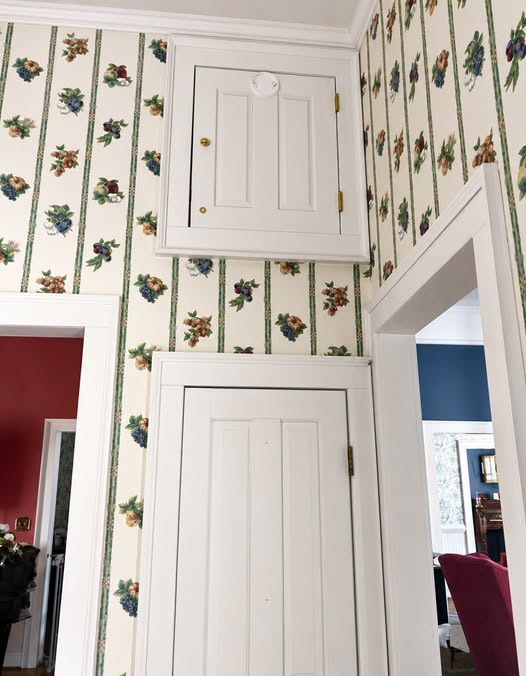
The Forgotten Purpose of High Cabinets in Older Homes
If you have ever explored an older house, visited a historic building, or looked closely at photographs of traditional interiors, you may have noticed an unusual architectural detail.
A small cabinet.
A shallow shelf.
Or a narrow storage compartment positioned surprisingly high on a wall, sometimes above a doorway or several feet above the floor.
At first glance, these spaces can seem almost impractical.
Why would anyone build a cabinet somewhere that is difficult to reach?
Why would a shelf be placed so high that a person would need a chair, ladder, or step stool to use it?
And why do some of these cabinets appear to have no doors at all?
The answer is connected to the way people once designed homes, stored household belongings, managed limited space, and thought about cleanliness and organization.
Today, modern kitchens and bedrooms are filled with cabinets, drawers, closets, shelves, and specialized storage systems. Almost everything has a clearly defined place.
Older homes often worked differently.
Storage was valuable, rooms were designed for multiple purposes, and household objects were sometimes placed in locations that would seem unusual by modern standards.
One of the most interesting examples is the high wall cabinet or shelf.
These features can tell us a surprising amount about everyday life in earlier generations.
Why Were Cabinets Built So High?
The simplest explanation is that not every storage space was designed for items that needed to be accessed every day.
People have always needed places to store belongings that were used occasionally.
Seasonal clothing.
Extra bedding.
Important papers.
Decorative objects.
Household supplies.
Special dishes.
Keepsakes.
Tools.
Cleaning materials.
In homes where floor space was limited, the unused space near the ceiling represented an opportunity.
Instead of leaving the upper portion of a wall completely empty, builders could incorporate shallow storage into it.
This made the most of the available room without taking valuable floor space away from furniture or daily activities.
A high cabinet might therefore have served as a form of secondary storage.
It wasn’t necessarily intended for everyday convenience.
It was intended to keep certain belongings out of the way.
Older Homes Used Space Differently
Modern houses often have dedicated storage areas.
We may have walk-in closets, kitchen pantries, garages, utility rooms, basement storage, and large built-in wardrobes.
Many older homes were considerably more limited.
A small house might have had only a few closets.
Some rooms were expected to serve several functions.
A dining room could also be used for sewing.
A bedroom might contain clothing, linens, trunks, and personal belongings.
A kitchen had to accommodate cooking equipment, food, dishes, and household supplies.
Because of these limitations, homeowners had to think creatively.
Walls became storage.
The space beneath stairs became storage.
The area underneath beds became storage.
Shelves were installed above doors.
Cabinets were placed high on walls.
Every available space could have a practical purpose.
The Area Above a Door Was Valuable
One particularly interesting location for a cabinet was above a doorway.
From a modern perspective, the space above a door may seem insignificant.
But architecturally, it can represent a useful area that otherwise serves no practical function.
A cabinet installed there could provide additional storage without interfering with furniture or walking space.
Because the cabinet was elevated, it also kept stored items away from children and everyday activity.
This could be useful for objects that weren’t needed frequently.
The homeowner could use a step stool when necessary.
In some cases, taller household members could reach the shelves without much difficulty.
The inconvenience was considered acceptable because the items stored there did not need to be accessed constantly.
What Was Stored in High Cabinets?
There wasn’t one universal purpose.
The contents depended heavily on the household, location, period, and design of the building.
Some high shelves could have been used for ordinary household goods.
Others may have held objects that needed to be kept away from children.
Seasonal items were another logical possibility.
For example, a family might store decorations that were only brought out during certain times of the year.
Extra linens could also be placed in elevated storage.
Old documents and personal papers might be kept somewhere less accessible.
In kitchens, high shelves could hold serving pieces or equipment that wasn’t used regularly.
The important point is that the cabinet’s height did not necessarily indicate a mysterious purpose.
Often, it was simply a practical solution to a storage problem.
Why Some Cabinets Had No Doors
The absence of doors is another detail that can make these features seem mysterious.
But open shelving has existed for centuries.
Doors add cost, weight, hardware, and construction complexity.
An open shelf can be built quickly and used immediately.
In some situations, there was also no need to conceal the stored objects.
If the shelf was high enough, its contents might not have been visible from normal standing height anyway.
That meant a cabinet could function almost like a recessed shelf.
Instead of installing doors, builders could leave the opening exposed.
This created a simple storage area without additional hardware.
Practicality Was More Important Than Appearance
Many older household features were designed primarily around function.
Modern interior design often emphasizes clean lines, visual consistency, and convenience.
Earlier builders frequently had different priorities.
A house needed to be durable.
It needed to make efficient use of available materials.
It needed to provide adequate storage.
It needed to accommodate the habits of the people living there.
A high shelf might not have been visually perfect, but if it solved a storage problem, it had a purpose.
This is one reason historic homes can contain details that appear strange to modern visitors.
The original occupants understood their function because they used the house every day.
We see the same feature decades later without the context that originally explained it.
High Storage and Household Organization
Before modern closets became common in many homes, people used a variety of methods to organize belongings.
Chests were common.
Trunks were common.
Freestanding wardrobes were used for clothing.
Shelves held dishes and household items.
Hooks stored tools and clothing.
Built-in cupboards provided additional space.
High cabinets were another part of this larger system.
Rather than expecting one large closet to hold everything, households distributed belongings throughout the home.
The location of an item could also depend on how frequently it was used.
Things needed every day stayed within easy reach.
Items used weekly or monthly might be placed farther away.
Seasonal belongings could be stored even higher.
This principle remains familiar today.
Most people don’t keep winter coats in the center of the living room during summer.
We place rarely used objects in attics, garages, basements, and upper shelves.
The difference is that older homes sometimes had fewer dedicated storage spaces.
The Connection With Ceiling Height
The usefulness of high storage depended partly on the height of the room.
Some historic houses had relatively tall ceilings.
That created considerable unused wall space above furniture and doorways.
Rather than leaving all of that space empty, builders could incorporate shelves or cabinets.
In a room with a high ceiling, a cabinet placed several feet above the floor could remain completely out of the way.
It could even be positioned above another piece of furniture.
For example, a cabinet might be installed above a desk, dresser, doorway, or work area.
The vertical arrangement allowed the homeowner to use both the lower and upper sections of the wall.
High Cabinets in Kitchens
Kitchens provide some of the clearest examples of elevated storage.
Before standardized modern kitchen cabinetry became widespread, kitchen layouts varied significantly.
Shelves and cupboards were installed wherever they were useful.
Some were positioned high because countertops and work surfaces occupied the lower portion of the wall.
A high shelf could hold objects that were needed occasionally.
Serving dishes, large containers, decorative kitchenware, or specialty equipment might be stored there.
The height could also protect certain objects from accidental contact.
A busy kitchen was a working environment.
Keeping rarely used items above the main workspace reduced clutter.
The Importance of Household Safety
Elevated storage could also have a safety-related benefit.
Homes were once filled with objects that might not be appropriate for young children.
Certain tools, supplies, or household materials needed to be kept away from children.
Putting them on a high shelf was one simple way to reduce access.
Of course, high storage should not be assumed to be a safe substitute for modern childproof storage, particularly for hazardous materials.
But historically, height was one of several ways families controlled access to particular belongings.
High Storage in Bedrooms
Bedrooms could also contain elevated shelves and cabinets.
Before large modern wardrobes became common, clothing and linens required creative storage solutions.
A bedroom might have a small built-in cabinet above a doorway.
The lower portion of the room could remain available for a bed, dresser, chair, or trunk.
The upper storage area could then hold spare linens or belongings that weren’t needed every morning.
For a household with limited closet space, this could be surprisingly useful.
Not Every High Cabinet Had the Same Purpose
It’s important not to assume that every unusual cabinet has a single historical explanation.
Architecture varies enormously.
A feature found in one region may have served a completely different purpose somewhere else.
The age of the building matters.
The room’s original function matters.
The family’s economic circumstances matter.
Local building traditions matter.
Even the position of the cabinet can provide clues.
A shelf above a kitchen work area is different from a cabinet above a bedroom doorway.
A recessed compartment beside a fireplace may have a different purpose from an open shelf near the ceiling.
Historic buildings need to be interpreted in context.
Why These Features Can Seem Mysterious Today
Part of the fascination comes from the fact that modern homeowners often have different expectations.
When we see a cabinet, we usually expect it to be within easy reach.
Modern kitchen cabinets are designed around human height.
Closets are designed so people can access clothing without climbing.
Storage systems increasingly emphasize convenience.
A cabinet several feet above eye level therefore looks unusual.
We instinctively ask:
“Why would anyone put it there?”
But the original builder may have been asking a different question:
“Where can we create more storage without taking up valuable floor space?”
The answer was sometimes:
“Up there.”
The Role of Step Stools
A step stool was an ordinary household object in many periods.
Today, people still use step stools to reach upper kitchen cabinets.
The same basic principle applied to high storage in older homes.
If something was used occasionally, the inconvenience of retrieving it wasn’t necessarily a problem.
A household might keep a small ladder or stool nearby.
This allowed residents to access elevated storage when needed.
The fact that something requires a step stool doesn’t automatically mean it was poorly designed.
It may simply mean that accessibility was balanced against storage capacity.
Before Modern Built-In Storage
The history of storage is closely connected to architecture.
In many modern homes, storage is built into the overall design.
Kitchen cabinets are standardized.
Closets are common.
Bathroom vanities contain drawers.
Laundry rooms have shelves.
Garages are designed around storage systems.
Older homes often developed more gradually.
Furniture itself provided much of the storage.
A large wooden chest could hold clothing.
A cupboard could hold dishes.
A trunk could store blankets.
Shelves could hold books.
A built-in wall cabinet was therefore one option among many.
Storage as a Sign of Changing Lifestyles
The way people store objects can reveal how their lifestyles have changed.
Families today often own far more possessions than households did in earlier periods.
We have electronic equipment, sports equipment, seasonal decorations, specialized kitchen appliances, luggage, clothing, tools, and countless small household items.
As possessions increased, storage became increasingly important in home design.
Modern homes often dedicate significant square footage to closets and cabinets.
Older homes frequently had less built-in storage.
This difference helps explain why historic houses sometimes contain clever solutions that would seem unusual today.
Architectural Efficiency
High cabinets demonstrate a simple architectural idea:
Use vertical space.
The floor of a room is limited.
But walls extend upward.
If a builder can add storage without reducing usable floor area, the house becomes more efficient.
This principle remains popular.
Modern designers use tall kitchen cabinets, floor-to-ceiling shelving, built-in wardrobes, and vertical storage systems for exactly the same reason.
The technology has changed.
The basic idea has not.
Why High Cabinets Were Sometimes Shallow
Another feature often seen in older elevated storage is limited depth.
A shallow cabinet is easier to build into a wall.
It also reduces the weight of stored objects.
A very deep cabinet placed high on a wall could become difficult to access and potentially dangerous if overloaded.
A shallow shelf is more practical for lightweight objects.
Its purpose may have been organization rather than storing large quantities of heavy materials.
The Importance of Preservation
When historic houses are renovated, unusual architectural details can sometimes disappear.
A homeowner may remove an old cabinet because it seems inconvenient.
A renovation may cover an original recessed shelf.
A wall may be rebuilt without preserving the older storage feature.
Once removed, the historical context can be lost.
For people interested in historic architecture, these small details are valuable.
They provide evidence of how earlier generations used their homes.
A high cabinet may seem insignificant compared with a large staircase or ornate fireplace, but it can still tell a story.
Looking at the Whole Room
When trying to understand an old architectural feature, it helps to look at the entire room.
Ask several questions.
Where is the cabinet located?
How high is it?
How deep is it?
Does it have doors?
Is there evidence of hinges?
Is it near a fireplace?
Is it above a doorway?
Is it inside a kitchen?
Does the surrounding architecture suggest that it was built at the same time as the house?
Were there shelves or hooks nearby?
What was the room originally used for?
These details can provide more information than the cabinet itself.
Signs of Original Construction
A cabinet that was installed during the original construction of a house may have different materials and craftsmanship from one added later.
Historic woodwork often matches surrounding trim.
The joinery may resemble other parts of the building.
Paint layers can sometimes indicate different periods of renovation.
Hardware can also provide clues.
Architectural historians and preservation specialists can sometimes determine when modifications were made by studying these details.
That means not every strange shelf in an old house should automatically be attributed to the original builder.
Some were added by later owners.
Everyday Life Leaves Architectural Evidence
One of the most interesting things about old houses is that they preserve traces of ordinary life.
A worn staircase tells us where people walked.
A repaired door shows repeated use.
A built-in cupboard reveals storage needs.
A small shelf can indicate how residents organized their belongings.
A kitchen layout can show how food was prepared.
Architecture isn’t only about grand design.
It is also about daily routines.
High cabinets are a small example of this principle.
They remind us that homes are shaped by the habits and limitations of the people who live in them.
Why We Should Be Careful With Historical Claims
There is a temptation to give unusual architectural features a dramatic explanation.
An obscure cabinet can quickly become the subject of stories claiming it had a secret purpose or was designed for some unusual activity.
Sometimes those stories are based on genuine historical practices.
Other times, they are simply guesses repeated until they sound like established facts.
The safest approach is to consider the evidence.
A high cabinet may have been used for storage.
But without documentation, we shouldn’t claim that every cabinet served the exact same purpose.
Historic buildings vary.
So do families.
And so do local traditions.
The Broader Lesson
The forgotten high cabinet is interesting precisely because it isn’t necessarily mysterious.
Its value comes from what it tells us about practical living.
People had limited space.
They owned household objects that needed to be organized.
They used available walls.
They separated frequently used items from things needed only occasionally.
They built homes around the materials and technology available to them.
In many cases, the simplest explanation is also the most useful one.
The cabinet was there because someone needed somewhere to put something.
A Small Feature With a Bigger Story
Imagine standing inside a house built generations ago.
The floorboards have been walked across by hundreds of people.
The doors have been opened thousands of times.
The kitchen has prepared countless meals.
And high above the doorway is a small shelf.
Perhaps it once held folded linens.
Perhaps it stored seasonal decorations.
Perhaps it contained household papers or dishes.
Maybe different generations used it for different purposes.
We may never know exactly what was placed there.
But the feature itself survives.
It reminds us that people in earlier generations faced many of the same challenges we face today.
They needed organization.
They needed storage.
They wanted their homes to function efficiently.
They simply solved those problems using different methods.
Why These Details Still Matter
Architecture is often discussed in terms of large features.
Historic facades.
Grand staircases.
Stone fireplaces.
Decorative ceilings.
But small practical details can be just as revealing.
A high cabinet tells us about storage.
A narrow pantry tells us about food organization.
A built-in bench tells us about seating.
A small service door can reveal how household work was arranged.
When we pay attention to these features, historic homes become more than old buildings.
They become records of everyday life.
Modern Homes Still Use the Same Idea
Interestingly, the basic concept behind high storage hasn’t disappeared.
Modern homeowners regularly install cabinets that reach almost to the ceiling.
The highest shelves may hold items that are rarely used.
People store holiday decorations, spare kitchen equipment, luggage, and seasonal belongings in elevated areas.
The reason is simple.
Vertical space is valuable.
So while the appearance of the storage has changed, the underlying logic remains remarkably familiar.
What High Cabinets Can Teach Us
The next time you visit an older home and notice an unusually high cabinet, don’t immediately assume it has a mysterious history.
Instead, look at it as a practical clue.
Ask what the original occupants might have needed to store.
Consider how frequently those items would have been used.
Think about how much storage the house provided elsewhere.
Look at the construction.
Look at the surrounding room.
And remember that buildings were designed for real people living real lives.
The cabinet may have been created for a very ordinary reason.
Perhaps it simply gave a family one more place to store something without sacrificing valuable floor space.
That may sound less dramatic than a hidden secret, but it is arguably more interesting.
Because it reflects the ingenuity of everyday life.
The Forgotten Function of Space
Older homes often remind us that good design doesn’t always look obvious.
A feature that seems strange today may have been completely sensible to the people who used it.
A high cabinet was not necessarily inconvenient by the standards of its time.
It was one part of a larger approach to household organization.
People worked with the space they had.
They built upward.
They stored rarely used belongings out of the way.
They adapted their homes to their needs.
And many of those solutions have survived long after the original occupants disappeared.
So the next time you walk through an older house and notice a small cabinet sitting high above a doorway or tucked near the ceiling, take a closer look.
It may not contain anything anymore.
It may not have a door.
It may not even seem particularly useful.
But it represents an idea that has remained relevant for centuries:
When space is limited, people find creative ways to use it.
Sometimes the most interesting pieces of history aren’t hidden behind locked doors.
They’re simply sitting above our heads, waiting for us to notice them.