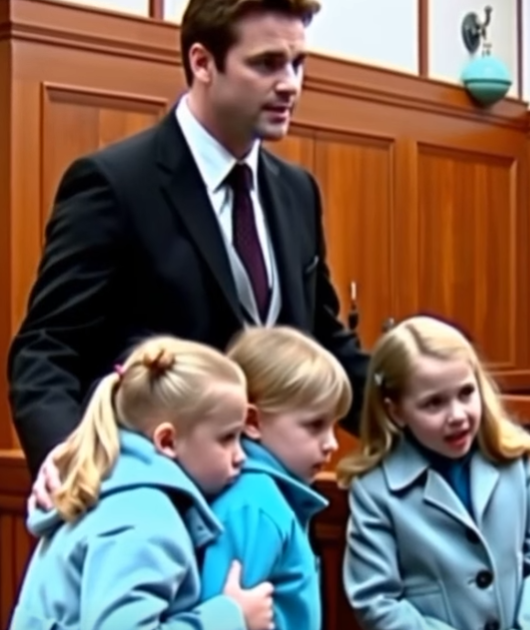
The Divorce Settlement Took an Unexpected Turn When a Father Presented New Evidence in Court
An emotional fictional story about marriage, trust, family secrets, and the difficult decisions that can change a family’s future.
Chapter 1: The Divorce That Changed Everything
After fifteen years of marriage, I never imagined that my relationship with my wife would end in a courtroom.
For most of our marriage, I believed we had built something meaningful together. We had a home, three children, shared responsibilities, and plans for the future. Like every family, we experienced disagreements and difficult moments, but I always thought our commitment to one another would be strong enough to overcome them.
My name is Crawford Chandler, and until recently, I considered myself an ordinary husband and father. I worked long hours, paid the bills, attended school meetings, and tried to give my children the opportunities I never had growing up.
My wife, Lenora, and I had been together for fifteen years. We had three children: Marcus, who was twelve, Jolene, who was nine, and Wyatt, who was six.
They were the center of my world.
I remembered Marcus learning to ride his bicycle in the driveway. I remembered Jolene insisting that I read her favorite bedtime story every evening, even when I returned home exhausted. And I remembered Wyatt falling asleep on my shoulder during long family trips.
Those memories made the end of my marriage particularly painful.
The problems between Lenora and me did not appear overnight. They developed slowly, through arguments, misunderstandings, and conversations that became increasingly difficult.
At first, I blamed our busy schedules. I thought we needed more time together. Later, I wondered whether financial pressure was affecting our relationship.
But Lenora seemed increasingly distant.
She spent more time away from home, became protective of her phone, and often avoided conversations about our future. Whenever I asked whether something was wrong, she insisted that everything was fine.
I wanted to believe her.
Unfortunately, I eventually discovered that pretending everything was normal could not repair a relationship that had already begun to fall apart.
One evening, after the children had gone to bed, Lenora sat across from me at the kitchen table.
She looked unusually calm.
“We need to talk about our marriage,” she said.
I put down my coffee.
“All right. What’s going on?”
She took a deep breath before answering.
“I don’t think we should continue living like this. I’ve been unhappy for a long time, Crawford. I think it’s time we went our separate ways.”
For several seconds, I could not find the right words.
I had expected another argument. Perhaps another discussion about money or responsibilities. I had not expected her to announce that she wanted a divorce.
“Are you certain?” I eventually asked.
She nodded.
“I’ve thought about this for months.”
I looked toward the hallway, where our children’s bedroom doors were closed.
“What about the kids?”
“They’ll adjust,” she replied.
Her answer hurt more than I expected.
I understood that relationships could end. People changed, and sometimes two individuals who once loved each other could no longer build a happy life together.
But I could not understand how she could discuss the end of our family as though it were simply another administrative decision.
That night, I barely slept.
Chapter 2: The Financial Dispute
The following weeks were difficult.
Lenora hired an attorney, and I eventually did the same. We began discussing the division of our property, financial responsibilities, and arrangements for the children.
I wanted the divorce to be as peaceful as possible.
My greatest concern was protecting Marcus, Jolene, and Wyatt from unnecessary conflict. They had already noticed that their parents were spending less time together.
Marcus asked whether I was moving away.
Jolene wanted to know whether we would still celebrate birthdays together.
Wyatt simply wanted everyone to eat dinner at the same table.
I tried to reassure them, although I had no idea how to explain everything that was happening.
Meanwhile, the financial negotiations became increasingly complicated.
Lenora requested the family home, two vehicles, a significant portion of our savings, and substantial monthly child support.
The proposed arrangement included payments of approximately $4,200 per month, subject to the court’s review and the final custody arrangement.
When I calculated the proposed payments over several years, the total was overwhelming.
It was not simply a matter of money.
I worried about maintaining a suitable home for the children, paying my own expenses, and continuing to provide for their education and daily needs.
My attorney explained that financial arrangements during divorce proceedings had to be evaluated according to applicable laws, income, custody responsibilities, and the children’s best interests.
He advised me not to sign anything simply because I felt pressured.
“Take your time,” he said during one meeting. “A settlement should reflect the actual circumstances of your family. It should not be based on assumptions or incomplete information.”
I appreciated his advice.
However, I was also becoming increasingly concerned about certain details involving our family.
During the marriage, there had been periods when Lenora’s behavior had seemed unusual. I had dismissed many of those concerns because I did not want suspicion to become the foundation of our relationship.
But as the divorce progressed, I realized that there were questions I needed to address.
I did not want to make accusations without evidence.
I also did not want to make decisions that could have permanent consequences without understanding the situation.
After discussing my concerns privately with my attorney, I decided to seek appropriate legal guidance.
Chapter 3: An Unexpected Discovery
A few weeks before the final settlement hearing, I received information that made me reconsider several things I thought I knew about my marriage.
I had arranged for privately obtained DNA information to be reviewed. The circumstances surrounding the testing were complicated, and I understood that any results involving the children would have to be handled carefully.
My attorney immediately warned me about the importance of protecting their privacy.
“These are children,” he explained. “Whatever happens between you and Lenora, they should not become the subjects of public arguments or personal attacks.”
I agreed.
The results raised questions about the biological relationships within our family.
I sat alone in my office for nearly an hour after reading them.
I had expected uncertainty, perhaps even an explanation that would put my concerns to rest.
Instead, I was confronted with information that I did not know how to process.
One result suggested that the biological relationship involving Wyatt might not be what I had always believed.
I read the document several times.
Then I placed it inside a folder and called my attorney.
He listened carefully while I explained what I had received.
“First, Crawford, don’t jump to conclusions,” he said. “Private testing can raise questions, but the legal significance depends on several factors. We need to establish whether the testing was conducted appropriately, whether the results are reliable, and whether the court can consider them.”
“What happens if the information is accurate?” I asked.
“That depends on the circumstances and the applicable law. Biological parentage, legal parentage, custody, and financial responsibility are not necessarily the same issue.”
His response was important.
Until that conversation, I had been thinking about the results primarily as a personal betrayal.
My attorney reminded me that the children were not responsible for anything the adults might have done.
I began to understand that the situation required more than anger.
It required patience.
Chapter 4: Preparing for the Hearing
The final hearing approached quickly.
Lenora appeared confident that the proposed financial settlement would be approved.
Her attorney had prepared the necessary documents and expected me to sign them.
During one of our last conversations before the hearing, Lenora told me that there was no reason to make things difficult.
“You know what the agreement says,” she explained. “We should finish this and move forward.”
I looked at her.
“Have you considered whether everything in the agreement is accurate?”
She frowned.
“What are you talking about?”
“I think there are some important questions that still need to be answered.”
She shook her head.
“Crawford, I don’t have the energy for another argument.”
I wanted to tell her about the report.
I wanted to ask questions that had been occupying my mind for days.
But my attorney had advised me not to turn a complicated legal matter into a confrontation outside the courtroom.
So I said nothing more.
On the morning of the hearing, I arrived early.
The courthouse was quieter than I expected. People walked through the corridors carrying folders, speaking to attorneys, and waiting for their cases to be called.
I sat on a wooden bench and looked through my documents.
I had spent fifteen years building a family.
Now I was preparing to discuss the future of that family in a room filled with strangers.
When Lenora arrived, she was accompanied by her attorney.
She looked composed and professionally dressed.
Her lawyer greeted my attorney, and the two began discussing the proposed settlement.
I remained silent.
I was no longer interested in arguing about who had won or lost the marriage.
I wanted the court to understand that the available information might be incomplete.
Chapter 5: The Moment Everything Changed
When our case was called, we entered the courtroom.
Judge Castellan reviewed the documents and asked both legal representatives whether the parties were prepared to proceed.
Lenora’s attorney stood.
“Yes, Your Honor. We are prepared to finalize the agreement.”
My attorney nodded but explained that we had an issue requiring the court’s attention.
The judge looked toward me.
“Mr. Chandler, is there something you wish to raise before the agreement is considered?”
I stood.
“Yes, Your Honor. I would respectfully request permission to submit additional information that became available shortly before this hearing.”
The judge adjusted his glasses.
“What kind of information?”
“Information concerning the biological parentage of one of the children included in the proposed financial and custody arrangements.”
The courtroom became noticeably quieter.
Lenora turned toward me.
“What are you talking about?” she whispered.
Her attorney immediately requested an opportunity to review the material before any decision was made.
Judge Castellan agreed.
“Nothing will be finalized until the court has considered the issue. I will not make assumptions based on an allegation, Mr. Chandler. Any evidence must be properly submitted and evaluated.”
My attorney handed the relevant documents to the court.
I watched as the judge reviewed the accompanying explanation.
His expression became serious.
After several moments, he looked up.
“Mr. Chandler, are you aware that these results may require additional verification before they can be considered reliable evidence?”
“Yes, Your Honor.”
“And are you requesting that the court postpone the finalization of the settlement?”
“Yes. I believe that would be appropriate.”
The judge turned toward Lenora.
“Mrs. Chandler, have you been made aware of these concerns?”
She appeared uncomfortable.
“I don’t know what he’s talking about,” she replied.
Her attorney requested time to examine the documents.
The judge agreed.
No dramatic announcement followed. There was no immediate ruling, and nobody was declared guilty of anything.
Instead, the court made the sensible decision to pause the settlement process.
The judge explained that questions involving parentage and financial obligations needed to be addressed through proper legal procedures.
That was the moment I realized something important.
The purpose of presenting the information was not to embarrass Lenora.
It was to ensure that the court did not approve an agreement without considering potentially relevant facts.
Chapter 6: A Difficult Conversation Outside the Courtroom
After the hearing was postponed, Lenora and I found ourselves standing in the courthouse corridor.
Her attorney was speaking with her, while my attorney reviewed the next steps with me.
Eventually, Lenora approached.
“What do you think you’re doing?” she asked.
I looked at her calmly.
“I’m trying to understand what happened.”
“You could have spoken to me privately.”
“I tried asking questions before. You didn’t want to discuss them.”
She crossed her arms.
“Are you trying to take the children away from me?”
“No,” I answered immediately. “I don’t want to take the children away from anyone. I want them to have stability.”
She looked away.
For the first time in months, I noticed that she seemed genuinely uncertain.
I wanted to ask whether the results were accurate.
I wanted to know whether she had known about the possibility of a different biological relationship.
But I also understood that the courthouse corridor was not the right place for such a conversation.
“Whatever happened between us,” I said, “the children deserve honesty, care, and protection.”
Lenora did not respond.
She simply walked back toward her attorney.
I watched her leave and wondered how two people who had once shared everything could become so distant.
Chapter 7: What the Tests Could and Could Not Prove
Over the following weeks, both legal teams examined the available information.
The initial DNA report was not treated as an automatic answer to every question.
Additional testing and legal review were discussed to determine whether the results were reliable and could properly be used in the proceedings.
My attorney explained that the law could distinguish between biological parentage and legal parentage.
That distinction mattered enormously.
I had been raising the children as their father. I had attended their birthdays, helped them with schoolwork, cared for them when they were sick, and supported them throughout their lives.
Whatever the biological results eventually showed, those experiences could not simply be erased.
I began thinking about Wyatt in particular.
He was six years old.
He knew me as his father.
He came to me when he was frightened, asked me to help with his toys, and expected me to be there when he woke up in the morning.
I could not imagine telling him that he had somehow become responsible for the complicated decisions made by adults.
He had done nothing wrong.
Neither had Marcus or Jolene.
My attorney encouraged me to focus on the children’s emotional well-being.
“We can deal with the legal questions through the court,” he explained. “But we should not allow the legal dispute to destroy the relationships that matter most to them