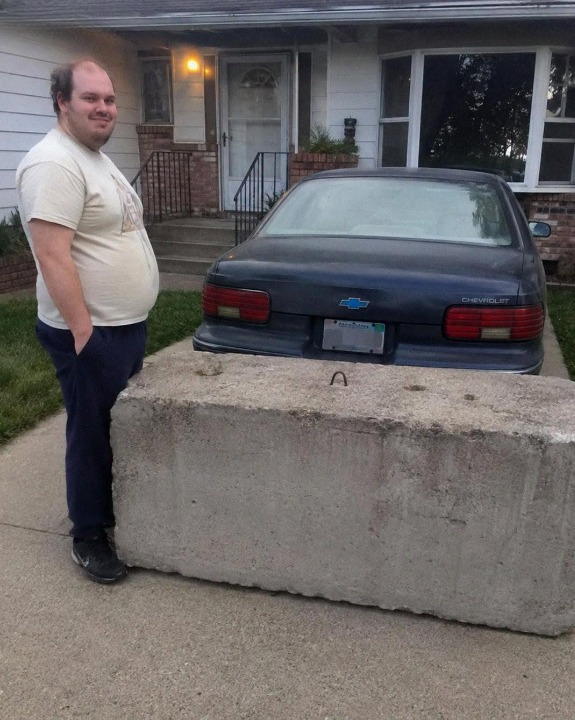
Getting your driver’s license at sixty years old is either an act of quiet liberation or mild insanity. For me, it was a little bit of both. After decades of relying on public transit, carpooling, and family favors, I decided it was time to take the wheel of my own life. I studied the driver’s manual until I knew every traffic statute by heart, spent hours in parking lots practicing parallel maneuvers, and passed my road test on the very first try. Behind the wheel of my reliable, albeit elderly, Chevrolet sedan, I was cautious to the point of being a mild annoyance to aggressive commuters.
Unfortunately, my independence didn’t sit well with everyone in our quiet suburban neighborhood.
Enter my new neighbor, Ryan. He was a loud, overbearing man who treated his lifted pickup truck like an extension of his ego and the neighborhood street like his personal fiefdom. From the day I moved in, Ryan made it clear he considered me an interloper. At first, I wrote off his cold stares and muttered comments as neighborhood friction. But as the months dragged on, the petty annoyances escalated into a targeted campaign of harassment.
He made a habit of backing his massive pickup just far enough across the mouth of my driveway to make pulling out a high-stakes geometry puzzle. One Tuesday morning, when I had an important dental appointment and asked him if he wouldn’t mind moving his truck so I could get past, he didn’t even turn off his engine. He just looked me up and down, let out a condescending chuckle, and spat, “Maybe just take an Uber, Carol. Women your age have no business driving a car anyway.”
Another time, when I was struggling to slide my car into a tight parallel spot near the local grocery store, he happened to be walking by. He paused on the sidewalk, cupped his hands around his mouth, and bellowed, “Careful! That mailbox didn’t do anything to you!” Passersby laughed, and my face burned with humiliation.
The hostility reached a fever pitch when I woke up to find both driver-side tires on my Chevrolet slashed clean through with a knife. I had no direct proof that Ryan had done it, but my gut instinct screamed that he was responsible. Boiling with righteous anger, I marched straight across the lawn and banged on his front door.
“I’ve had enough,” I said, my voice shaking slightly as he opened the door with a beer in hand. “Why are you doing this? This is MY property, and I have a right to live in peace.”
Ryan didn’t even pretend to be polite. He rolled his eyes, took a sip of his drink, and sneered, “I don’t care about your property. I’ve been trying to send a message that women can’t drive, especially elderly ones like you. Driving is a man’s job. You’re a hazard on the road, and I’m doing everyone a favor.”
I stared at him, stunned by his brazen arrogance. Instead of backing down, I replaced the tires that very afternoon and continued driving. I refused to let a bully dictate my freedom. But my stoicism only seemed to fuel his determination to break me.
The Morning of the Concrete Block
The final escalation happened on a crisp Tuesday morning. I was rudely jolted awake at 7:00 AM by a grinding, mechanical roar echoing right outside my bedroom window.
I threw on a bathrobe, rushed out the front door, and froze in absolute horror.
Parked in the middle of my private driveway was a heavy-duty construction truck. Two hired laborers were actively wrestling a massive, industrial-grade concrete parking barrier off the flatbed, using a hydraulic arm to lower it directly across the end of my driveway, sealing my car in completely.
Standing on my lawn, arms folded triumphantly across his chest, was Ryan. He wore a smug, ear-to-ear smirk that practically begged to be wiped away.
“What in the world do you think you’re doing?!” I yelled over the din of the idling truck engine.
Ryan strolled toward the edge of my lawn, looking immensely pleased with himself. “Doing you a favor, Carol. Now you won’t have to worry about crashing into anyone. We’ll finally have some peace and quiet around here.”
I stared at him, and in that split second, a profound clarity washed over me. Arguing with a man like Ryan was utterly pointless. He operated on a primitive level of bullying and intimidation, assuming that because I was an older woman living alone, I had no recourse, no power, and no voice. People like Ryan only understood the sharp consequences of authority.
Without wasting another breath on him, I turned on my heel, walked back inside my house, and calmly closed the front door.
I didn’t call the police non-emergency line. I didn’t call a towing company. Instead, I picked up my landline and dialed a direct extension—reaching out to someone Ryan would never in a million years have expected me to know.
Karma Delivers
I spent three minutes on the phone, explaining the situation clearly and referencing specific county ordinances regarding property obstruction and unauthorized construction on private residential lots. When I hung up the phone, I stepped back out onto the front porch, crossed my arms, and watched the show.
The two laborers had just finished unhooking the hydraulic chains from the concrete block and were climbing back into their truck. Ryan was leaning against his pickup, sipping coffee, basking in his morning victory.
Then, down the quiet suburban street, a sleek, unmarked black sedan turned the corner.
As it rolled closer, I saw the official insignia on the side panel and the light bar mounted subtly on the roof. It was county code enforcement, accompanied directly by a senior zoning inspector and a local municipal magistrate who happened to be an old acquaintance of my late brother.
The car pulled up right behind Ryan’s pickup, blocking him in.
The driver’s door swung open, and Officer Vance stepped out, adjusting his cap with a stern, no-nonsense expression. Behind him stepped Marcus Vance, the head of the municipal zoning and property rights board, looking at the massive concrete block resting on my private asphalt as if he had just discovered toxic waste in a public park.
Ryan’s smug smile instantly evaporated. The coffee cup slipped from his hand, shattering against his truck’s bumper as the hot liquid splashed across his sneakers. He watched in sheer, unadulterated panic as the officials bypassed him entirely and walked straight up to my porch.
“Morning, Carol,” Marcus said, tipping his hat politely. “Looks like you’ve got an unauthorized structural addition to your property.”
“It certainly looks that way, Marcus,” I replied evenly. “And it was installed without my consent by the gentleman over there.”
Officer Vance turned sharply toward Ryan, whose face had gone completely, ghostly pale. The color drained from his skin so fast he looked like he might actually faint.
Ryan took a frantic step forward, his voice cracking in absolute terror.
“Wait! Wait, officer, hold on!” Ryan stammered, stumbling over his own words as he pointed a trembling finger at the inspectors. “It was just a joke! A neighborhood prank! You can’t be serious!”
Marcus pulled out a heavy clipboard, flipping through official violation notices with agonizing slowness. “Prank or not, sir, placing unpermitted industrial concrete structures on private residential property without a deed holder’s permission constitutes criminal trespassing, property damage, and a direct violation of municipal zoning codes.”
Officer Vance began unholstering his citation book, stepping directly toward Ryan’s direction. “That’ll be a heavy fine for illegal dumping, obstruction of emergency egress, and malicious property alteration. Furthermore, you’re paying for a heavy-duty crane to haul that block out of here immediately, or your truck gets impounded on the spot.”
“NO! Anything but that! Please, stop it!!” Ryan practically shrieked, his tough-guy facade completely shattering into a million pieces as he realized the financial and legal nightmare he had just engineered for himself. He looked at me with wide, pleading eyes, silently begging for mercy where he had shown none.